Skip to content
Heavy-duty concrete garage floor — Northpole Design & Build

Concrete Garage Floors / Hamilton

Concrete Garage Floors in Hamilton

Concrete garage floors and pads in Hamilton, ON. Serving Ancaster, Dundas, and Westdale, and the wider Hamilton area.

Hamilton's own building code references single out garage floors, carport floors, and all exterior flatwork by name, holding them to 32 MPa concrete at a 0.45 water-cementitious ratio with air entrainment, the same standard applied to open exterior work. A Hamilton garage slab also passes through more inspection hold points than most of the trade realizes: footing, then a radon check, then under-slab insulation, all before a single yard of concrete gets poured. Our Hamilton work spans Ancaster, Dundas, and Westdale, where every garage floor and equipment pad goes over a compacted granular base with reinforcement sized to the load the slab is expected to carry.

None of that inspection rigour touches the part of the job that actually determines how long a Hamilton garage floor coating lasts, because that part happens after the concrete has already passed its final inspection. Whether the slab's moisture condition gets tested before a coating goes down, and whether the coating system is built to handle how a vehicle actually uses the floor, has nothing to do with the building permit and everything to do with the finishing contractor's process. We treat that step as seriously as the concrete itself.

More on concrete garage floors, or see everything we build in Hamilton.

Related concrete work.

We have not photographed a concrete garage floors job in Hamilton yet. This is the same work elsewhere in our service area, built to the same spec.

On video

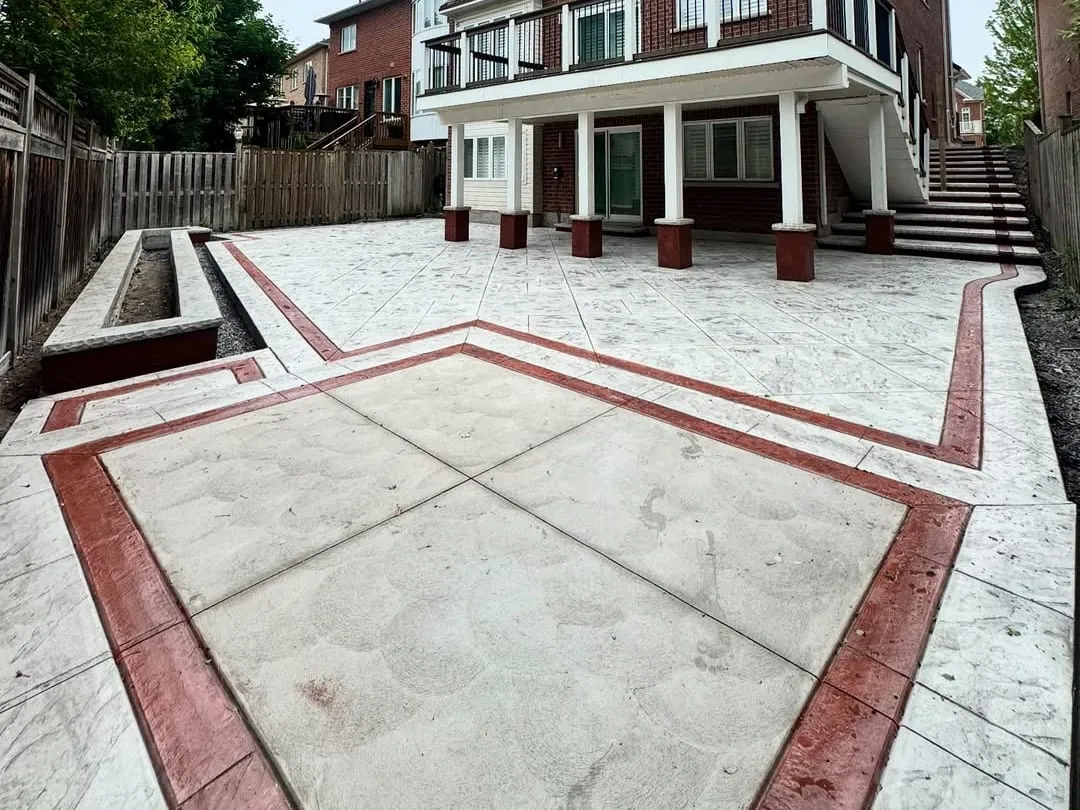
Stamped patio

Concrete garage floors and pads in Hamilton

The slab is the part of a Hamilton garage floor that gets inspected. What decides whether the finish on top of it lasts is a separate question the building code does not really address. Ground moisture does not stop at the underside of a slab; without a vapour barrier in between, it simply keeps migrating through the concrete, year after year. Sealing a coating over that untested condition is the actual cause behind most of the blistering and peeling jobs we get called to repair, not a workmanship problem on the surface.

Homeowners usually ask which product is better, epoxy or polyaspartic, when the honest answer is that a good floor needs both doing separate jobs: an epoxy layer, curing over a day or more, addressing moisture as a base coat, and a polyaspartic layer, curing in hours, taking the wear, resisting hot tires, and holding its colour where epoxy tends to yellow.

The mechanism behind hot-tire marks is specific: heat drives plasticizers out of the tire rubber, and a coating that has not fully cured lets them bond into the finish rather than staying on the surface. Standard epoxy marks more easily than polyaspartic. Waiting out the full cure period before parking is the one dependable way to avoid it.

Reinforcement follows a simple rule: fibre throughout for shrinkage, rebar specifically wherever the slab sits over backfill from the original foundation dig or under a vehicle lift's footprint. Being indoors and under a roof does not exempt a Hamilton garage from freeze-thaw either, since an unheated attached garage tracks the temperature outside closely enough, and the salt a car tracks in concentrates on one narrow stretch of floor instead of spreading across an open surface. It is the same reasoning behind the air-entrained mix we pour for concrete driveways. For more on this service, see our concrete garage floors page, or view everything we build across Hamilton.

Above the escarpment or out along the lakeshore, the order of operations does not change. Concrete garage floors in Oakville and garage floor coating in Mississauga work through the same test-then-coat sequence on their own housing stock.

The larger properties inside the city bring their own versions: a driveway running downhill into the garage above the brow, dealt with on concrete garage floors in Ancaster, and detached rural shop slabs built for equipment rather than cars, covered on garage floor concrete in Waterdown.

What concrete garage floors costs

Coating systems are quoted separately after moisture testing. Pricing below reflects the region, not one city.

Concrete Garage Floors price ranges across our service area
ItemRange
Uncoated slab$10-$15 per sq ft
Typical 2-car garage (24x24 ft)$5,900-$7,800 total

Ranges cover our whole service area, not Hamilton alone. Site conditions, access and finish move the number, so treat this as a starting band and not a quote.

Concrete Garage Floors in Hamilton, answered.

Why is my garage floor coating peeling?

Ground moisture does not stop at the underside of a slab; without a vapour barrier in between, it simply keeps migrating through the concrete, year after year. It is also the actual cause behind most of the blistering and peeling jobs we get called to repair, not a workmanship problem on the surface.

Epoxy or polyaspartic for a Hamilton garage floor?

Homeowners usually ask which product is better, when the honest answer is that a good floor needs both doing separate jobs: an epoxy layer addressing moisture as a base coat, and a polyaspartic layer taking the wear, resisting hot tires, and holding its colour on top.

Why do my tires leave marks on the floor?

The mechanism is specific: heat drives plasticizers out of the tire rubber, and a coating that has not fully cured lets them bond into the finish rather than staying on the surface. Standard epoxy marks more easily than polyaspartic. Waiting out the full cure period before parking is the one dependable way to avoid it.

Does Hamilton's building code cover garage floor coatings?

Not directly. The code sets the concrete standard, 32 MPa and air-entrained for garage floors and all exterior flatwork, and requires several inspections before the pour. What happens after the slab is finished, moisture testing and coating choice, is a separate process the permit does not cover.

Do I need to test my Hamilton garage floor before coating it?

Yes. A slab can look dry and still be releasing moisture from below, particularly in older Hamilton housing poured before a vapour barrier was standard. Coating that condition without testing first is the single most common reason garage floor finishes fail.

Does an attached garage need the same winter protection as a driveway?

Reinforcement follows a simple rule: fibre throughout for shrinkage, rebar specifically wherever the slab sits over backfill from the original foundation dig or under a vehicle lift's footprint. Being indoors and under a roof does not exempt a Hamilton garage from freeze-thaw, since an unheated attached garage tracks the temperature outside closely enough, and the salt a car tracks in concentrates on one narrow stretch of floor.

Is grinding the slab really necessary before coating?

Yes, and skipping it is a common cause of bond failure. A slab's top surface often carries a curing compound or is simply too smooth on its own for a coating to key into, and that shows up later as clean-looking sections that peel away regardless of how carefully the coating itself was applied. Diamond grinding is how we avoid that.

Keep exploring

Looking for concrete garage floors beyond Hamilton? Compare our concrete garage floors across Ontario, see everything we build in Hamilton, or add Basement Renovation in Hamilton.