
Skip to content
Heavy-duty concrete garage floor — Northpole Design & Build

Concrete Garage Floors / Guelph

Concrete Garage Floors in Guelph

Concrete garage floors and pads in Guelph, ON. Serving Old University, Exhibition Park, and Kortright Hills, and the wider Guelph area.

Guelph draws nearly all of its drinking water from groundwater sitting over limestone and dolomite bedrock, with a layer of glacially deposited clay, silt, and sand between the surface and that bedrock. Any excavation for a garage slab or an attached pad meets that same overburden before reaching rock, and it shapes how the base gets compacted and how a footing behaves once backfill settles. We pour garage floors and equipment pads across Guelph neighbourhoods including Old University, Exhibition Park, and Kortright Hills, working to a 4 to 6 inch slab on a properly compacted granular base, reinforced with synthetic fibre throughout and rebar wherever the floor spans disturbed backfill or carries a concentrated load.

Most homeowners we meet in Guelph think about the slab and stop there, but the floor itself is usually the easy part. What actually determines whether a garage floor lasts is what goes on top of it: whether the concrete's moisture condition gets tested before any coating goes down, and whether the coating system is matched to how a vehicle actually uses that floor through a Guelph winter. Guelph's building department prices a garage or carport permit at a flat $160 per bay, a small cost next to what a poorly specified coating ends up costing in redone work.

More on concrete garage floors, or see everything we build in Guelph.

Related concrete work.

We have not photographed a concrete garage floors job in Guelph yet. This is the same work elsewhere in our service area, built to the same spec.

On video

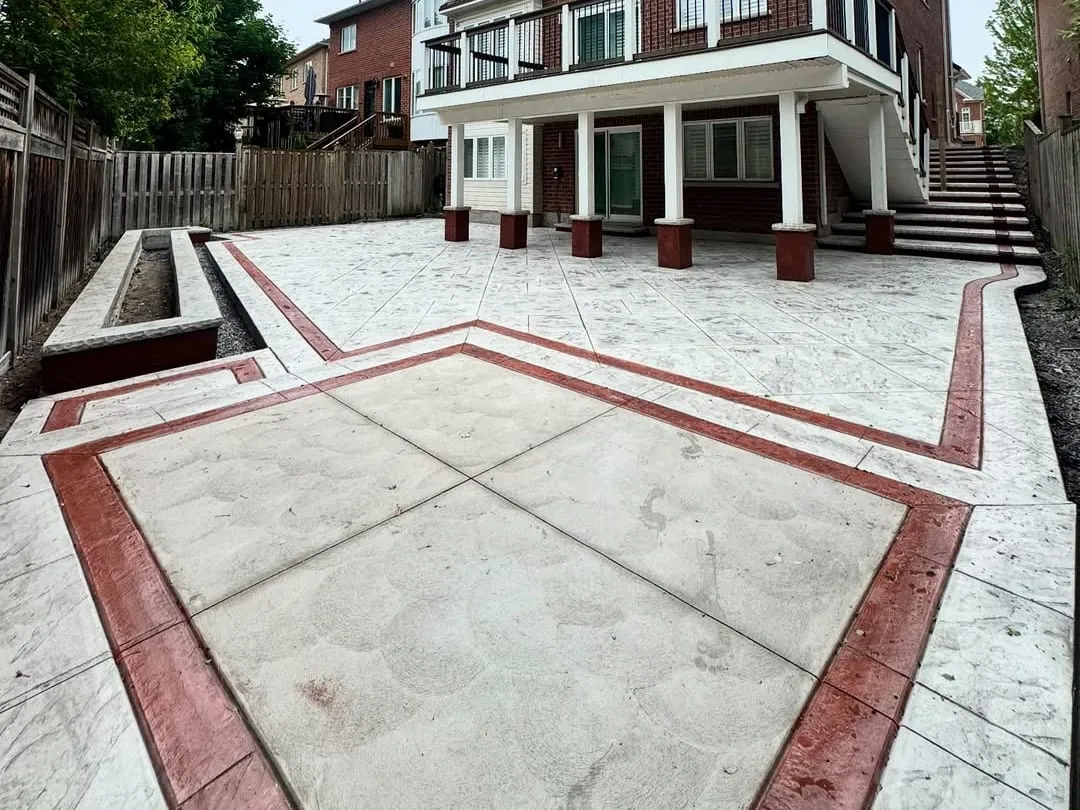
Stamped patio

Concrete garage floors and pads in Guelph

A garage slab is straightforward exterior-grade flatwork, but a garage floor is a different problem, because most of what fails on this job happens after the concrete has already cured. Pour a slab without a vapour barrier below it and the concrete never really separates from the ground it sits on, so water vapour keeps finding its way up through it, sometimes for decades. That is the fact behind nearly every coating failure we get called to fix: a finish sealed over a slab that was never checked for what it was still releasing.

The question is rarely epoxy versus polyaspartic, as if they compete for the same role. Epoxy takes longer to cure but can be built specifically to manage moisture as a base coat; polyaspartic cures within hours, shrugs off hot-tire marks, and resists UV yellowing far better than epoxy manages on its own. We put each material where it actually earns its place on a Guelph job: an epoxy base handling moisture where testing calls for one, and a polyaspartic topcoat carrying the wear.

Hot-tire pickup is the other failure mode worth naming plainly. As a tire heats up from driving, plasticizers in the rubber migrate to its surface and can bond into a coating that has not fully cured, leaving dark, tacky marks at the tire path. Giving the coating its full cure window before the car goes back in avoids it.

None of this replaces sound concrete underneath. We reinforce with synthetic fibre for shrinkage control everywhere, and add rebar specifically where a Guelph garage slab spans backfill from the house's own foundation excavation or carries a vehicle lift's point loads. An unheated attached garage tracks Guelph's outdoor temperature closely enough to see the same freeze-thaw cycling as an open driveway, and salt dripping off tires concentrates that exposure at the door and tire path rather than spreading it evenly, which is why we hold to the same air-entrained mix used on our concrete driveways. See our wider concrete garage floors work, or explore what we build across our Guelph service area.

We build the same system through the rest of the region. If the garage is over in Waterloo Region instead, epoxy garage floors in Cambridge and garage floor coatings in Waterloo cover what the ground under each of those slabs adds to the picture.

What concrete garage floors costs

Coatings are quoted separately after moisture testing. Pricing reflects the region, not this city alone.

Concrete Garage Floors price ranges across our service area
ItemRange
Uncoated slab$10-$15 per sq ft
Typical 2-car garage (24x24 ft)$5,900-$7,800 total

Ranges cover our whole service area, not Guelph alone. Site conditions, access and finish move the number, so treat this as a starting band and not a quote.

Concrete Garage Floors in Guelph, answered.

Why did my garage floor coating start bubbling and peeling?

Almost always trapped moisture, not poor surface work. Pour a slab without a vapour barrier below it and the concrete never really separates from the ground it sits on, so water vapour keeps finding its way up through it. Once a coating seals over that, it collects into a blister until it eventually breaks through. Testing the slab's moisture condition first is the fix, not a repair after it shows up.

What's the difference between epoxy and polyaspartic for a garage floor?

The question is rarely epoxy versus polyaspartic, as if they compete for the same role. Epoxy takes longer to cure but can be built specifically to manage moisture; polyaspartic cures within hours, shrugs off hot-tire marks, and resists UV yellowing far better. We put each material where it actually earns its place: an epoxy base under a polyaspartic topcoat.

Why do my tires leave marks on the coating?

As a tire heats up from driving, plasticizers in the rubber migrate to its surface and can bond into a coating that has not fully cured, leaving dark, tacky marks at the tire path. Polyaspartic resists this better than standard epoxy. Giving the coating its full cure window before the car goes back in avoids it.

Does an attached garage in Guelph really need the same freeze-thaw protection as a driveway?

Yes. An unheated attached garage tracks Guelph's outdoor temperature closely enough to see the same freeze-thaw cycling as an open driveway, and salt dripped off tires concentrates at the door and tire path rather than spreading out evenly the way it would outside. We use the same air-entrained mix for both.

Do I need to test my garage floor before coating it?

Yes, if the coating is meant to last. A slab can look dry and clean and still be releasing moisture from underneath, especially in older Guelph housing built before a vapour barrier was standard practice. Skipping the test and coating anyway is the most common reason garage floor coatings fail.

How thick should a garage floor slab be?

We pour residential garage floors at 4 to 6 inches on a compacted granular base, going thicker where a vehicle lift or heavier equipment is expected. Reinforcement is synthetic fibre throughout, with rebar added specifically where the slab spans backfill from the house's original foundation excavation.

Do you grind the slab before coating it?

Yes, mechanical grinding, not just cleaning, is what actually gives a coating something to bond to. A new slab often carries a curing compound from the pour, and an older Guelph garage floor usually has years of sealed-in dust and oil, either of which stops a coating from keying in properly. Diamond grinding removes that surface layer before anything gets applied.

Keep exploring

Looking for concrete garage floors beyond Guelph? Compare our concrete garage floors across Ontario, see everything we build in Guelph, or add Basement Renovation in Guelph.