
Skip to content
Heavy-duty concrete garage floor — Northpole Design & Build

Concrete Garage Floors / KWC

Concrete Garage Floors in Cambridge

Concrete garage floors and pads in Cambridge, ON. Serving Galt, Preston, and Hespeler, and the wider KWC area.

Cambridge is the one city in our service area where a garage slab excavation can plausibly hit bedrock rather than overburden, since most of the city's aquifers sit directly in rock rather than in the sand and gravel found in Kitchener and Waterloo. Where a footing actually bears on sound rock, the frost-depth question is effectively settled by the bearing surface itself, though depth to bedrock varies lot to lot and has to be confirmed on site. Our Cambridge work covers Galt, Preston, and Hespeler, with every garage floor reinforced by fibre and, where the site calls for it, rebar as well.

Cambridge also carries the oldest housing stock of the four Waterloo Region cities we researched, with close to a quarter of it built before 1960, which puts a real number of Cambridge garages on slabs poured before a vapour barrier was standard practice. Whether the ground below is rock or overburden, an untested slab in that condition is set up the same way: a coating sealed over it without checking what the concrete is still releasing is asking for trouble, regardless of what the excavation found underneath.

More on concrete garage floors, or see everything we build in Cambridge.

Related concrete work.

We have not photographed a concrete garage floors job in Cambridge yet. This is the same work elsewhere in our service area, built to the same spec.

On video

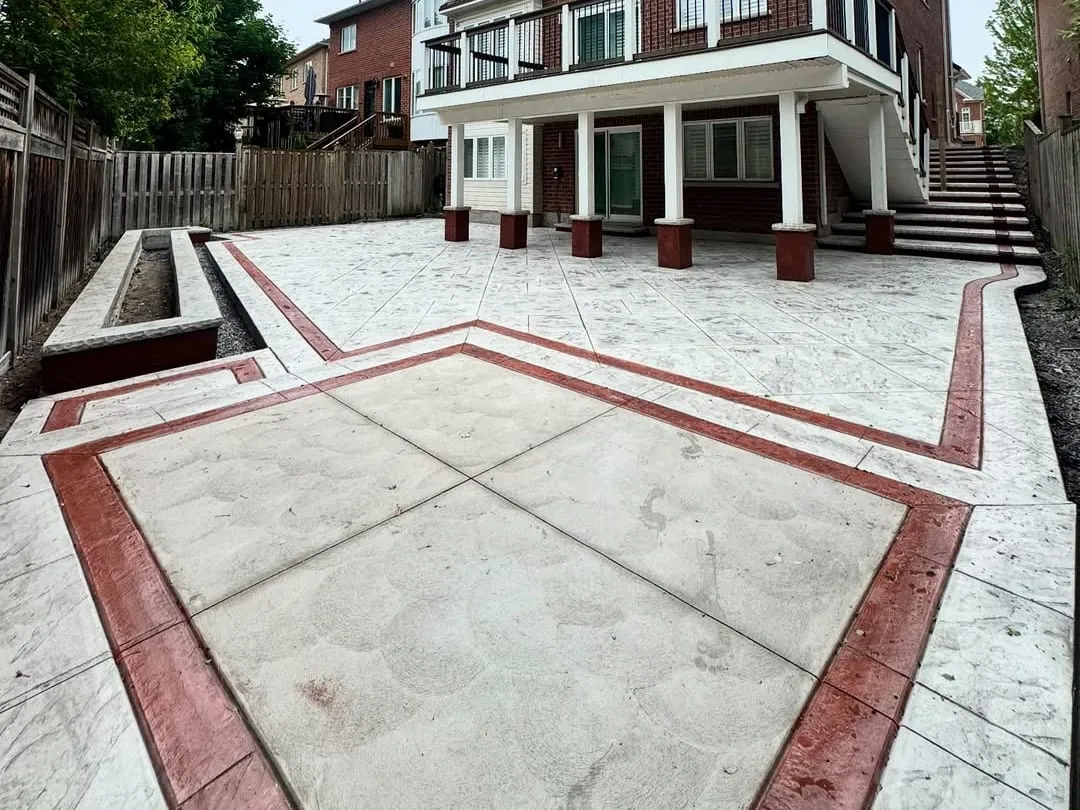
Stamped patio

Concrete garage floors and pads in Cambridge

Bearing on rock changes the foundation-depth question for a Cambridge slab, but it does not change the coating question at all. Whether the slab bears on bedrock or ordinary fill, no vapour barrier means the concrete stays in direct contact with whatever moisture sits beneath it. Coat that slab without testing it, and the moisture trapped underneath does not disappear, it surfaces later as a blister, which is the leading reason a garage floor finish eventually lifts.

Think of epoxy and polyaspartic as covering two different jobs rather than two versions of one job. Epoxy is slower to cure yet can be built as a moisture-managing base coat; polyaspartic cures within a day, wears far better against hot tires, and holds colour longer under sunlight than epoxy does alone. Most Cambridge floors we build pair the two, so the base handles what is rising from below while the faster topcoat takes the actual traffic.

Heat is the trigger behind hot-tire marks. A tire warms as it drives, plasticizers migrate to the rubber's surface, and a coating that has not fully cured absorbs and bonds with them right at the tire path. The remedy is simply time: hold off parking until the coating has genuinely finished curing, not just dried on top.

Fibre goes through the entire pour to control ordinary shrinkage, and rebar gets added specifically at the two spots that actually need it: over disturbed fill left from the house's foundation dig, and under the footprint of a vehicle lift. None of that changes because Cambridge sits partly on bedrock, only the excavation does. Winter does not spare an unheated attached garage here either, since it tracks the same outdoor swings an open driveway feels, and tire-borne salt lands on one narrow strip of floor near the door instead of spreading across a wider surface, so the concrete underneath is built to the same standard as our concrete driveways. Explore our concrete garage floors portfolio, or see everything we build across Cambridge.

A Kitchener or Guelph garage slab sits on moraine sand rather than rock, and the coating decision still comes out identical, which is rather the point. Concrete garage floors in Kitchener and garage floor coating in Guelph start from the same moisture test we run here.

The detached laneway garages on London's century streets bring an access problem as much as a concrete one, dealt with on garage floor concrete in London.

What concrete garage floors costs

Coatings are quoted separately once moisture testing is done. Figures below reflect the wider region.

Concrete Garage Floors price ranges across our service area
ItemRange
Uncoated slab$10-$15 per sq ft
Typical 2-car garage (24x24 ft)$5,900-$7,800 total

Ranges cover our whole service area, not Cambridge alone. Site conditions, access and finish move the number, so treat this as a starting band and not a quote.

Concrete Garage Floors in Cambridge, answered.

Why is my garage floor coating blistering?

Whether the slab bears on bedrock or ordinary fill, no vapour barrier means the concrete stays in direct contact with whatever moisture sits beneath it. Coat that slab without testing it, and the moisture trapped underneath does not disappear, it surfaces later as a blister.

Epoxy or polyaspartic for my Cambridge garage floor?

Think of epoxy and polyaspartic as covering two different jobs rather than two versions of one job. Epoxy is slower to cure yet can be built as a moisture-managing base; polyaspartic cures within a day, wears far better against hot tires, and holds colour longer under sunlight. Most Cambridge floors get both.

Why do my tires leave marks on the coating?

Heat is the trigger. A tire warms as it drives, plasticizers migrate to the rubber's surface, and a coating that has not fully cured absorbs and bonds with them. The remedy is simply time: hold off parking until the coating has genuinely finished curing, not just dried on top.

Does bedrock under my Cambridge garage change anything for the coating?

Not for the coating, no. Rock underneath changes how the foundation depth question gets answered, but it has no bearing on whether the slab needs its moisture tested before a coating goes down. That step matters the same regardless of what the excavation found.

My house is older, built before 1960. Does that matter?

It can. Close to a quarter of Cambridge's housing predates 1960, the oldest share of any Waterloo Region city we work in, and a slab from that period rarely got a vapour barrier at all. On a house that age, we treat the moisture test as essential, not optional.

How thick should a garage floor slab be in Cambridge?

Residential garage floors from us run 4 to 6 inches thick over a compacted granular base, thicker again if a vehicle lift or heavy equipment is part of the plan. Fibre carries the shrinkage control job throughout, while rebar goes in only over backfill from the original excavation.

Do you grind the slab, or just clean it, before coating?

Grinding, not just cleaning. Whether the slab bears on bedrock or ordinary fill, its top surface is often left with a curing compound from the original pour, or is simply too smooth for a coating to bond to. Diamond grinding removes that layer, which cleaning on its own cannot do.

Keep exploring

Looking for concrete garage floors beyond Cambridge? Compare our concrete garage floors across Ontario, see everything we build in Cambridge, or add Basement Renovation in Cambridge.