Concrete patios in Guelph
Guelph is the largest Canadian city to rely almost entirely on groundwater, drawn from limestone and dolomite bedrock beneath a glacial overburden of clay, silt and sand. That overburden, not open sand or gravel, is the material a patio excavation actually meets before hitting rock, and it is what the compacted granular base underneath a new slab has to drain through. Getting that base right matters more in Guelph's layered ground than in a city sitting on a simple sand-and-gravel moraine.
Every patio we pour here uses the same C-2 exposure class used for a driveway: 32 MPa concrete, air-entrained, at a 0.45 maximum water-cementitious ratio. A patio does not carry vehicle load, but Ontario's freeze-thaw cycling and the chloride tracked in from a nearby walkway or salted steps apply regardless. Air entrainment, not the strength number alone, is what gets a Guelph patio through a winter without surface scaling.
Where the patio meets something rigid, the house foundation, an existing walkway, a pool deck, a set of steps, we cut an expansion joint at that contact. A lot of the older patios we replace in Guelph sit at homes from the 1961 to 1980 boom, the city's single biggest construction era, and many were poured tight against the foundation with no isolation at all. Left that way, the two surfaces push against each other every freeze-thaw cycle and eventually spall at the seam.
Guelph also carries four heritage conservation districts, Brooklyn and College Hill, Downtown Guelph, the Ontario Reformatory district and Ward, plus roughly 80 individually designated properties citywide. Getting a patio's design signed off inside one of those boundaries is usually the first item on the checklist, ahead of any excavation. Properties near a watercourse, floodplain or wetland fall under Grand River Conservation Authority review instead, which we check before quoting rather than after.
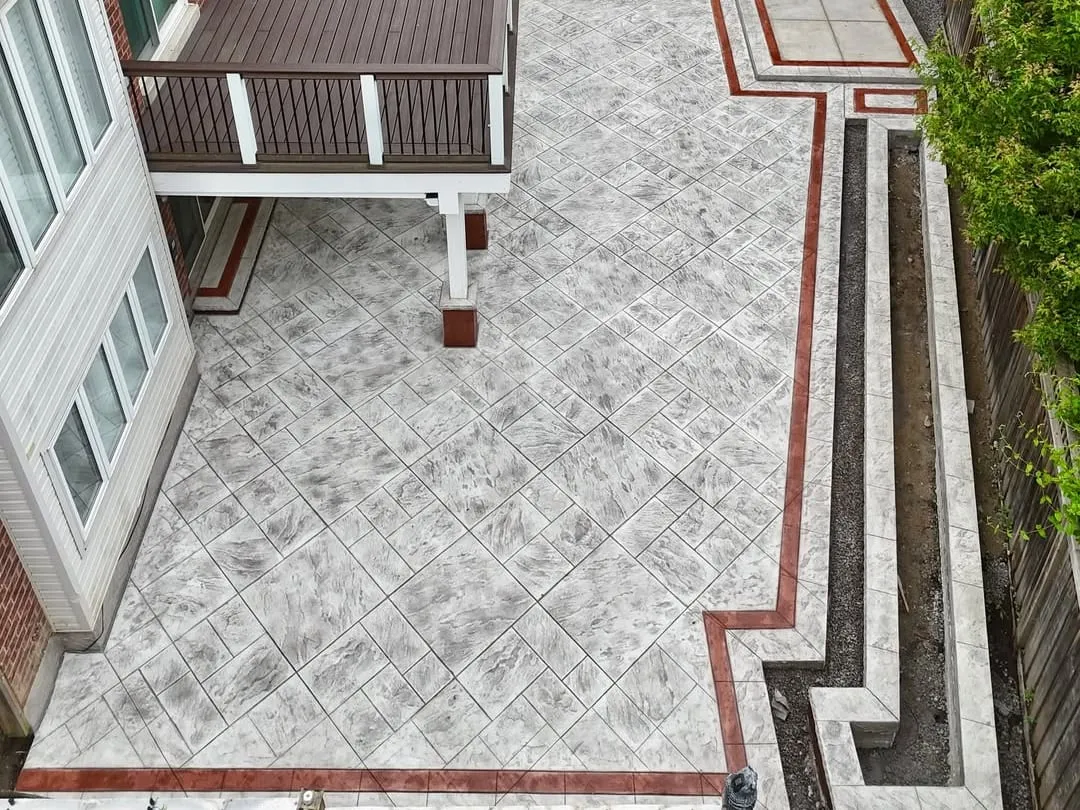
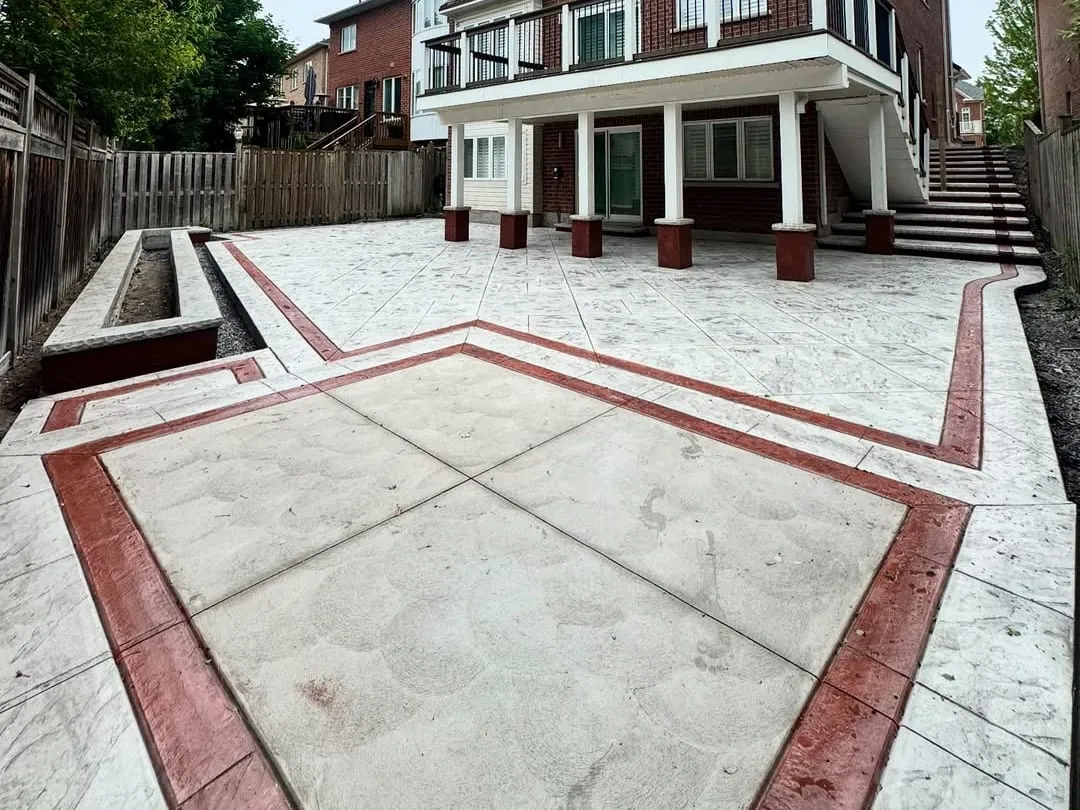
Our own work here includes a stamped, ashlar-slate patio with integral colour in Exhibition Park, poured on a compacted base and sealed for regular outdoor use; see the full project. On irregular layouts and decorative borders, joint spacing has to follow the actual shape of the pour rather than a mechanical grid, which is where our concrete driveways and concrete steps work on the same property often connects back to the patio design. Conservation authority review is the step that makes Guelph different; a few kilometres west, stamped concrete patios in Cambridge and concrete patio installation in Kitchener turn instead on which residential by-law the lot falls under. Browse more of our Guelph work or see the full patio gallery.