Key Takeaways
- A concrete driveway is only as good as what's under it: excavation depth, compacted granular base, and reinforcement decide whether it lasts 10 years or 30, more than the finish on top does.
- Ontario's freeze-thaw cycle is the real adversary. Air-entrained concrete, a low water-cementitious ratio, and proper drainage are what actually resist it.
- Budget $12 to $35 per square foot depending on finish, plan for a spring or fall pour, and expect 7 days before foot traffic and a full 28 days before the slab is at design strength.
What a concrete driveway actually is, structurally
A concrete driveway isn't just a slab poured on dirt. It's a system: excavated subgrade, a compacted granular base (usually crushed stone), steel reinforcement (rebar or wire mesh) placed at the correct depth, a properly proportioned air-entrained concrete mix, and a surface finish applied while the concrete is still workable. Skip or shortcut any one of those layers and the finish on top doesn't matter, the slab fails from the bottom up.
That's worth saying plainly because most of the marketing around driveways is about finish, broom versus stamped versus exposed aggregate, when the layer that determines whether the driveway is still flat and crack-free in year 15 is the one nobody sees after the pour. We build every driveway in Guelph, Oakville, Waterloo, and Hamilton on that same base-first logic, because the soil and the winter don't care what the surface looks like.
Why Ontario driveways need a different mix than a garage floor
An interior slab never sees freeze-thaw cycling or de-icing salt. A driveway sees both, every winter, for its entire life. That's why a proper driveway mix is air-entrained: microscopic air bubbles are deliberately mixed into the concrete to give water somewhere to go when it freezes and expands inside the slab's pores. Without that air, repeated freeze-thaw cycles cause surface scaling and spalling, concrete literally flaking off the top layer, well before the structural slab itself would otherwise fail.
The other variable that matters more than most homeowners expect is the water-cementitious ratio, essentially how much water goes into the mix relative to cement. Too much water makes the concrete easier to place but weaker and more porous once it cures, which means it holds more water and takes more freeze-thaw damage. A driveway mix specified for Ontario's climate keeps that ratio low and the air content in a target range, which is a job-site quality-control detail, not something you can eyeball after the fact once the slab has cured.
Excavation and base: the part nobody sees
Every driveway starts with excavation to the correct depth below the finished grade, deep enough to remove topsoil and organic material and to place a proper granular base. That base, typically crushed stone, gets spread and mechanically compacted in lifts rather than dumped and leveled, because an uncompacted base settles unevenly under the concrete's weight and under vehicle loads over time. Settlement is the single most common cause of a driveway that looks fine at year one and has a sunken corner or a tilted panel by year eight.
Soil conditions vary across our service area in ways that actually change how much base prep a site needs. Clay-heavy soils hold water and heave more under frost; sandy or well-draining soils are more forgiving but still need proper compaction. A crew that skips soil evaluation and just pours on whatever's there is the most common shortcut behind an early driveway failure, and it's invisible until the slab is already cracking.
Reinforcement: why placement matters more than rebar vs. mesh
Reinforcement doesn't stop concrete from cracking, concrete cracks because it shrinks slightly as it cures, and that's normal. What reinforcement does is hold any crack that does form tightly together, so it stays a hairline instead of becoming a trip hazard or a path for water to get underneath the slab.
Rebar and welded wire mesh both work, but placement matters more than which one you pick. Reinforcement has to sit at the correct depth within the slab, roughly the middle to upper third, not laid flat on the ground and poured over, which is unfortunately a common corner-cut because it's faster. Steel sitting on the base does essentially nothing structurally and can even become a corrosion point once moisture reaches it through the slab.
Finishes: broom, exposed aggregate, stamped, and coloured
A driveway's finish is chosen after the base and structural decisions, not before, but it's still the part homeowners spend the most time deciding on because it's what you actually see and walk on every day.
Broom finish is the value option: a broom dragged across the surface while the concrete is still plastic, leaving a fine texture that provides slip resistance without any added labour cost. It's the most common finish on a straightforward driveway replacement, and it holds up structurally identically to any other finish since the texture is purely cosmetic.
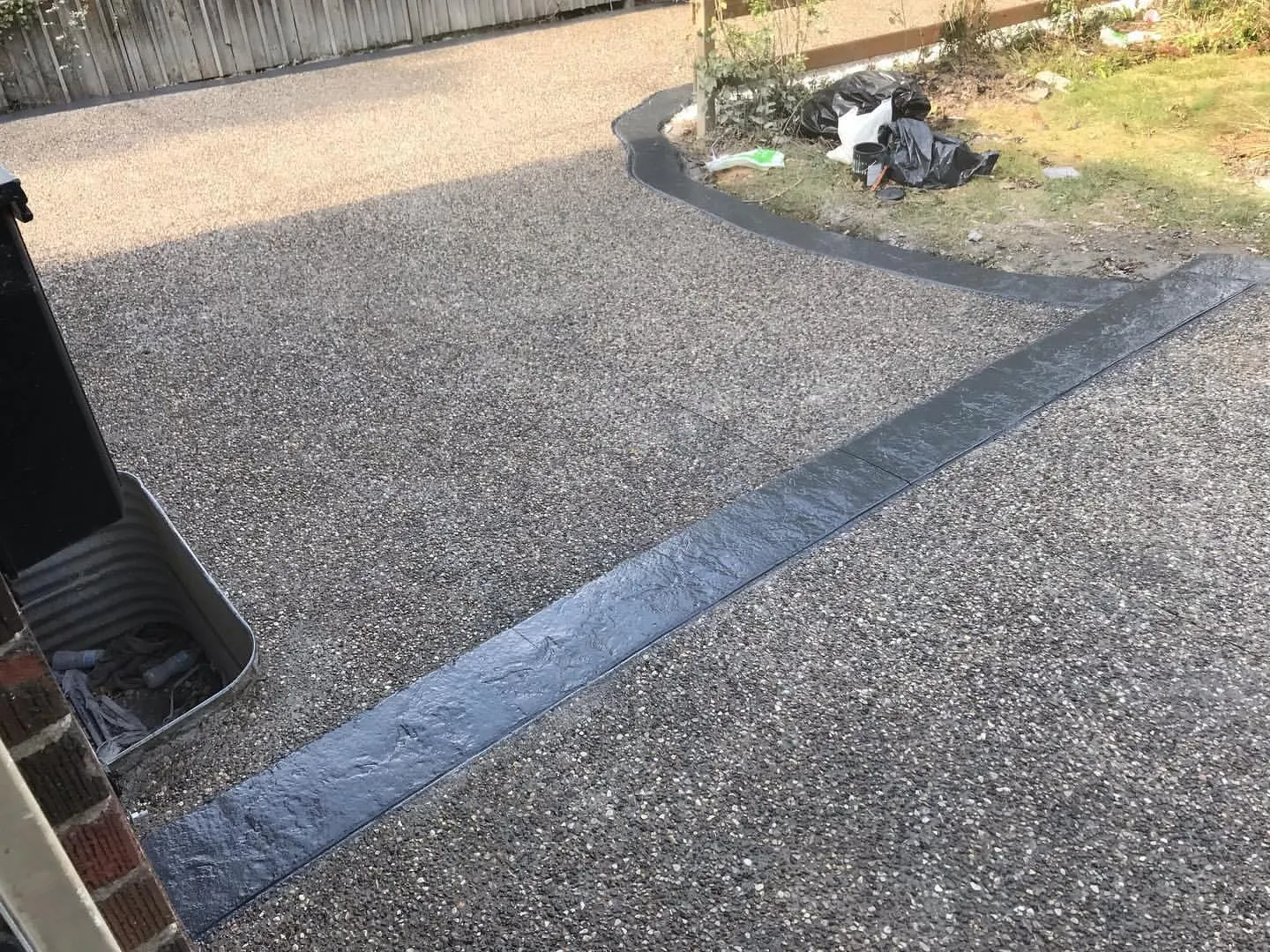
Exposed aggregate washes or brushes away the top layer of cement paste before the slab fully cures, exposing the stone aggregate underneath. It gives real, built-in traction, since the grip comes from the stone itself rather than a surface treatment, and minor wear over the years is far less visible because the texture runs through the material. It's a strong default for a daily-use driveway in a climate with icy mornings.
Stamped concrete presses texture mats into the surface while it's still workable, then usually adds an integral or acid-stain colour, to imitate flagstone, cobblestone, or slate. It gives the most design control of any finish, at the cost of a maintenance schedule, resealing every 2 to 3 years to protect the colour layer and pattern lines. For a full comparison of how stamped and exposed aggregate actually perform against each other on traction, cost, and winter durability, see our detailed breakdown of stamped versus exposed aggregate concrete. If you want all four put side by side rather than just those two, we compare every concrete finish on traction, cost, and upkeep, and colour and stain options covers the pigment side separately, since colour is a different decision from texture.
Coloured concrete mixes integral pigment directly into the batch rather than applying colour to the surface, giving a consistent tone that doesn't wear off the way a surface-applied stain can.
What it costs per square foot in Ontario
Pricing runs by finish, and the spread is wide enough that "concrete driveway cost" isn't a single number worth quoting without the finish attached:
| Finish | Typical range (per sq ft) |
|---|---|
| Broom finish | $12 to $20 |
| Coloured | $14 to $25 |
| Exposed aggregate | $16 to $28 |
| Stamped | $20 to $35 |
These ranges hold across our service area, with GTA jobs typically landing near the top of whichever finish you choose, driven by local labour and permit costs rather than the concrete itself. The finish is a smaller share of total cost than most homeowners assume: excavation, base prep, and reinforcement are built to the same standard regardless of which finish sits on top, so a broom-finished driveway isn't a cut-rate driveway, it's the same structural work with a simpler final step.
For a line-by-line look at what actually moves that number, excavation and disposal, base depth, slab thickness, reinforcement, and site access, see concrete driveway cost per square foot in Ontario. If you're still choosing between materials rather than finishes, we run the twenty-year numbers on concrete versus interlock versus asphalt.
The installation process, start to finish
A driveway install runs through the same sequence regardless of finish: site evaluation and planning, excavation and removal of the existing surface if there is one, granular base installation and compaction, forming to set the driveway's edges and grade, reinforcement placement, the concrete pour itself, finishing (broom, exposed aggregate, or stamping while the concrete is still workable), cutting or tooling control joints, and a final sealing pass.
On a straightforward residential driveway, that whole sequence typically runs 3 to 5 days from excavation to a finished, jointed slab, weather and site conditions permitting. Curing continues well after the crew leaves: concrete gains most of its working strength within about a week, enough for careful foot traffic, but it needs the industry-standard 28 days to reach its full design strength, which is why driving on a brand-new driveway too early or applying de-icing salt in its first winter both carry real risk to the surface.
When the pour happens matters as much as the sequence it follows. The best time of year to pour a concrete driveway in Ontario covers the temperature thresholds that govern placement and why the shoulder seasons are worth booking ahead for.
Drainage and grading: why the slope matters as much as the base
A driveway has to shed water away from the garage and the foundation, not toward them, and getting that grade right during forming is as important as the base compaction underneath. A slab poured dead flat, or worse, sloped back toward the house, traps water at the low point every time it rains or snow melts, and that trapped water is exactly what drives freeze-thaw damage fastest, since it sits in one spot and cycles through freezing and thawing repeatedly instead of draining off.
The fix is a grading plan set before forms go in: a slope shallow enough that it isn't noticeable underfoot but steep enough to move water toward the street or a drain, typically worked out alongside the driveway's width and any transition to a walkway or garage apron. Where the driveway meets an existing grade that already slopes the wrong way, that's a site problem worth solving with excavation and fill, not something a finish or a sealer can compensate for afterward.
Permits and curb cuts: what actually triggers a call to the city
A straightforward at-grade driveway replacement, same footprint, same width, generally doesn't trigger a building permit on its own in most Ontario municipalities, since it isn't a structure in the way an addition or a deck is. What does trigger a call to the city is any change that touches the boulevard or the curb: widening a driveway, adding a second one, or cutting a new curb access all typically require an entrance permit from the municipality's engineering or public works department, separate from any building permit.
Timelines on that municipal side are worth planning around independently of the concrete work itself. Curb cuts are commonly seasonal, many municipalities won't touch curb work over winter, and approval plus scheduling can run one to three months depending on the city's queue. A widening planned for autumn is realistically a next-season job for the municipal half of it, even if our crew could pour the concrete itself within days. Zoning by-laws also commonly cap driveway width and the number of driveways per lot, so a wider or second driveway is worth a zoning check before it's worth a quote.
Expansion and control joints: why the cuts are there on purpose
Every properly built driveway has a pattern of joints cut or tooled into it, and those aren't decorative. Control joints create a weak point where the concrete will crack in a straight, planned line as it naturally shrinks during curing, rather than cracking randomly across the slab. Expansion joints, typically at the edges where the driveway meets a garage slab, sidewalk, or foundation, give the concrete room to expand and contract with temperature swings without pushing against a fixed structure and cracking at that boundary instead.
A driveway poured without a correct joint layout, spacing that's too wide for the slab's thickness, is one of the more common causes of the diagonal, unplanned cracks homeowners call about, as opposed to the hairline cracks that sit neatly inside a joint line and are simply the material doing what the joint was cut to make it do. Why expansion joints matter on an Ontario concrete driveway goes further into spacing, depth, and where the isolation joints belong.
Freeze-thaw damage: the actual mechanism
Ontario's climate puts a concrete driveway through dozens of freeze-thaw cycles every winter, and understanding the mechanism explains almost every driveway problem homeowners ask about. Water gets into the concrete's pores, freezes, and expands by roughly 9%. Over enough cycles, that expansion causes surface scaling, spalling, and eventually structural cracking if the concrete wasn't properly air-entrained to give that expanding water somewhere to go.
A peer-reviewed study in The Scientific World Journal found that air-entrained concrete's freeze-thaw deterioration is measurably slower than plain concrete's, remaining durable through 300 freeze-thaw cycles at typical residential mix strengths, while non-air-entrained concrete degraded far faster under the same testing. That's the practical argument for insisting on an air-entrained mix rather than treating it as an upsell: it's the difference between a driveway that shrugs off twenty Ontario winters and one that starts scaling within five. How Ontario's freeze-thaw cycle actually damages concrete works through the mechanism in detail, along with the mix specifications that stop it.
De-icing salt: a real risk, not just a cosmetic one
Rock salt and other chloride de-icers are convenient, but they interact with cement paste in a way that goes beyond surface staining. NIST research published in Cement and Concrete Composites found that calcium chloride de-icer reacting with cement paste can form calcium oxychloride, an expansive compound that damages concrete at temperatures above freezing once concentrations pass roughly 11% by mass. That means the damage isn't limited to the freeze-thaw cycle itself, it can happen on a mild day too, if enough chloride has built up in the concrete.
The practical takeaway: skip de-icing salt entirely on a brand-new driveway through its first winter while it finishes curing, use sand for traction instead, and afterward favour calcium magnesium acetate or a lower-concentration product over straight rock salt if the surface is stamped or otherwise has a sealer and colour layer worth protecting. Winter salt damage on concrete shows what scaling looks like in its early stages and what can still be done once it starts.
Maintenance and sealing over the life of the driveway
A broom or exposed-aggregate driveway is close to maintenance-free: an occasional pressure wash and, optionally, a penetrating sealer every 3 to 5 years to guard against staining and salt penetration. A stamped or coloured driveway needs a firmer schedule, resealing every 2 to 3 years, because the pattern lines and colour layer both sit at the surface where UV exposure and de-icer contact do the most visible damage.
Sealing isn't just cosmetic upkeep. A penetrating or film-forming sealer reduces how much water and de-icing chemical actually get into the concrete's pores in the first place, which is the same mechanism driving both freeze-thaw scaling and calcium oxychloride formation. Skipping resealing on a stamped surface for too many winters shows up as dulled colour and chipped pattern edges well before the underlying concrete is structurally at risk, but it's still avoidable damage that a maintained sealer coat would have prevented. Sealing your concrete driveway, how often and why sets out the schedule by finish and which products are worth the money.
How long a well-built driveway actually lasts
A concrete driveway built with proper base compaction, correctly placed reinforcement, an air-entrained mix suited to Ontario's climate, and a maintained sealer schedule commonly reaches 25 to 30 years of service before it needs replacement rather than repair. Driveways that fail well short of that timeline almost always trace back to one of the base-level shortcuts covered above: inadequate compaction, reinforcement laid on the ground instead of at proper depth, a mix without enough air entrainment, or a joint pattern that doesn't match the slab's actual dimensions.
That's the real argument for not shopping a driveway quote purely on price per square foot. Two quotes with the same finish and a similar number can represent very different amounts of base prep and reinforcement, and that difference doesn't show up until years three through eight, by which point the cheaper job is usually the one calling about cracks. How long a concrete driveway lasts in Ontario breaks the number down by what was actually built underneath it.
When to repair versus replace
Hairline cracks sitting inside a control joint's pattern are normal shrinkage behaviour, not a defect. What warrants a closer look is a diagonal crack running across a panel, an edge or corner that sits noticeably higher or lower than its neighbour, or a crack that keeps visibly widening season over season. Those point to a base or drainage problem underneath rather than surface wear, and patching the surface without addressing what's happening below it is a short-term fix at best.
A driveway with isolated panel damage, localized scaling from an early bad winter, or a single settled section can often be addressed with targeted repair or a resurfacing pass rather than a full tear-out. Widespread structural cracking, significant settlement across multiple panels, or a base that's clearly failed calls for full replacement, starting the same excavation-to-finish process again with the base issue actually corrected this time.
Concrete driveway cracking, and when to repair versus replace covers how to read a crack before deciding anything, and driveway resurfacing versus full replacement compares the two routes on cost, disruption, and how long each one buys you.
Frequently asked questions
How much does a concrete driveway cost in Ontario?
It depends on the finish: broom finish runs $12 to $20 per square foot, coloured $14 to $25, exposed aggregate $16 to $28, and stamped $20 to $35. GTA-area jobs generally land near the top of whichever range applies.
How long does a new concrete driveway take to cure before I can park on it?
Concrete gains enough strength for careful foot traffic within about a week, but vehicle traffic should wait until the concrete has had adequate time to develop strength, and the slab doesn't reach its full design strength until the standard 28-day cure period is complete.
Does a concrete driveway need rebar?
It needs reinforcement, either rebar or welded wire mesh, placed at the correct depth within the slab. The reinforcement type matters less than making sure it's actually positioned mid-depth rather than resting on the ground before the pour.
What's the best time of year to pour a driveway in Ontario?
Spring and fall generally offer the most reliable curing conditions. Concrete can be poured through summer with attention to rapid moisture loss, and through cooler shoulder-season weather with cold-weather protection, but pouring during hard freezes without proper protection risks the fresh concrete before it has developed enough strength to withstand freezing.
Why does my driveway have cracks even though it's new?
Hairline cracks that sit inside the cut or tooled joint lines are the concrete doing exactly what those joints were designed to make it do as it naturally shrinks during curing. That's expected and not a sign of a problem. A crack running diagonally across a panel, outside any joint, is worth having looked at.
Do I need a permit to replace my concrete driveway?
Usually not for a straightforward replacement in the same footprint, since it isn't a structure the way a deck or addition is. What does typically require a separate entrance permit from the municipality is any change to the curb or boulevard, widening the driveway, adding a second access, or cutting a new curb, so it's worth a quick check with the city before the width changes at all.
Can I pour a concrete driveway myself to save money?
Technically yes, but the parts that determine whether it lasts, base compaction, correct reinforcement depth, an air-entrained mix proportioned for freeze-thaw exposure, and proper joint spacing, are exactly the parts that are hardest to get right without experience and the right equipment. A driveway is one of the more expensive things to get wrong, since fixing a bad base means removing the concrete that's already there.
Getting it right from the ground up
A concrete driveway that actually holds up through twenty Ontario winters is decided long before the finish goes on: the excavation depth, how well the base was compacted, where the reinforcement actually sits, and whether the mix was specified for freeze-thaw exposure in the first place. Homeowners in Guelph, Oakville, Waterloo, and Hamilton are all building on different soil under different microclimates, but the same base-first standard applies everywhere we pour. Get that right, and the finish you pick, broom, exposed aggregate, stamped, or coloured, is a real choice about how the driveway looks, not a bet on how long it lasts. See the full concrete driveways lineup, or browse real finished jobs in our concrete driveway gallery.