Key Takeaways
- Exposed-aggregate is the better default for a driveway: better grip when wet or icy, and wear shows up less because the texture runs through the material, not just the surface layer.
- Stamped concrete is the better default for a patio, pool deck, or entryway, where pattern and colour control matter more than maximum traction.
- Both finishes sit on the same excavation, granular base, and reinforced pour; get the base and mix right first, then pick the finish.
The short answer
Exposed-aggregate is the better default for a driveway. Stamped concrete is the better default for a patio. That's not a hard rule, it's a reflection of what each finish is actually good at, and homeowners in Guelph, Kitchener, and Oakville usually land on the same split once they weigh traction against appearance.
Exposed-aggregate: texture that works with the weather
Exposed-aggregate concrete is poured, then the top layer of cement paste is washed or brushed away before it fully cures, leaving the stone aggregate underneath exposed at the surface. That gives you two things a smooth or stamped finish can't: real grip when it's wet or icy, and a surface where minor wear over the years is far less visible, since the texture is structural, not printed on top.
The tradeoff is pattern. You get a consistent, natural texture, not a specific look. If you want a paver or flagstone appearance, this isn't the finish for that.
Stamped concrete: pattern and colour control
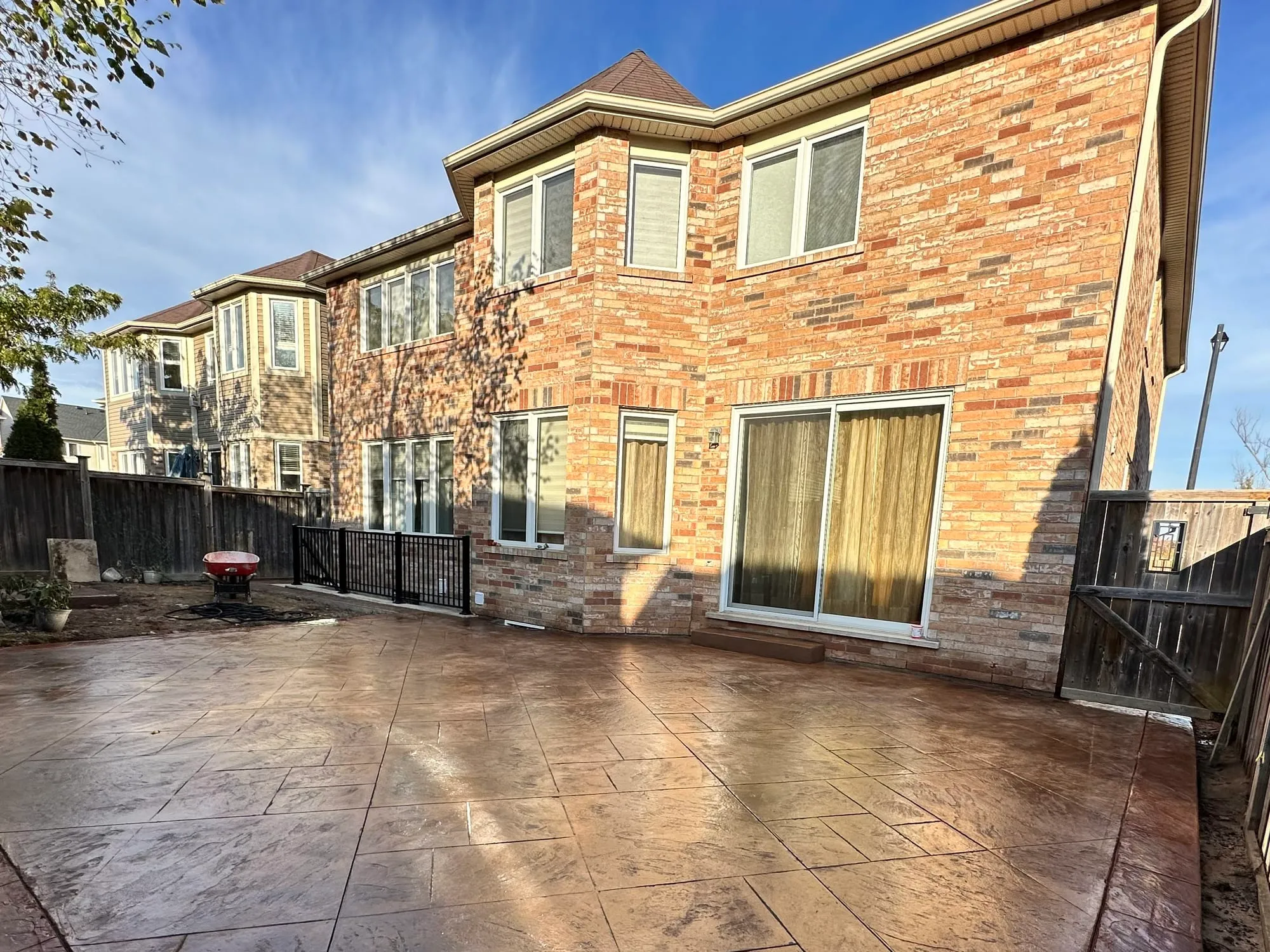
Stamped concrete uses texture mats pressed into the surface while it's still plastic, then a release agent and often an integral or acid-stain colour, to imitate flagstone, cobblestone, brick, or slate. It gives you far more design control than exposed-aggregate, which is why it's the more common choice for patios, pool decks, and entryways where the look matters more than maximum traction.
The tradeoff is the surface itself. The pattern lines and the colour layer both sit at the surface, so deep scratches, de-icing salt damage, and heavy freeze-thaw cycling show up more visibly over time than they do on an exposed-aggregate surface. A stamped driveway isn't a bad idea, but it needs a more disciplined maintenance routine (resealing every 2 to 3 years, careful de-icer selection) to still look right after a decade of Ontario winters.
Traction and safety: exposed-aggregate wins
Exposed-aggregate wins on traction because the grip is built into the aggregate itself, not applied to the surface. Walk on an exposed-aggregate driveway in January and the texture holds even under a thin layer of frost. Stamped concrete can be textured too, but its grip depends on how deep the mats pressed and how much the pattern has worn down; a smooth stamped pattern with heavy sealer buildup can get genuinely slick when wet.
The gap narrows on a patio that's swept and maintained regularly, where slipperiness has more to do with sealer choice than finish type. But for anything that sees daily foot or vehicle traffic through an Ontario winter, a driveway, a front walkway, entry steps, exposed-aggregate's built-in texture is the safer default.
Appearance and design control: stamped wins
Stamped concrete wins on appearance because it's the only one of the two that can imitate a specific material. Flagstone, cobblestone, ashlar slate, herringbone brick: stamped patterns can approximate all of them, paired with an integral or stained colour that ranges from warm sandstone tones to charcoal. Exposed-aggregate offers colour choice through the aggregate itself (river stone, granite chips, a specific regional blend) but the visual result is always texture, not pattern.
For a pool deck or entertaining patio where the finish is doing design work, not just structural work, stamped usually wins. For a driveway, where the finish is seen more than it's studied, most homeowners find exposed-aggregate's natural texture reads as premium on its own.
What actually drives the cost difference
Both finishes start from the same base cost: excavation, a compacted granular base, and a properly reinforced pour, built to the same standard regardless of the finish. The finish itself is a smaller share of total cost than most homeowners assume. Stamped concrete usually costs somewhat more per square foot than exposed-aggregate, mainly because of the extra labour for stamping, colouring, and sealing, not because the concrete mix itself differs.
Freeze-thaw is the real test
Ontario's freeze-thaw cycle, not the finish, is what actually determines whether a driveway or patio lasts. Water gets into any concrete surface's pores, freezes, expands, and over enough cycles causes surface spalling. Base preparation and the concrete mix itself, air entrainment in particular, matter more to long-term durability than which finish sits on top: a peer-reviewed study in The Scientific World Journal found air-entrained concrete's freeze-thaw deterioration is measurably slower than plain concrete's, and remained durable through 300 freeze-thaw cycles at typical residential mix strengths. A well-built stamped driveway will outlast a poorly-built exposed-aggregate one. The finish decision should come after the base and mix decision, not before it.
Maintenance over the years
Exposed-aggregate is close to maintenance-free: an occasional pressure wash and, optionally, a penetrating sealer every 3 to 5 years to guard against staining. Stamped concrete needs a real maintenance schedule: resealing every 2 to 3 years to protect the colour layer and pattern lines from de-icing salt and UV fading, plus more care around which de-icer gets used near it. NIST research published in Cement and Concrete Composites found that calcium chloride de-icer reacting with cement paste can form calcium oxychloride, an expansive compound that damages concrete at above-freezing temperatures once concentrations pass roughly 11% by mass, which is why an unsealed or poorly sealed stamped surface is more exposed to that risk than one with an intact sealer coat. Skip the resealing on a stamped surface for too many winters and the colour dulls and the pattern edges start to chip well before the underlying concrete itself is at any risk.
Who should choose what
A homeowner replacing a daily-use driveway: choose exposed-aggregate. The traction and low maintenance matter more over a 20-plus year lifespan than the pattern options you'd be giving up.
A homeowner building a new patio or pool deck: choose stamped. It's a space you're designing to look a certain way, and it doesn't see winter foot traffic the way a driveway does.
A homeowner doing a full front-yard package, driveway, walkway, and entry steps together: most split the two, exposed-aggregate on the driveway, stamped on the walkway and entry, tied together with a shared border or accent band so the transition reads as intentional rather than mismatched.
A homeowner in a heavy freeze-thaw area (most of the GTA, Kitchener-Waterloo, and Niagara fall into this) who wants a stamped driveway anyway: it's not a mistake, but budget for resealing every 2 to 3 years from day one rather than treating it as optional maintenance.
Frequently asked questions
Is stamped concrete more expensive than exposed-aggregate?
Usually, yes, though the gap is mostly labour, not material. Stamping, colouring, and sealing all add time on the crew's side that a broom or exposed-aggregate finish doesn't need.
Which finish holds up better to winter salt?
Exposed-aggregate, because there's no surface colour layer for de-icing salt to attack. Stamped concrete can hold up fine too, but only with a sealer that's reapplied on schedule and careful de-icer selection near the surface.
Can I combine both finishes on one property?
Yes, and it's common. Exposed-aggregate on the driveway for traction, stamped on the patio or entry for appearance, usually tied together with a matching border or accent colour so the two finishes feel like one design decision rather than two separate jobs.
Does the base need to be different for stamped versus exposed-aggregate?
No. Both need the same excavation depth, compacted granular base, and reinforcement for a given application (driveway loads differ from patio loads, but that's about use, not finish). The finish is applied at the very end of the pour and doesn't change what's underneath it.
Bottom line
Ask what the surface needs to do first. A driveway that gets walked on in January needs traction more than a specific look, exposed-aggregate usually wins. A patio that's mostly a summer entertaining space can prioritize appearance, stamped usually wins. For a full walkway or entryway that bridges both, splitting the two finishes and tying them together with a shared border is the approach most homeowners land on. Our concrete driveway gallery has real examples of both finishes side by side if you want to see how that split looks in practice.
If you're still working out the rest of the decision, base depth, reinforcement, cost, cure time, and how long the slab should actually last, the complete guide to concrete driveways in Ontario covers the whole build, and every concrete finish compared adds broom and coloured finishes to the two here.