Key Takeaways
- Asphalt is the cheapest to install but the shortest-lived: typically 15 to 20 years, according to NerdWallet, against 25 to 30 years for a properly built concrete driveway.
- Interlocking pavers cost the most upfront but can outlast both: a 2023 industry life-cycle cost analysis prepared for the Interlocking Concrete Pavement Institute found that interlock "can be long lasting (20+ years) when properly designed, installed, and maintained."
- There's no universal winner. The material that "costs less long-term" depends on how long you're actually keeping the driveway and how much upkeep you're willing to do yourself.
The short answer
There isn't one material that wins on every measure, and any contractor telling you otherwise is selling, not comparing. Asphalt wins on upfront price. Interlock wins on repairability and, per industry data, on maximum lifespan. Concrete lands in the middle on cost and requires the least ongoing attention of the three. Which one "costs less long-term" depends entirely on how many years you're counting and how much maintenance time you're willing to put in yourself.
This isn't a concrete sales pitch dressed up as a comparison. We pour concrete driveways, not interlock or asphalt, so we have no first-hand pricing to offer on those two. Every interlock and asphalt figure below is sourced to a named industry association, government-adjacent report, or an established consumer publication, linked inline so you can check it yourself.
Quick comparison
| Asphalt | Concrete | Interlock | |
|---|---|---|---|
| Typical install cost | $3.00 to $8.17/sq ft (Canada) | $12 to $22/sq ft (finish-dependent) | roughly $10 to $25/sq ft (North American benchmark) |
| Typical lifespan | 15 to 20 years | 25 to 30 years | 20+ years per industry case studies, up to a 25-year design-life assumption in the same study |
| Maintenance interval | Sealcoat about every 3 years | Sealer every 3 to 5 years (2 to 3 for stamped) | Periodic joint-sand top-up and spot paver relevelling |
| Repair pattern | Visible patch | Cut-and-repour a full panel | Lift, fix, reset the same pavers |
| Install speed | Fastest | 3 to 5 days to walk on, 28 days to full strength | Slowest (units set and levelled individually) |
| Lowest upfront cost | Asphalt | ||
| Lowest 25-year maintenance burden | Concrete | ||
| Highest lifespan ceiling (per case studies) | Interlock |
What each surface actually costs to install
For a typical two-car residential driveway, the three materials land in a rough order that hasn't changed much in years: asphalt cheapest, concrete in the middle, interlock priciest.
Asphalt runs about $3.00 to $8.17 per square foot installed in Canada, according to Green Building Canada's 2026 cost guide, with the low end for straightforward jobs and the high end for sites needing more excavation or a thicker base. It's the fastest of the three to install and the fastest to walk or drive on afterward.
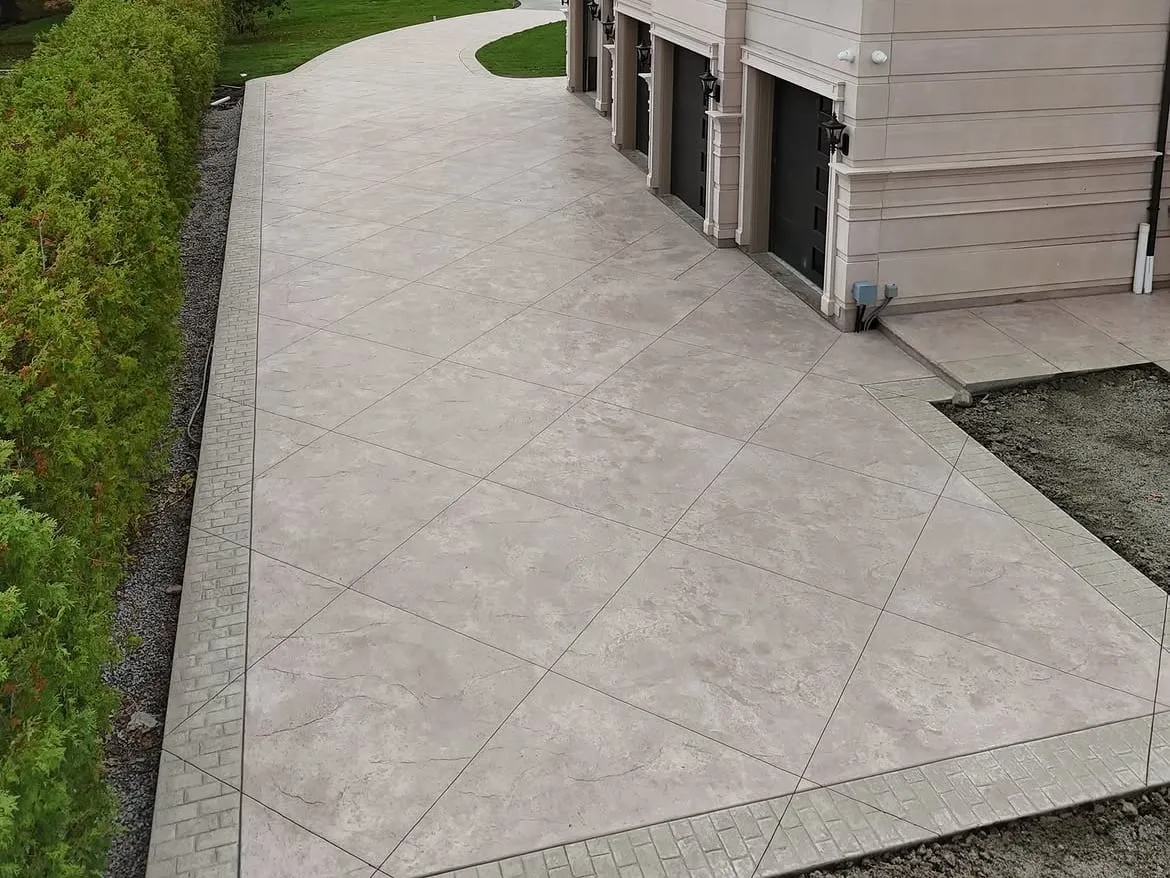
Concrete, based on our own current pricing across Mississauga, Toronto, and Cambridge, typically runs $12 to $22 per square foot depending on finish, with a broom or exposed-aggregate surface at the lower end and a stamped or coloured finish pushing higher. A typical pour takes 3 to 5 days from excavation to a driveway you can walk on, though the slab needs a full 28 days to reach design strength. Our complete guide to concrete driveways in Ontario breaks down what drives that range finish by finish.
Interlocking pavers are the most expensive to install, and no Canadian government or industry body publishes a single authoritative retail number for residential jobs. As a general North American benchmark, NerdWallet puts concrete paver installation at roughly $10 to $25 per square foot, with premium stone or complex patterns running higher still. Part of what you're paying for is labour: unlike a pour, which is placed once and finished, every paver on an interlock driveway is set and levelled individually over a compacted base.
Verdict: asphalt wins on upfront cost, decisively. For a homeowner working to a tight renovation budget this year, that gap is real and it matters. It's just not the whole story.
How long each surface actually lasts
This is where the upfront-cost story starts to look incomplete.
Asphalt typically lasts 15 to 20 years, according to NerdWallet's cost and lifespan guide, assuming reasonable maintenance. Skip the maintenance and that number drops; asphalt is a petroleum-based product and its binder degrades under UV exposure and water intrusion faster than the aggregate structure of concrete or interlock does.
Concrete commonly reaches 25 to 30 years when the base is properly compacted, the reinforcement is placed correctly, and the mix is air-entrained for freeze-thaw exposure, the standard we build to across our own projects.
Interlocking concrete pavement has the widest range and, per the strongest data available, the longest ceiling. A 2023 life-cycle cost analysis prepared by Stantec Consulting for the Interlocking Concrete Pavement Institute Foundation, surveying municipal agencies across Canada and the U.S. (nearly half from Ontario), modelled all three pavement types, asphalt, poured concrete, and interlock, against the same 25-year initial design life for comparison purposes, then concluded from real case studies that interlock "can be long lasting (20+ years) when properly designed, installed, and maintained." That's a municipal-infrastructure study, not a residential-driveway one, but the underlying material science, individual concrete units on a compacted base, applies the same way in a driveway.
Verdict: interlock has the highest lifespan ceiling on paper, concrete is the more consistent performer in practice, since interlock's actual lifespan depends heavily on how well the base was compacted and how promptly individual pavers get releveled when they shift, a maintenance step homeowners more often skip than professionals surveyed for a municipal report.
The maintenance schedule each surface actually needs
Lifespan numbers assume maintenance happens. Here's what each surface actually needs, and how much of it is realistic for a homeowner to keep up with.
Asphalt needs the most frequent attention. Expert guidance cited by Family Handyman recommends sealcoating an asphalt driveway about once every three years to protect the binder from UV and water damage, plus prompt crack filling as hairline cracks appear. Skip sealing for several cycles and the surface ages faster than the 15-to-20-year baseline assumes.
Interlock needs the least labour per visit, but a wider range of small jobs. According to the same ICPI-commissioned survey of agencies managing interlock pavement, the most common maintenance tasks are replacing individual damaged pavers, repairing the base or sub-base under a shifted section, and topping up joint sand as it washes out over time. None of these require resurfacing the whole driveway, which is interlock's real advantage: a repair is local, not driveway-wide. The tradeoff is that a homeowner has to notice a shifting paver or thinning joint sand before it becomes a tripping hazard or an entry point for weeds.
Concrete needs the least frequent and least involved maintenance of the three. A broom or exposed-aggregate driveway needs little beyond an occasional pressure wash and, optionally, a penetrating sealer every 3 to 5 years. A stamped or coloured finish needs resealing on a tighter 2-to-3-year cycle to protect the surface colour and pattern lines, similar to interlock's joint-sand schedule.
Verdict: concrete asks the least of a homeowner over time; asphalt asks the most on a fixed schedule; interlock's maintenance is intermittent but requires actually noticing the problem.
What a 25-year window actually looks like
Put the install cost, lifespan, and maintenance together and a clearer picture forms for anyone planning to stay in a home for two decades or more.
Over 25 years, an asphalt driveway installed today is very likely to need a full replacement partway through that window, since its typical lifespan tops out around 20 years even with good sealing. A concrete driveway built to a proper standard will likely still be the original slab at year 25, having asked for nothing more than occasional sealing. An interlock driveway sits in between in practice: the design life supports lasting the full 25 years and beyond, but that outcome depends more on installation quality and homeowner follow-through on small repairs than either of the other two materials, since a poorly compacted base or neglected joint sand can shorten interlock's real-world life well short of its design ceiling.
That's the honest version of "costs less long-term": asphalt's low entry price gets partly or fully spent again on a repave inside a 25-year window, concrete's higher entry price is amortized over the longest reliably-achieved lifespan of the three without depending on ongoing small repairs, and interlock can match or beat concrete's lifespan, but only if the base was built right and the pavers get attention when they need it.
Where interlock and asphalt genuinely have the edge
A fair comparison means saying where concrete loses.
Interlock wins on repairability. If a section of interlock heaves from a tree root or a utility cut needs to go through the driveway, a contractor lifts the affected pavers, fixes what's underneath, and resets the same pavers, often with no visible seam. Concrete doesn't offer that: a damaged section usually means cutting out and repouring a full panel, which can leave a colour or texture mismatch against the older concrete around it, and asphalt patches are usually visible too, though less jarring since asphalt has less surface pattern to mismatch.
Asphalt wins on flexibility and upfront cost, and it has genuinely good cold-weather traction characteristics. Asphalt is more flexible than concrete or a rigid paver base, which lets it tolerate minor ground movement without cracking as readily. And its lower upfront cost is a real advantage for anyone who knows they won't be in the home long enough to benefit from a 25-year lifespan anyway.
Concrete doesn't win on design flexibility or repairability, only on the combination of moderate cost, long consistent lifespan, and low maintenance. That's a real advantage for a driveway a homeowner wants to install once and mostly forget about, not a claim that it beats the other two on every axis.
How Ontario's freeze-thaw cycle treats each surface
Ontario's winters are a genuine stress test, and the three materials respond differently.
Concrete's main freeze-thaw vulnerability is surface scaling from de-icing salt, which is why an air-entrained mix and a maintained sealer matter more here than in a milder climate. Asphalt's flexibility actually helps it handle minor frost heave without cracking the way a rigid surface can, but that same flexibility means it softens more in summer heat and can rut under a parked vehicle's weight over years. Interlock's individual units can each move slightly with frost heave without transmitting stress to the units next to them, which is part of why municipal survey respondents in the ICPI-commissioned report cited crack-free performance under frost movement as a benefit, but the same individual movement is also what eventually knocks joints and edges out of alignment if the base wasn't compacted to spec.
Who should choose what
A homeowner planning to stay 20-plus years and wants to deal with the driveway once: concrete. The combination of moderate cost, long typical lifespan, and minimal upkeep fits a set-and-forget approach better than either alternative.
A homeowner on a tight renovation budget, or planning to sell within 10 years: asphalt. The lower entry cost matches a shorter ownership horizon, and a well-sealed asphalt driveway easily outlasts a typical pre-sale timeline.
A homeowner who wants the most design flexibility and doesn't mind a maintenance routine: interlock. Pattern and colour options exceed what concrete offers, and repairs stay local to the damaged section rather than requiring a full-panel repour.
A homeowner doing a full driveway-plus-walkway package: it's common to see interlock or stamped concrete used for a walkway or entry accent while the main driveway runs a more budget-conscious material, since the two surfaces don't have to match to look intentional.
Frequently asked questions
Is interlock or concrete more expensive?
Interlock generally costs more upfront, since it's a benchmark commonly cited around $10 to $25 per square foot in installed North American pricing versus $12 to $22 for a typical concrete driveway. The gap narrows or reverses on premium concrete finishes like stamped or coloured work, which can push past $25 per square foot.
Does asphalt or concrete handle Ontario winters better?
Both hold up fine when built correctly for the climate. Asphalt's flexibility resists frost-heave cracking better, but its surface degrades faster without regular sealing. Concrete resists surface wear longer but needs an air-entrained mix and a maintained sealer to avoid salt-related scaling.
Can I mix materials, like an asphalt driveway with a concrete or interlock apron?
Yes, and it's a common way to control cost. A concrete or interlock apron at the street or garage entrance, the sections that see the most wear and the most visible staining, paired with asphalt for the rest of the driveway, is a reasonable middle ground on both budget and durability.
Does the "20-plus years" interlock lifespan apply to a home driveway, not just municipal streets?
The Stantec/ICPI report studied municipal streets and sidewalks, which see heavier and more consistent traffic loading than a residential driveway. A driveway carrying only passenger vehicles puts less stress on the pavement structure than a municipal collector road, so a well-built residential interlock driveway should reasonably meet or exceed the 20-plus-year figure from the municipal case studies, provided the same base-compaction and maintenance standards are followed.
Bottom line
Asphalt costs the least today. Concrete costs more today but the least over a 25-year window if you count on doing little more than occasional sealing. Interlock costs the most today and can match or beat concrete's lifespan according to industry data, but only with more attentive, if less labour-intensive, upkeep along the way. None of that makes concrete the automatic answer, it's the better fit for a homeowner who wants long, low-maintenance service from one investment, not a universal winner. If that's the driveway you're after, we build to that base-and-mix standard on every job, whichever Ontario city it's in. Once you've settled on concrete, what actually drives the cost per square foot breaks the quote down line by line.