Key Takeaways
- Freeze-thaw damage happens because water expands about 9% in volume when it freezes inside concrete's capillary pores, building up pressure that has nowhere to go unless the mix contains a network of microscopic air voids to relieve it.
- Air-entrained concrete with the right void spacing shows several hundred percent better freeze-thaw resistance than the same mix without it, according to American Concrete Institute guidance.
- Water-cement ratio matters almost as much as air content: peer-reviewed testing found low-strength, higher-w/c mixes losing over a third of their stiffness by 300 cycles while properly proportioned mixes barely changed.
- Curing conditions in the first days after a pour can matter more than either of the above. Concrete cured at freezing temperatures failed after only 50 freeze-thaw cycles in one study, versus 250 cycles for the same mix cured normally.
- De-icing salt adds a second, separate damage mechanism (calcium oxychloride formation) on top of ordinary freeze-thaw cycling, one that can damage concrete even above freezing.
What's actually happening inside the concrete when it freezes
Concrete is porous. Even a dense, well-finished slab has a network of capillary pores left behind by water that didn't chemically combine with the cement during hydration. When those pores are wet and the temperature drops below freezing, the water inside them turns to ice, and ice takes up about 9% more volume than the water it came from.
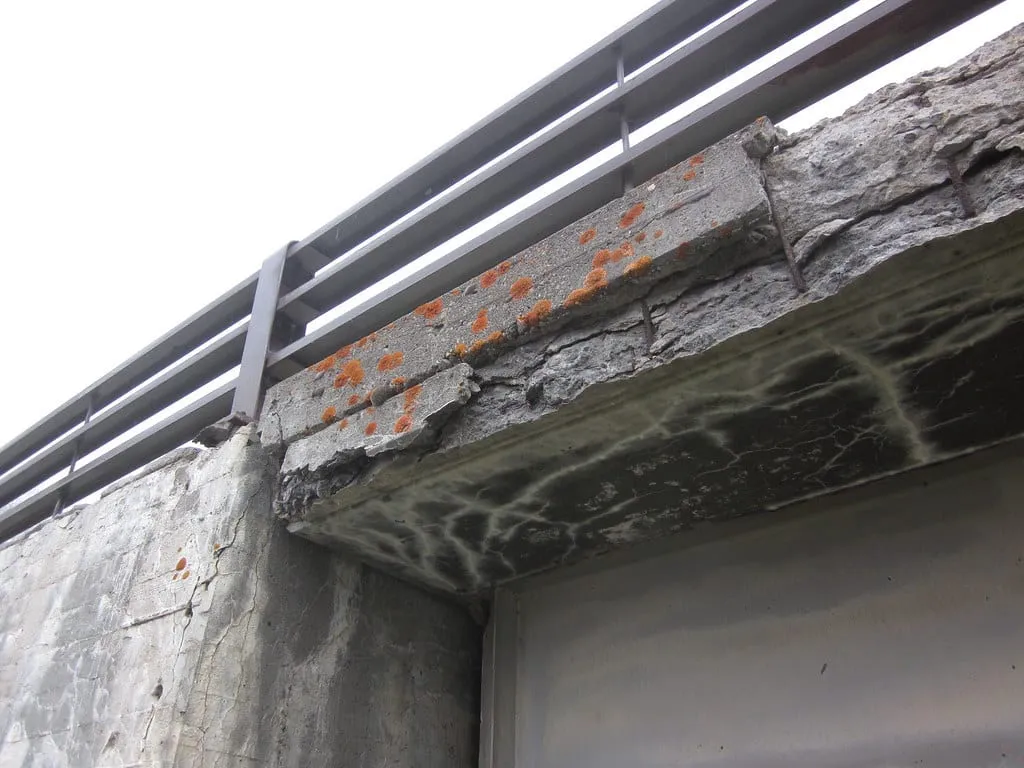
That expansion has to go somewhere. If the surrounding paste is saturated enough, the growing ice crystals push the remaining unfrozen water ahead of them through the pore structure, building up hydraulic pressure as they go. Once that pressure exceeds what the paste can withstand in tension, it cracks the material from the inside. This happens invisibly at first, one freeze cycle at a time, long before it shows up as a visible spall or crumbled surface.
This is why a driveway that looked fine in November can start scaling and pitting by March. Nothing sudden happened. It's the accumulated result of dozens of freeze-thaw cycles acting on the same pore structure over a single winter, and it's why the pillar guide to concrete driveways in Ontario treats mix design, not just finish, as the real determinant of how long a driveway lasts.
Air entrainment: the single biggest factor in freeze-thaw survival
The fix the concrete industry settled on decades ago is deceptively simple: deliberately mix millions of microscopic air bubbles into the paste. According to the American Concrete Institute's own guidance on freezing and thawing resistance, those bubbles need to sit no more than about 0.2 mm apart throughout the paste. At that spacing, no point in the material is far enough from a bubble for damaging pressure to build up, since the freezing water can push into the nearest air void instead of fracturing the paste around it. ACI's guidance describes air-entrained concrete as showing "several hundred percent" better freeze-thaw resistance than plain concrete with the same mix otherwise.
Getting the air content right isn't automatic, though. A Federal Highway Administration study on marginal air content tested concrete across a range of fresh air contents from 2.5% to 4.5%, below the traditional 6% ± 1% target, and found the results depended heavily on which air-entraining admixture was used. Mixes made with a vinsol resin-based admixture stayed durable (durability factors above 80%, and as high as 87.9%, even at air contents as low as 2.7%), while mixes using a synthetic admixture at similar air contents performed far worse, with durability factors as low as 28.7% in the weakest case. Two batches can report similar "percent air" on a slump test and still perform completely differently through a real winter, which is one reason a contractor's mix design and admixture choice matters more than the number on a delivery ticket.
Water-cement ratio: why two driveways of the same age differ
Air entrainment protects the paste from hydraulic pressure. Water-cement ratio determines how much of that vulnerable pore structure exists in the first place. Less mixing water relative to cement means fewer, smaller capillary pores once the concrete cures, and less pathway for water to get in and freeze.
A peer-reviewed freeze-thaw durability study in The Scientific World Journal tested five concrete grades (C20 through C50) with similar air content, around 5.5-6.5% across all mixes. By 300 cycles, the C20 and C25 mixes had lost more than a third of their relative dynamic modulus of elasticity, a measure of internal stiffness and crack damage, dropping to roughly 63-65% of their original value. C40 and C50, poured with lower water-cement ratios (0.36 and 0.32 versus 0.40), stayed above 90% through the same 300 cycles, essentially undamaged. The one result that complicates a simple "less water is always better" story: C30 used the identical 0.40 water-cement ratio as C20 and C25, yet stayed above 93%, which the study's authors attribute to its higher compressive-strength cement. Water-cement ratio is a major lever, but it's shorthand for overall mix quality, not the only variable, which is why the grade and cement specified for a pour matters as much as the number that ends up on the ticket. It's the same underlying logic behind why exposed-aggregate and stamped finishes perform differently over time: the finish sits on top of a mix decision that was made long before the surface texture was chosen.
This is also the practical argument for having the mix, not just the price, be part of any conversation about a driveway pour in Guelph or elsewhere in the region. A lower water-cement ratio costs more in admixtures and finishing labour, since stiffer concrete is harder to place and finish, but the freeze-thaw data above is exactly why that tradeoff exists.
Curing conditions: damage locked in before the first winter
Air content and water-cement ratio are mix design decisions made before the truck even arrives. Curing is what happens (or doesn't) in the days immediately after the pour, and the research suggests it may matter more than either.
A study on curing temperature and freeze-thaw failure in air-entrained concrete, published via PMC, compared identical concrete cured under three conditions: standard curing, curing at 5°C, and curing at -3°C. The standard-cured concrete withstood 250 freeze-thaw cycles before reaching the study's failure criteria. The concrete cured at 5°C managed only 150 cycles. The concrete cured at -3°C, meaning it was setting while already exposed to freezing temperatures, failed after just 50 cycles: a fifth of the standard-cured concrete's durability, from curing conditions alone, with no change to the mix itself.
That's the underlying reason cold-weather pours need real protection (insulated blankets, heated enclosures, or timing the pour for warmer conditions) rather than just "concrete that can handle cold once it's cured." Concrete that freezes before it has gained enough strength doesn't recover that lost durability later; the damaged pore structure from an unprotected cold pour is permanent. It's a big part of why timing and pour scheduling matter just as much for a patio in Hamilton or a set of entry steps in Kitchener as they do for a driveway. Steps in particular see the same freeze-thaw exposure as a driveway on a much smaller footprint, so a curing mistake shows up just as fast.
Base drainage: why the ground under the slab is doing half the work
Everything above assumes water is available to saturate the concrete's pores in the first place. Cutting off that water supply from underneath is the other half of freeze-thaw protection, and it happens before the concrete is even poured.
A compacted granular base under a slab isn't just structural support, it's a capillary break. Fine-grained native soil can wick groundwater upward through capillary action, but the larger pore spaces in a well-graded crushed stone base are too coarse to support that same capillary draw, so moisture drains through instead of being pulled up toward the underside of the slab. Combined with proper surface grading and drainage away from the slab edge, this keeps the concrete closer to a dry, unsaturated state through the winter, which matters because the hydraulic-pressure mechanism described above only causes damage once the pore system is saturated enough for freezing water to have nowhere to expand into. A slab sitting on a poorly drained base, or one where surface water pools against an edge instead of running off, spends more of the winter saturated and pays for it in surface scaling and cracking years earlier than an identical mix on a well-drained base.
This is base-and-grading work, not finish work, which is why it applies the same way to a driveway, a patio, or a walkway, and why excavation depth and granular base get treated as non-negotiable on every one of those jobs regardless of what gets poured on top.
De-icing salt: a second damage mechanism riding on top of freeze-thaw
Everything so far describes plain water freezing in concrete. Road salt and other calcium chloride-based de-icers introduce a separate chemical mechanism that compounds the physical one.
NIST research published in Cement and Concrete Composites found that calcium hydroxide in cured cement paste reacts with calcium chloride and water to form calcium oxychloride, an expansive compound. Above a concentration of roughly 11.3% calcium chloride by mass, the study found this compound forms rapidly and remains stable even at room temperature, meaning the damage mechanism isn't limited to freezing conditions the way ordinary hydraulic pressure damage is. Calcium oxychloride formation can expand and crack concrete, and reduce how well fluids move through it, at temperatures where plain water freeze-thaw damage wouldn't be happening at all.
That's a meaningfully different mechanism from the pore-pressure damage described above, which is exactly why our post on winter salt damage covers it as its own topic: which de-icers concentrate calcium chloride to damaging levels, and which don't. The short version here is that de-icer chemistry doesn't replace anything in this article, it adds a second clock running alongside ordinary freeze-thaw cycling, which is one more reason a well-entrained, low-w/c, properly cured, well-drained slab still needs sensible de-icer choices to actually reach its full service life.
What this actually means for a pour in Guelph, Hamilton, or Kitchener
None of this is exotic engineering. Air-entraining admixtures, reasonable water-cement ratios, proper curing protection, and a compacted granular base are all standard, available practices, not premium upgrades. The research above is really an explanation for why two driveways that look identical on pour day can age at completely different rates: one variable out of alignment (air content, w/c ratio, curing protection, or base drainage) is often enough to cut years off a slab's service life, regardless of which surface finish sits on top.
Frequently asked questions
How many freeze-thaw cycles does a typical Ontario winter put a driveway through?
It varies by year and by region, but southern Ontario's winters routinely hover around the freezing point for weeks at a stretch rather than staying reliably below it, which is exactly the condition that produces repeated freeze-thaw cycling rather than one long freeze. That's the practical reason freeze-thaw resistance matters more here than in a climate that freezes once in November and stays frozen until March.
Does a thicker slab resist freeze-thaw damage better?
Not directly. Freeze-thaw damage is a function of the paste's pore structure, air void system, and saturation level, not slab thickness. A thicker slab poured with the wrong mix or cured badly in the cold will still deteriorate; thickness helps with structural loading and cracking from settlement, not with the freeze-thaw mechanism itself.
Can freeze-thaw damage be repaired, or does the slab need replacing?
Minor surface scaling can sometimes be addressed with resurfacing if the underlying structural concrete is sound. Once damage has progressed to significant spalling or the internal crack network has advanced (the kind of deterioration the dynamic-modulus testing above is measuring), repair is usually temporary and replacement becomes the more durable option.
Is air-entrained concrete required by code for exterior work in Ontario?
Air entrainment is standard, expected practice for any exterior flatwork in a climate with regular freeze-thaw cycling, and it's what a properly specified residential mix design in this region should include by default, not an optional upgrade to ask for separately.
Bottom line
Freeze-thaw damage isn't bad luck or an inevitable cost of an Ontario winter, it's a specific mechanism with well-documented mitigations: entrained air at the right spacing, a water-cement ratio low enough to limit capillary porosity, real cold-weather curing protection, and a granular base that actually drains. Get those four right and the finish decision, whether that's exposed-aggregate, stamped concrete, or a plain broom finish, is what determines how the surface looks, not whether it survives the winter.