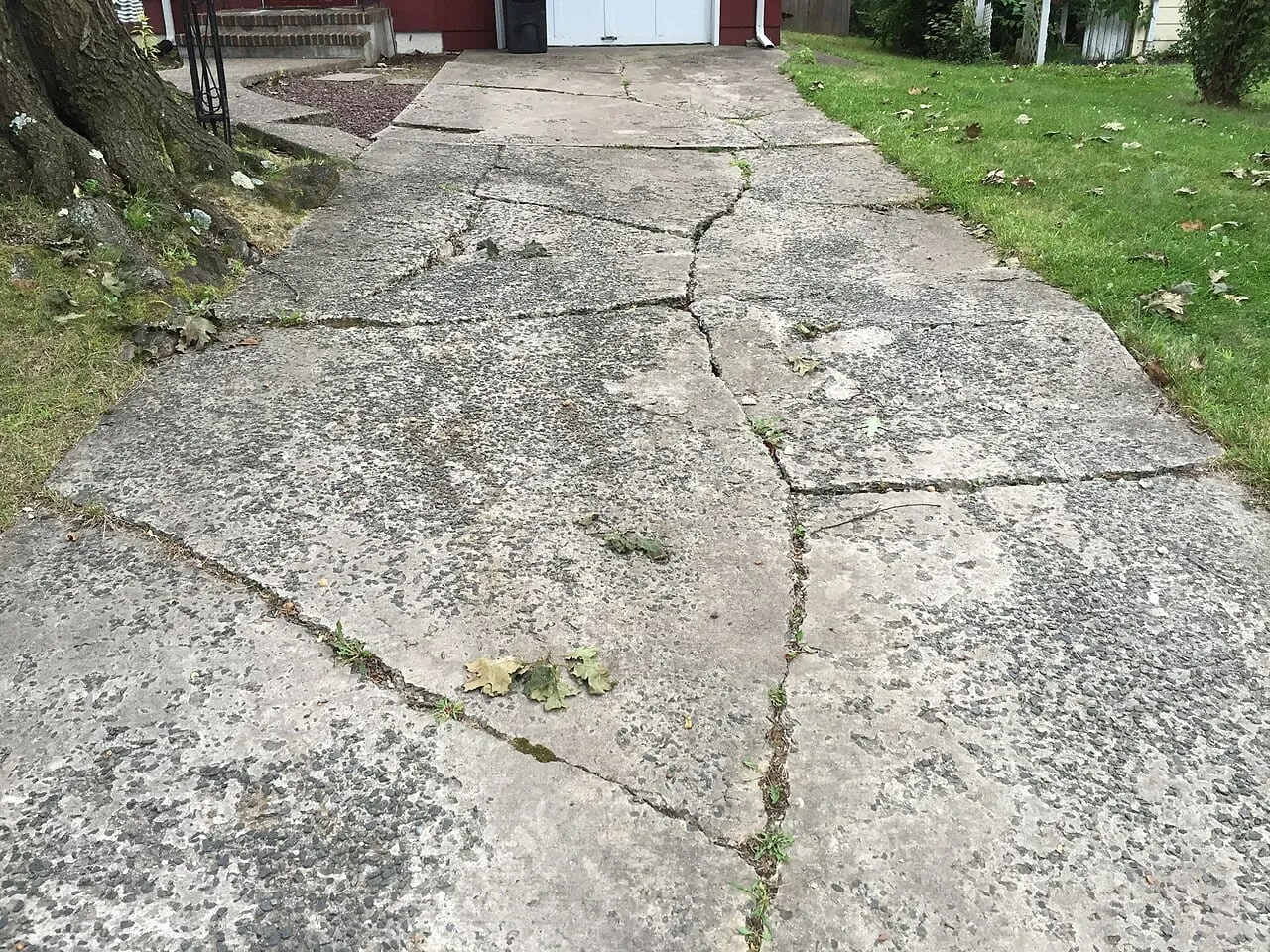
Key Takeaways
- Most driveway cracking comes down to three causes: freeze-thaw water intrusion, a base that wasn't compacted properly before the pour, or joints spaced too far apart to control shrinkage. Tree roots and heavy vehicle loads cause the rest.
- A hairline crack under about 1/8 inch with no vertical offset is almost always cosmetic. A crack you can catch a fingernail in, one side higher than the other, or cracking that's spreading year over year, is a different problem.
- Repair buys you years, not decades, when the underlying cause (a failed base, poor drainage, undersized joints) hasn't been fixed. Fix the cause or the same crack, or one just like it, comes back.
Why concrete driveways crack in the first place
Concrete shrinks as it cures and keeps expanding and contracting with every freeze-thaw cycle after that. In an Ontario winter, that's not an occasional stress, it's a routine one, and it's the reason driveway cracking is one of the most common calls we get across Kitchener, St. Catharines, and Hamilton.
Freeze-thaw water intrusion. Water gets into any concrete surface through its pores and any existing hairline cracks. Water expands as it freezes, and that expansion pushes outward against the surrounding concrete. Do that dozens of times a winter for enough winters and small cracks widen, surface layers spall, and joints that were tight start to open up. This is the single biggest driver of driveway cracking in our climate, more than any material defect.
A base that wasn't compacted properly. A driveway slab is only as stable as what's underneath it. If the granular base wasn't compacted to uniform bearing before the pour, or if a soft spot (an old water line trench, disturbed soil, poor drainage) was missed, the slab settles unevenly over the following seasons. Concrete doesn't bend, so uneven settlement shows up as a crack, usually running perpendicular to whatever's failing underneath.
Joints spaced too far apart, or none at all. Control joints exist to create a deliberate weak point where the slab can crack in a straight, hidden line instead of at random. The National Ready Mixed Concrete Association's guidance puts maximum joint spacing at 24 to 36 times the slab's thickness, meaning a typical 4-inch driveway needs a joint roughly every 10 feet, and no more than every 15 feet. A driveway poured with joints spaced wider than that, or with corners and odd angles left unjointed, is a driveway that's going to crack somewhere other than where you'd want it to.
Tree roots. A mature tree close to the driveway edge will push a root system under the slab looking for moisture, and roots don't stop for concrete. The result is a slab that doesn't just crack, it heaves and tilts, with one panel visibly higher than its neighbour. That's a different repair conversation than a shrinkage crack, since the driveway won't sit flat again until the root pressure is dealt with.
De-icing salt. Calcium chloride and similar de-icers are common across the southern Ontario because they work at lower temperatures than rock salt. NIST research published in Cement and Concrete Composites found that calcium chloride reacting with cement paste can form calcium oxychloride, an expansive compound that damages concrete at above-freezing temperatures once concentrations pass roughly 11.3% by mass. An unsealed driveway, or one with an existing crack that lets concentrated salt brine soak in and sit, is exposed to that reaction in a way a properly sealed surface isn't.
Heavy loads the slab wasn't designed for. A standard residential driveway is built for cars, not a fully loaded delivery truck, a dumpster bin, or heavy equipment parked in one spot for days. That kind of load concentrates stress well beyond what the slab and base were designed to carry.
Is it a hairline crack or a real problem? How to tell
Not every crack means the same thing, and the right response depends on which of these you're looking at.
Cosmetic, seal it and move on:
- Under about 1/8 inch wide
- Both sides of the crack are level with each other
- It isn't growing longer or wider year over year
- It follows a control joint or a natural expansion point
Worth a proper repair:
- 1/8 inch to roughly 1/4 inch wide
- Some minor vertical offset (you can feel it under your foot, but it's not a trip hazard)
- Water is visibly pooling in or around the crack
- It's isolated to one section, not spread across the whole slab
Signs the slab itself may need to go, not just the crack:
- Wider than 1/4 inch, or a gap you can fit a coin into
- Noticeable height difference between the two sides
- Multiple cracks radiating from one point, or cracking across most of the driveway's surface
- The crack keeps coming back after being sealed or patched
- Visible heaving, sinking, or a slab that rocks underfoot when you walk on it
If you're only dealing with one or two items from that middle or top list, a repair is usually still worth trying before jumping to replacement. If most of the driveway shows several of those signs at once, that's usually the base talking, not the concrete, and a repair on top of a failed base rarely holds for long.
Repair methods, from least to most involved
1. Crack sealant for hairline and cosmetic cracks
A flexible polyurethane or silicone crack sealant, applied after cleaning out debris and any loose material, keeps water from getting into a hairline crack and doing freeze-thaw damage from the inside. It's the cheapest fix, it's genuinely effective for narrow, stable cracks, and it's something a homeowner can do themselves with a caulking gun on a dry, mild day. It does nothing for a crack that's actively moving.
2. Epoxy or polyurethane injection for structural cracks
For a crack with some depth or minor movement, injecting a two-part epoxy or a flexible polyurethane resin under pressure fills the crack through its full depth, not just at the surface. Epoxy bonds rigidly and restores some of the slab's original strength across the crack, which makes it the better choice on a crack that isn't expected to keep moving. Polyurethane stays flexible, which suits a crack that's still shifting slightly with the seasons.
3. Routing and sealing wider cracks
For cracks in the 1/8 to 1/4 inch range that aren't a candidate for injection, cutting the crack out into a clean, uniform channel with a grinder or router, then filling it with a self-leveling polyurethane sealant, gives a cleaner and more durable result than sealant applied directly over a ragged crack edge. This is the same principle behind a properly cut control joint: a clean, consistent channel holds sealant far better than an irregular one.
4. Slabjacking or polyurethane foam lifting
When a section of driveway has sunk but the concrete itself is still sound, slabjacking (pumping a cementitious grout or expanding polyurethane foam underneath the slab) can raise it back to grade without removing any concrete. This addresses settlement, not cracking directly, but it's often the right move when the crack you're looking at is really a symptom of an uneven slab rather than shrinkage.
5. Partial replacement of a single panel
When a specific control-joint panel is badly cracked, heaved by a root, or has settled beyond what lifting can fix, cutting out just that panel and repouring it, tying the new pour into the existing joints, fixes the problem without touching the rest of the driveway. This is usually the right call when the damage is contained to one or two panels out of many and the rest of the slab, and the base under it, is still sound.
6. Full driveway replacement
When cracking is spread across most of the surface, when the base itself has failed in multiple spots, or when a driveway is old enough that repeated repairs are becoming the norm rather than the exception, replacing the whole driveway resets the clock, on the base, the joint layout, and the concrete mix, rather than patching a problem that keeps resurfacing somewhere new every year.
Resurfacing as a middle option
Between a spot repair and a full tear-out, a bonded concrete overlay (a thin layer of polymer-modified concrete applied over the existing slab) can hide surface-level cracking, spalling, and staining and give a driveway a fresh, uniform finish. It's not a fix for a structural crack or a slab with base problems, an overlay follows the shape and any movement of what's underneath it, so a crack that's still active will usually telegraph through the new surface eventually. Where it does work well is on a driveway that's cosmetically tired but structurally fine, and it's also the point where homeowners often decide to change finish entirely, moving from a plain broom finish to something like the stamped or exposed-aggregate options we install across the region.
When repair stops making sense
Repair is the right call when the damage is contained, the base is sound, and the driveway is otherwise in reasonable shape for its age. Replacement starts making more financial sense once you're looking at more than two or three of the following at the same time:
- The driveway is already 20-plus years old and showing its first serious cracking
- You've had the same section repaired more than once
- Cracking covers more than roughly a third of the total surface
- There's visible settlement or heaving, not just surface cracks
- Drainage pools against the house or garage instead of running off
A driveway that only needs one clean repair is rarely worth replacing early. A driveway asking for its third repair in five years is telling you the underlying problem was never actually fixed.
Maintenance that prevents the next crack
Most of what extends a driveway's life happens before any crack shows up.
Seal it on a schedule, not just when it looks dry. A penetrating sealer (Concrete Alberta, a Canadian ready-mix trade association, recommends a silane-based penetrating sealer applied at least a month after the concrete has cured) keeps water and de-icing salt from soaking into the surface in the first place. For a plain broom-finished driveway, every 3 to 5 years is typically enough.
Watch what you use to de-ice it. Calcium chloride and magnesium chloride both work at lower temperatures than rock salt, but both are more aggressive on unsealed or already-cracked concrete. Sand for traction and a lighter hand with de-icer, especially in the driveway's first winter, goes a long way.
Keep an eye on drainage. Water that pools against the driveway, especially where it meets the garage slab or a foundation wall, is water that's getting more freeze-thaw cycles than it should. Regrading a low spot is far cheaper than repairing the cracking it eventually causes.
Deal with hairline cracks while they're still hairline. A $20 tube of sealant today is meaningfully cheaper than an epoxy injection in two years, once that same crack has let a few dozen freeze-thaw cycles in.
When to call a professional instead of doing it yourself
A homeowner can reasonably handle a straightforward sealant job on a stable hairline crack. Call a contractor once you're dealing with any of the following:
- A crack wider than 1/4 inch, or with any noticeable height difference across it
- Visible heaving from a tree root, which usually means the root needs addressing before any repair will hold
- Cracking near the garage slab, a load-bearing wall, or a foundation, where the cause might not be limited to the driveway at all
- A driveway with cracking in multiple, unrelated spots at once, which usually points to a base problem rather than a series of coincidences
- Any repair that's already failed once
Frequently asked questions
Can I just fill a crack myself, or should I get a professional in?
For a stable, hairline crack, a flexible polyurethane sealant from a hardware store is a reasonable DIY job. Once a crack has any vertical offset, keeps reopening after being filled, or is wider than about 1/4 inch, it's worth having someone look at the base underneath before you spend money on a repair that won't hold.
How much of a driveway needs to be cracked before replacement makes more sense than repair?
There's no fixed percentage, but once cracking has spread across roughly a third or more of the surface, or the same section has already been repaired more than once, the cost of repeated repairs usually catches up to the cost of just replacing the slab.
Does a cracked driveway always mean the base failed?
No. A lot of cracking, especially cracks that follow a joint line and stay level on both sides, is normal shrinkage and freeze-thaw stress that has nothing to do with the base. Base failure is more likely when you see uneven settlement, heaving, or cracks that keep widening and spreading rather than staying put.
Bottom line
A crack by itself doesn't tell you much. What it's doing, whether it's widening, whether one side sits higher than the other, whether it keeps coming back after a repair, is what actually tells you whether you're looking at a $50 tube of sealant or a driveway that needs to come out. When in doubt, get someone to look at the base before paying for a surface fix. Our concrete driveway gallery has real examples of driveways we've repaired and replaced across the region if you want to see what each option actually looks like once it's done.