Key Takeaways
- Scaling is freeze-thaw damage, not a chemical reaction eating the concrete. De-icing salt makes it worse by keeping water liquid, and liquid, longer, right at the surface where it can refreeze and push.
- Properly air-entrained concrete resists scaling because microscopic air bubbles give freezing water somewhere to go. A mix without enough entrained air, or air voids spaced too far apart, doesn't have that protection no matter how well it was finished.
- The single most common cause of first-winter scaling on a new driveway isn't the mix, it's using de-icing salt before the concrete has fully cured.
What scaling actually looks like
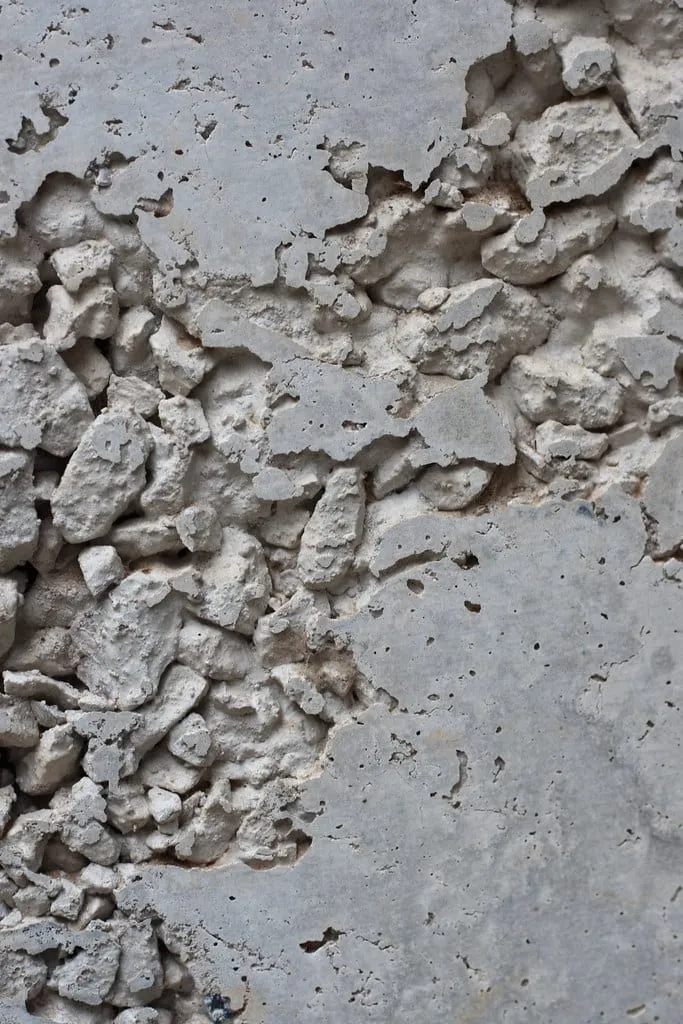
Scaling is the loss of a thin layer of surface concrete, usually a few millimetres, that leaves a rough, pitted, sometimes flaky surface where the aggregate underneath starts to show through. It's not the same as a crack, which is a structural split through the slab. It's also not a pop-out, a small cone-shaped chip where a single piece of aggregate near the surface pushes out. Scaling is broad and surface-level, like the top skin of the concrete peeled away.
It shows up almost exclusively on horizontal surfaces exposed to freeze-thaw cycling and moisture: driveways, sidewalks, and patios. A driveway in Guelph that scales usually starts at the edges near the garage apron or along the street, wherever water pools or salt concentrates, before spreading.
Why de-icing salt turns freeze-thaw into scaling
The underlying damage mechanism is freeze-thaw, not chemical attack. Concrete has microscopic pores, and pores hold water. When that water freezes, it expands by about 9%, and if there's nowhere for that expansion to go, it pushes outward against the surrounding paste. One freeze-thaw cycle rarely does visible damage. Dozens of cycles over a winter, repeated every winter for years, is what eventually breaks the surface loose.
De-icing salt makes this worse in two ways. First, it lowers the freezing point of water at the surface, so instead of the slab freezing solid all at once, a thin layer stays liquid while the layer just underneath it freezes. That creates a sharper temperature and pressure gradient right at the surface, exactly where scaling shows up. Second, salt draws more water to the surface to begin with, since a slab that's regularly salted and slushy stays wetter, longer, than one that's just exposed to snow.
A 2022 study in the peer-reviewed journal Materials tested air-entrained concrete against 3% sodium chloride solution through repeated freeze-thaw cycling. It found that the standard air-void criteria on their own, a spacing factor at or below 0.200 mm with a minimum of 1.5% micro air content, weren't enough. Concrete also needed a water-cement ratio at or below 0.50 to reliably resist salt scaling, even with roughly 5.5% entrained air. Non-air-entrained mixes needed a much lower water-cement ratio, 0.35 or below, to hold up at all. In plain terms: a driveway poured with too much water in the mix is still exposed, even if it has some air entrainment.
Air entrainment is the real defense
Air-entrained concrete has microscopic, deliberately-introduced air bubbles distributed through the paste. Those bubbles work like relief valves: when pore water freezes and expands nearby, it has somewhere to move into instead of pushing against the surrounding concrete. This is why a properly air-entrained driveway can go through 20 or 30 Ontario winters without visible scaling. A mix with no entrained air, or too little of it, can show damage in two or three seasons.
This is also why the concrete for a driveway in a heavy freeze-thaw region like Waterloo isn't the same mix you'd use for an interior slab or a warm-climate pour. A peer-reviewed study published through ASTM's Advances in Civil Engineering Materials points to ACI 318's exposure class for concrete exposed to deicing chemicals. That class sets a minimum air content of 6% and a minimum compressive strength around 4,500 psi (31 MPa), both noticeably higher than what plain, salt-free concrete needs. The same study found mixes at or above that air content and strength held up well in deicer scaling tests. But it also flagged finishing and curing practices as a significant factor: a correctly specified mix can still scale if it's finished or cured poorly. Ask a contractor directly whether the mix is air-entrained and to what target air content, not just what strength is quoted. Strength alone says nothing about freeze-thaw or scaling resistance.
When a driveway's air-void protection isn't actually there
Air entrainment fails in three common ways:
- It was never specified in the mix design.
- It was specified, but the target air content wasn't achieved or checked at the truck.
- It was achieved at the truck, but over-finishing (excessive troweling, or working the surface too long) collapsed the air voids near the surface before the concrete set.
This isn't a hypothetical problem. A 2014 Oregon Department of Transportation and Federal Highway Administration study cored existing bridge deck concrete and checked its air-void system years after construction. At least half of the sampled decks had an air-void spacing factor above 200 microns, the threshold past which concrete no longer has a properly protective air-void system, despite having been built to specification originally. Concrete's protection against scaling isn't guaranteed just because a mix ticket says "air-entrained." It has to be verified in the field, and it can degrade over the concrete's life. A driveway that scaled badly in its first few winters is more often telling you something about how it was mixed, placed, or finished than something about the salt used on it afterward.
The mistake that causes most first-winter scaling
If a brand-new driveway scales in its first winter, the most common cause isn't the mix design at all. It's de-icing salt applied before the concrete finished curing. Fresh concrete needs time, typically a minimum of 30 days and ideally a full winter season, before it's ready to handle both vehicle traffic and de-icer exposure. Salting it in the first few weeks exposes concrete that hasn't developed its full strength or its resistance to the freeze-thaw cycling salt accelerates. Sand, or a small amount of clean gravel for traction, is the safer choice on any driveway poured within the last several months.
Scaling versus other concrete damage
Homeowners often lump every kind of driveway deterioration together as "salt damage," but the causes and fixes differ. Cracking is usually a structural or base issue, not a surface one, and is worth reading up on separately if that's what you're actually seeing. Pop-outs are small, localized, and usually caused by a single porous or reactive piece of aggregate near the surface rather than a mix-wide problem. Scaling is broad, surface-level, and freeze-thaw and salt-driven, which is what this article covers.
If your driveway is stamped or has an applied colour layer, the damage looks and behaves differently from plain broom or exposed-aggregate scaling. Our guide to stamped versus exposed-aggregate concrete covers how calcium chloride de-icers specifically attack a stamped surface's colour and pattern layer, and why that finish needs a more disciplined sealing schedule than plain concrete does.
Preventing and managing scaling
Prevention starts before the pour, not after. A driveway specified with proper air entrainment, a controlled water-cement ratio, and correct finishing technique is protected from the mechanism itself, not just from its symptoms. That's the conversation worth having with a contractor before a driveway in Oakville or anywhere else in a freeze-thaw climate gets poured, not after the first winter shows problems. For the fuller picture on how a driveway gets specified, built, and maintained end to end, see our complete guide to concrete driveways in Ontario.
Once a driveway exists, a few habits meaningfully reduce scaling risk:
- Seal it on a schedule. A penetrating sealer reduces how much water and salt solution gets into the surface pores in the first place, which matters even on a properly air-entrained mix. Resealing every few years is worth the relatively small cost against the alternative.
- Choose your de-icer carefully. Straight sodium chloride (rock salt) is generally gentler on concrete than calcium or magnesium chloride blends. All of them are harder on an unsealed or poorly built surface than on a well-built, sealed one. Skip generic "ice melt" blends with unclear formulations if you're protecting a newer driveway.
- Don't over-salt. More de-icer doesn't mean faster melting past a certain point, it just means more salt solution sitting on the surface longer. Use the minimum amount that clears the ice, and shovel or plow first so the salt has less to work through.
- Watch drainage. Water that pools on a driveway instead of running off gives freeze-thaw cycling more material to work with. A driveway graded to shed water is inherently lower-risk than a flat or bird-bath-prone one, independent of the mix.
Frequently asked questions
Can scaling be repaired, or does the whole driveway need replacing?
Light, cosmetic scaling, limited to the top few millimetres, can often be resurfaced with a bonded overlay. Once scaling has exposed a lot of aggregate, or the surface is genuinely rough and crumbling, resurfacing tends not to hold up well. Replacement is the more durable fix at that point.
Is rock salt actually safe to use on a concrete driveway?
On a driveway that's properly air-entrained, cured, and ideally sealed, straight sodium chloride in reasonable amounts is one of the lower-risk de-icers you can use. The real risk was never the salt on its own. It's using any de-icer on concrete that isn't built or cured to handle the freeze-thaw cycling that salt speeds up.
How long should I wait before using de-icer on a new driveway?
At minimum 30 days. Many contractors recommend skipping de-icing salt entirely through the first winter, using sand for traction instead, if your schedule allows it. The concrete needs that time to build up the strength and internal structure to handle both traffic and the freeze-thaw acceleration that salt brings.
Does scaling mean my driveway was built wrong?
Not on its own. But a driveway that scales badly and early, within the first two or three winters, usually points to an air entrainment or curing issue, not bad luck with the weather. A driveway that only develops light scaling after 15 or 20 winters is closer to normal wear for the region.
Bottom line
Scaling is a freeze-thaw problem that de-icing salt speeds up, not a chemical attack salt causes on its own. The real defense is built into the concrete before it's ever poured: proper air entrainment, a controlled water-cement ratio, and finishing that doesn't collapse the air-void system near the surface. Once that's in place, a few habits do the rest: sealing on a schedule, choosing a gentler de-icer, and not over-salting. Get both right, and a driveway can still look the way it did the year it was poured, twenty winters later.