Key Takeaways
- Broom finish is the standard, lowest-cost option and still the right call for most driveways, at roughly $12-20/sq ft.
- Exposed aggregate and stamped both cost more ($16-28 and $20-35/sq ft respectively) because they add labour, not because the concrete itself changes.
- Colored concrete ($14-25/sq ft) is really an add-on, integral color or acid stain layered onto any of the other finishes, not a finish on its own.
- Salt finish gives a pitted, non-slip texture at close to broom-finish cost, but it's fallen out of common use because the pits trap water and de-icing salt.
- The right finish depends on the surface: driveways favour traction and low maintenance, patios favour appearance.
The short answer
Five finish options come up when homeowners plan a concrete driveway or patio: broom, exposed aggregate, stamped, colored, and salt finish. They aren't five competing versions of the same thing. Broom and salt finish are texture applied to plain concrete during the final pass. Exposed aggregate reveals the stone that's already in the mix. Stamped presses a pattern into the surface. Colored is a dye or pigment layered onto any of the above. Once you sort them into what they actually do, picking one gets a lot simpler. Homeowners in Oakville, St. Catharines, and Guelph usually end up choosing based on whether the surface is a daily-use driveway or a patio that's mostly seen, not walked on in January.
Quick comparison
| Finish | Cost (per sq ft) | Traction | Maintenance | Best for |
|---|---|---|---|---|
| Broom finish | $12-20 | Good, adjustable by broom pressure | Low | Driveways, walkways, any daily-use surface |
| Exposed aggregate | $16-28 | Very good, built into the material | Low | Driveways, pool decks |
| Stamped | $20-35 | Fair to poor once sealer builds up | High (reseal every 2-3 years) | Patios, entryways, pool surrounds |
| Colored (add-on) | $14-25 | Depends on the base finish it's applied to | Medium to high | Patios, accent bands, entry walks |
| Salt finish | $12-20 | Good when fresh, degrades as pits fill in | Medium | Pool decks, older-style patios (less common now) |
GTA jobs tend to land near the top of each range; base excavation and reinforcement don't change with the finish, so a lot of the spread above is the finish's own labour cost.
Broom finish: the default for a reason
Broom finish is what most people picture when they picture a "concrete driveway." A crew floats the surface, then drags a stiff-bristled broom across it while it's still plastic, leaving a pattern of fine parallel lines. It's the least expensive finish, the fastest to apply, and it gives you real, adjustable traction: a heavier broom pass digs deeper grooves for more grip, a lighter pass leaves a smoother, more refined texture. The National Ready Mixed Concrete Association's finishing guide recommends exactly this for exterior flatwork, texturing the surface with a push-broom after floating specifically to produce a non-slip result, before any decorative treatment like colour or stamping goes on top.
The tradeoff is that it's plain. There's no colour variation and no pattern beyond the brush lines themselves. For a daily-use driveway where the surface needs to perform in Ontario winters more than it needs to look distinctive, that plainness is the point, not a downside.
Exposed aggregate: texture built into the material
Exposed aggregate takes the same poured concrete and washes or brushes away the top layer of cement paste before it fully cures, exposing the stone aggregate that's already mixed into the concrete. That gives you a surface where the grip and the visual texture are structural, not applied afterward, so wear over the years shows up far less than it does on a finish that sits on top of the surface. Our comparison of stamped versus exposed aggregate covers this finish against stamped in more depth, including how each one holds up through a full freeze-thaw winter, if you're deciding between just those two.
Stamped concrete: the finish for pattern control
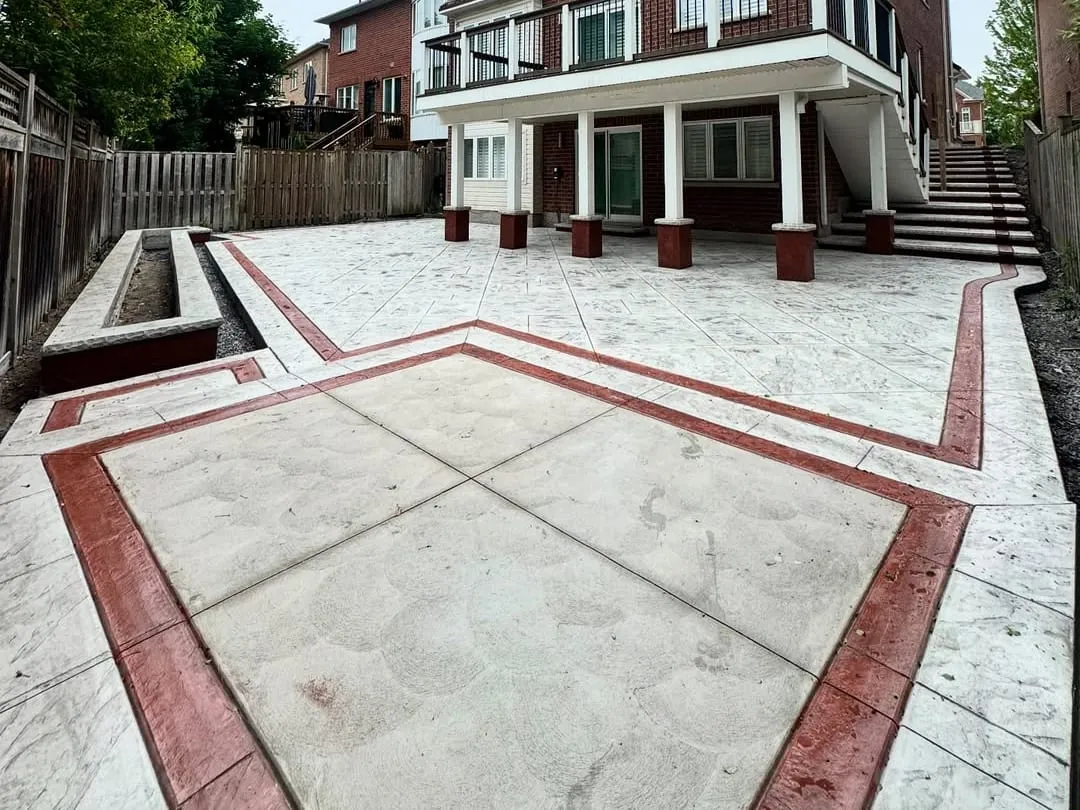
Stamped concrete presses texture mats into the surface while it's still workable, usually with a release agent and a colour layer, to imitate flagstone, slate, cobblestone, or brick. Nothing else on this list gets you a specific, repeatable pattern. That's why it's the common choice for patios, pool decks, and entryways, where the finish is doing design work rather than structural work.
The cost of that design control is maintenance. The pattern lines and colour layer both sit at the surface, so they need resealing every 2 to 3 years to hold up against UV fading and de-icing salt. Skip a few winters of resealing and the pattern edges start to chip well before the concrete underneath is at any real risk.
Colored concrete: an add-on, not a fifth option
Colored concrete isn't really a separate finish category. It's either an integral color mixed into the concrete before the pour, or an acid stain or dye applied to the surface afterward, and it can be layered onto a broom, exposed aggregate, or stamped base. Most colored driveways and patios are colored stamped concrete, because the two together give you both pattern and a specific tone. A plain broom-finished surface with integral color is less common but still done, usually on a patio or entry walk where a homeowner wants a warm tone without the cost of stamping.
Because the colour sits at or near the surface either way, it inherits whatever maintenance schedule the base finish already needs, plus its own UV fading risk. An unsealed colored surface fades faster than an unsealed plain one.
Salt finish: the option that's fallen out of favour
Salt finish works by broadcasting rock salt crystals onto the fresh concrete surface, pressing them in, then washing them out once the concrete sets, leaving a pattern of small pits. It gives good traction while it's new, at a cost close to broom finish, which made it a common patio and pool-deck choice for decades.
It's seen a lot less on new work now, for a straightforward reason: the pits that give salt finish its texture also trap water and de-icing salt, and they fill in with dirt and debris over time in a way a broom-finished surface doesn't. Most contractors in freeze-thaw climates now recommend broom or exposed aggregate over salt finish for any surface that needs to hold up over the long term.
Traction: exposed aggregate and broom finish lead
For a surface that gets walked or driven on through an Ontario winter, exposed aggregate and broom finish are the two to choose between. Both build the grip into the material itself rather than a surface treatment, so the texture doesn't wear away or get sealed over. Stamped concrete can be textured too, but its grip depends on how deep the mats pressed and how much sealer has built up on top; a heavily sealed stamped surface can get slick when wet in a way a broom-finished one doesn't.
Cost: what you're actually paying for
Every finish starts from the same base cost: excavation, a compacted granular base, and a properly reinforced pour. That part doesn't change regardless of which finish goes on top. What separates a $12/sq ft broom-finished driveway from a $35/sq ft stamped one is labour, the time it takes a crew to stamp, colour, and seal a surface versus running a broom across it once. Exposed aggregate sits in between because washing and exposing the aggregate takes real skill and timing, but it doesn't require a colour layer or sealing schedule the way stamped does.
Maintenance over the years
Broom finish and exposed aggregate are both close to maintenance-free: an occasional pressure wash, and optionally a penetrating sealer every 3 to 5 years to guard against staining. Stamped and colored concrete need a real schedule, resealing every 2 to 3 years to protect the pattern and colour layer, plus more care about which de-icer touches the surface near it. Salt finish sits in the middle: no colour layer to protect, but the pits need more regular cleaning to keep grime and salt from settling in.
Which finish fits your project
A daily-use driveway: broom finish or exposed aggregate. Both prioritize traction and low maintenance over pattern, which matters more over a 20-plus year lifespan than the design options you'd be giving up.
A patio, pool deck, or entryway: stamped, with or without integral colour. It's a space designed to look a certain way, and it doesn't take the daily winter traffic a driveway does.
A full front-yard package (driveway, walkway, entry steps together): most homeowners split the finishes, broom or exposed aggregate on the driveway, stamped or colored on the walkway and entry, tied together with a shared border or accent band. Our complete guide to concrete driveways in Ontario walks through how that split fits into planning a driveway project end to end.
A pool deck specifically: exposed aggregate or stamped, not salt finish. The pits in a salt-finished surface hold pool chemicals and water in a way that shortens its lifespan around a pool.
Frequently asked questions
What's the cheapest concrete finish?
Broom finish and salt finish are both close to the same cost, generally $12-20/sq ft, because both are applied during the same pass rather than needing a separate stamping or colouring step.
Is exposed aggregate the same as stamped concrete?
No. Exposed aggregate reveals the stone already mixed into the concrete by washing away the top layer of cement paste. Stamped concrete presses a pattern into the surface using texture mats. They're often compared because both cost more than plain broom finish, but they achieve the look in opposite ways.
Can I combine finishes on one property?
Yes, and it's common. A typical split is broom or exposed aggregate on the driveway for traction, stamped or colored on the patio and entry for appearance, usually tied together with a matching border.
Does colored concrete cost more than plain concrete?
Yes, generally $14-25/sq ft versus $12-20 for plain broom finish, because integral colour and stains both add material and labour cost on top of the base pour.
Why don't contractors use salt finish as much anymore?
The pits that give salt finish its grip also trap water and de-icing salt over time, which shortens its lifespan compared to broom finish or exposed aggregate in a freeze-thaw climate. It still shows up on some pool decks and older-style patios, but it's less common on new driveway work.
Bottom line
Start with what the surface needs to do. A driveway that sees daily traffic through an Ontario winter needs traction and low maintenance first, broom finish or exposed aggregate. A patio or entryway that's designed to look a certain way can prioritize pattern and colour, stamped with or without an integral tint. Salt finish still has a place on some pool decks but has mostly been replaced by exposed aggregate for new work. If you're planning a full property and want to see these finishes side by side, our concrete driveway gallery has real examples from recent jobs.