Key Takeaways
- Resurfacing bonds a thin new layer to your existing slab. It only works if that slab is still structurally sound underneath, resurfacing over a failing base just brings the failure back to the surface faster.
- Full replacement removes the driveway down to the base and rebuilds it, the right call once there's structural cracking, settlement, or a base problem, not just surface wear.
- Cost per square foot favours resurfacing, but the honest comparison is cost per year of service, and that math often favours replacement once a driveway is genuinely past its structural life.
The short answer
If the concrete underneath is sound and the problem is cosmetic, wear, staining, minor surface pitting, resurfacing is the right call. If the problem is structural, cracks that run through a panel rather than sitting inside a joint, a sunken or tilted section, or a base that's clearly moved, resurfacing won't fix it and full replacement is the only real option. Homeowners in Guelph, Kitchener, and Niagara Falls ask us this exact question every spring after a rough winter, and the answer almost always comes down to what's happening below the surface, not what it looks like on top.
What resurfacing actually is
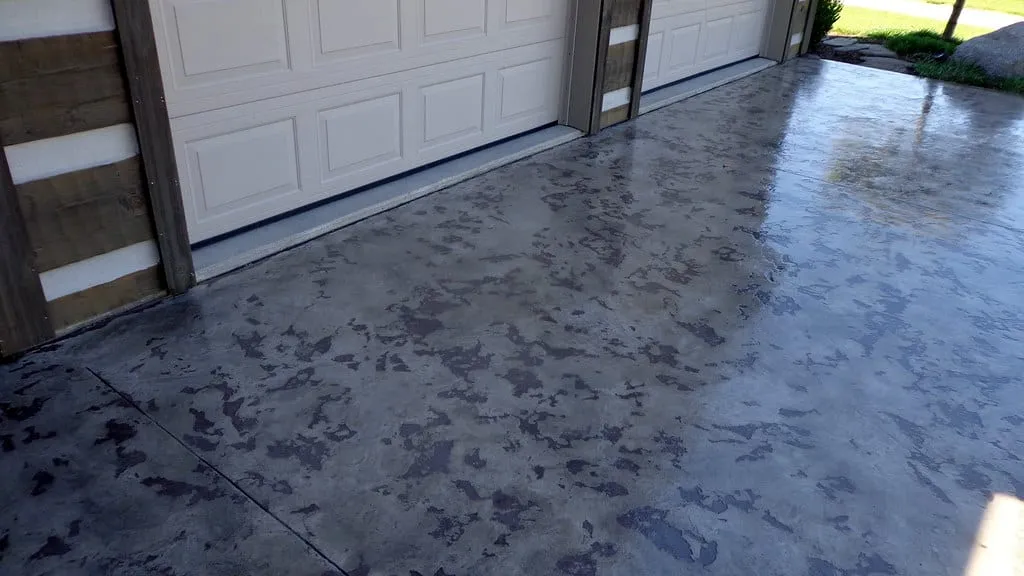
Resurfacing means bonding a new layer, typically a polymer-modified concrete overlay somewhere between an eighth of an inch and two inches thick, directly onto the existing slab. Done properly, the crew grinds or shot-blasts the old surface to expose sound concrete and create enough texture for the new layer to mechanically key into it, then places the overlay while the bond is fresh. The result can look like a brand-new driveway, including a stamped pattern or a new colour, at a fraction of what a full tear-out costs.
The catch is baked into how bonding works. Every credible engineering source on concrete overlays treats bond integrity as the whole game: the new and old layers have to behave as one monolithic slab, or stress concentrates at whatever's weakest and the overlay delaminates. Pavement Interactive's overlay reference puts it plainly, the surface has to be mechanically roughened so the new layer can key into the old one and the two behave as a single structure. That only works when the old structure is still, in fact, structurally intact.
What full replacement actually is
Full replacement is exactly what it sounds like: the existing slab comes out, the crew re-evaluates and re-compacts the base underneath, checks or replaces drainage and grading, places new reinforcement, and pours a new driveway from the ground up. It's the same process as a first-time driveway install, just with a demolition step in front of it. Our complete guide to concrete driveways in Ontario covers that full build sequence, excavation, base, reinforcement, pour, finish, in more detail if you want the whole picture of what a rebuild involves.
Replacement costs more up front because you're paying for demolition and disposal on top of a full new install. What you get in exchange is a fresh 25-to-30-year service life built on a base that's actually been inspected and fixed, rather than a cosmetic layer bonded on top of whatever's still wrong underneath.
The real question: is the problem on the surface or under it
This is the entire decision, and it's worth being blunt about it: resurfacing is a surface-level fix, and it can only solve surface-level problems. Staining, minor pitting, dulled colour, a worn or outdated finish, these live entirely at the surface and resurfacing addresses them directly. A cracked slab, a settled panel, or a base that's shifted are structural problems, and bonding a new layer on top doesn't change what's happening underneath. Within a season or two, whatever moved the old slab moves the new layer too, and now you've paid for an overlay that failed on the same timeline the original crack would have widened on its own.
We wrote a full breakdown of when a cracked driveway needs repair versus replacement if cracking specifically is what's driving the question. The short version that matters here: hairline cracks sitting inside a control joint are normal and don't rule out resurfacing, but a diagonal crack running across a panel, outside any joint line, is a structural signal that points toward replacement, not a cosmetic one that resurfacing can bridge.
Signs resurfacing can actually fix
- Surface staining from oil, rust, or years of de-icing salt that a pressure wash and sealer haven't solved
- A worn, dulled, or outdated broom or stamped finish where the underlying slab is otherwise flat and sound
- Minor surface pitting or scaling from a rough winter or two, without cracks running through it
- A driveway that's structurally fine but you want a different look, colour, or texture without a full rebuild
Signs that mean you need full replacement
- Cracks that run across a panel rather than sitting neatly inside a joint line
- A section that's visibly sunken, heaved, or sits at a different level than its neighbours
- Multiple panels affected, rather than one isolated spot
- Water pooling on the surface because the grade itself has shifted, not just a puddle from a low finish
- A driveway that's already had one resurfacing attempt fail within a few years, which usually means the underlying problem was never actually fixed
If more than one of these applies, resurfacing is very likely to be money spent on a problem that comes back, and a straight replacement conversation is the more honest one to have.
What it actually costs, and what that number is missing
Resurfacing typically runs a fraction of full replacement per square foot, since there's no demolition, disposal, excavation, or new base and reinforcement to pay for. That's the number most homeowners lead with when comparing quotes, and on its own it makes resurfacing look like the obvious choice.
The number that actually matters is cost per year of service, not cost per square foot. A resurfaced driveway over a sound base can last well over a decade, close to what a broom or exposed-aggregate finish on new concrete would give you. A resurfaced driveway over a compromised base buys you a few good-looking years before the same underlying problem reads back through the surface, at which point you're paying for a full replacement anyway, on top of what you already spent on the overlay. Getting an honest read on the base before committing to either option is the part of the quote worth insisting on, not the per-square-foot price on its own.
Freeze-thaw makes this decision less forgiving in Ontario
A thin overlay has less mass to absorb the freeze-thaw cycling that defines an Ontario winter, and Ontario driveways go through dozens of those cycles every season. A peer-reviewed study in The Scientific World Journal found that air-entrained concrete resists freeze-thaw deterioration measurably better than concrete without it, holding up through 300 freeze-thaw cycles at typical residential mix strengths in lab testing. That finding applies to a new full-depth pour where air entrainment is specified into the mix. A thin resurfacing overlay is a different product with a different tolerance for that cycling, which is exactly why a resurfacing job over a base that's already showing frost heave or drainage problems tends to fail faster here than the same overlay would somewhere with a milder winter. The climate doesn't just make the underlying base problem worse over time, it shortens the runway a cosmetic fix buys you.
De-icing salt adds a second, separate risk to the bond line itself. NIST research published in Cement and Concrete Composites found that calcium chloride de-icer reacting with cement paste can form calcium oxychloride, an expansive compound that damages concrete once concentrations pass roughly 11% by mass, and it does that damage at temperatures above freezing, not just during a freeze-thaw cycle. That reaction doesn't care whether it's happening in a full-depth slab or a thin overlay, but a thin overlay has less material to absorb it before the damage reaches the bond interface and starts working the new layer loose from the old one underneath.
Who should choose what
A homeowner with a driveway that's structurally sound but looks worn or dated: resurfacing is the right call, and it's genuinely good value, a new finish and colour without paying for a rebuild you don't need.
A homeowner with visible cracking across panels, settlement, or a driveway that's already failed once after a previous repair: replacement is the honest answer, even though it costs more up front. Resurfacing here is money spent buying a couple of years, not a fix.
A homeowner who isn't sure which category they're in: that's worth an actual inspection rather than a guess based on how the surface looks, since the two problems can look similar from a distance and only diverge once someone's checked what's happening at panel edges, joints, and any low or sunken spots.
A homeowner in Guelph, Kitchener, Niagara Falls, or anywhere else that sees a real winter: budget resurfacing as a shorter-term option than it would be somewhere with a gentler climate, and don't resurface a driveway that already shows drainage or frost-heave problems expecting the new layer to outlast the conditions that damaged the old one.
Frequently asked questions
How long does a resurfaced driveway last compared to a new one?
A resurfaced driveway over a genuinely sound base can last a decade or more, though it's still a thinner layer than a full new pour and typically doesn't match the 25-to-30-year lifespan of a properly built new driveway. A resurfaced driveway over a compromised base can fail within a couple of years, since the overlay never addressed what was actually wrong.
Can any driveway be resurfaced, or does it depend on the crack pattern?
It depends on what's causing the cracks, not just how many there are. Hairline cracks inside control joints and isolated surface issues are usually fine to resurface over. Structural cracking that runs across panels or an uneven, settled base means the same problem will come back through the new layer.
Is resurfacing a good option before selling a house?
It can be, if the base is genuinely sound and the goal is curb appeal rather than fixing a real problem. It's a worse idea if an inspection during the sale process is likely to catch the underlying issue anyway, since a buyer finding out a resurfacing job covered a structural crack is a worse outcome than having addressed it upfront.
Does resurfacing require the same base work as a new driveway?
No, that's the entire point of resurfacing, it bonds to the base that's already there instead of rebuilding it. That's also exactly why it only works when that existing base is sound. If the base needs work, you're back to a full replacement regardless of what happens at the surface.
Bottom line
The question isn't really "resurfacing or replacement," it's "is the problem on the surface or underneath it." A worn, stained, or dated but structurally sound driveway is a great candidate for resurfacing, and there's no reason to pay for a full rebuild you don't need. A driveway with real structural cracking, settlement, or a compromised base needs replacement, and resurfacing over that problem just delays the same conversation by a year or two at extra cost. If you're not sure which one describes your driveway, that's worth a real look before either project starts, not a guess based on how bad the surface looks from the front step.