
Concrete walkways in Kitchener
A Kitchener driveway can spend a stretch of deep winter under a plow bank with hardly a boot on it. The front walkway never gets that rest: it is salted on a routine schedule for safety and carries every trip to the door through the exact weeks freeze-thaw is hardest on concrete, which is why we build every Kitchener walkway to the same 32 MPa, air-entrained spec used on any exterior flatwork facing that exposure, not a lighter mix on the theory that a footpath matters less than a driveway.
Jointing follows the walkway's own shape rather than a driveway's. A standard-width path only needs transverse joints across it, spaced roughly two to three times the slab thickness in feet, to control shrinkage cracking, so it skips the centreline joint a broader driveway or patio slab relies on. We bring rebar into the layout specifically at grade changes or old trench crossings, since a long, narrow run is more likely to cross varied ground than a single compact pad.
Kitchener's own housing stock shapes a lot of the walkway work we do here. The city's biggest single band of homes dates to 1961-1980, a bigger share of that era than any other city we serve, and a walkway poured in that period is more often narrow, thin, and laid with no isolation joint at the porch than a newer one is. Ground beneath most of Kitchener is the same layered sand, gravel and clay found across Waterloo Region, which drains reasonably well but varies enough along a lot's length that we compact and grade the base evenly over the whole run. With Dufferin's own plant a short drive away on Forwell Road, we rarely have to build extra delivery time into a Kitchener schedule the way we do in a city with no local supplier.
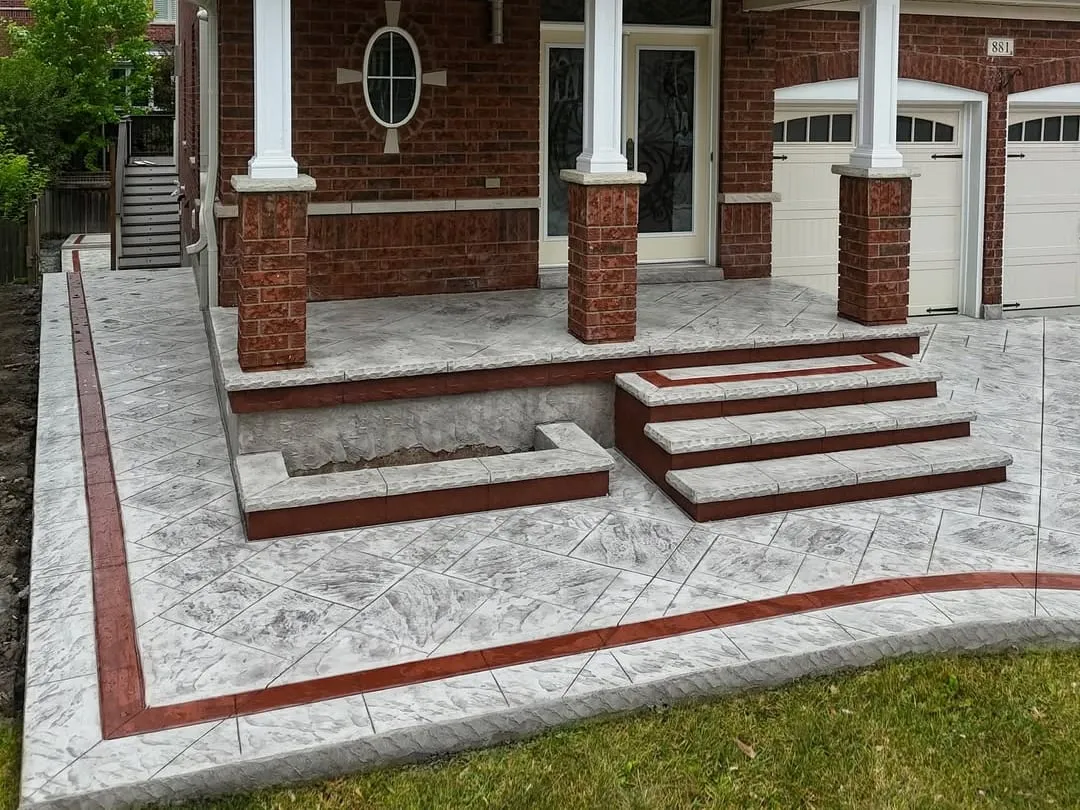
We serve Forest Heights, Stanley Park, and Doon, and often extend a walkway job into concrete steps at the entrance or a patio out back. See everything we build across our Kitchener service area.
Thin paths from the 1961 to 1980 band, laid narrow and with no isolation joint at the porch, are most of what we tear out here; the balance tips toward newer builds on concrete walkway installation in Waterloo and back toward older ones on poured walkways in Cambridge.
The same narrow-slab heave problem turns up on London clay with a heritage question attached on the older streets, covered on concrete walkways in London.