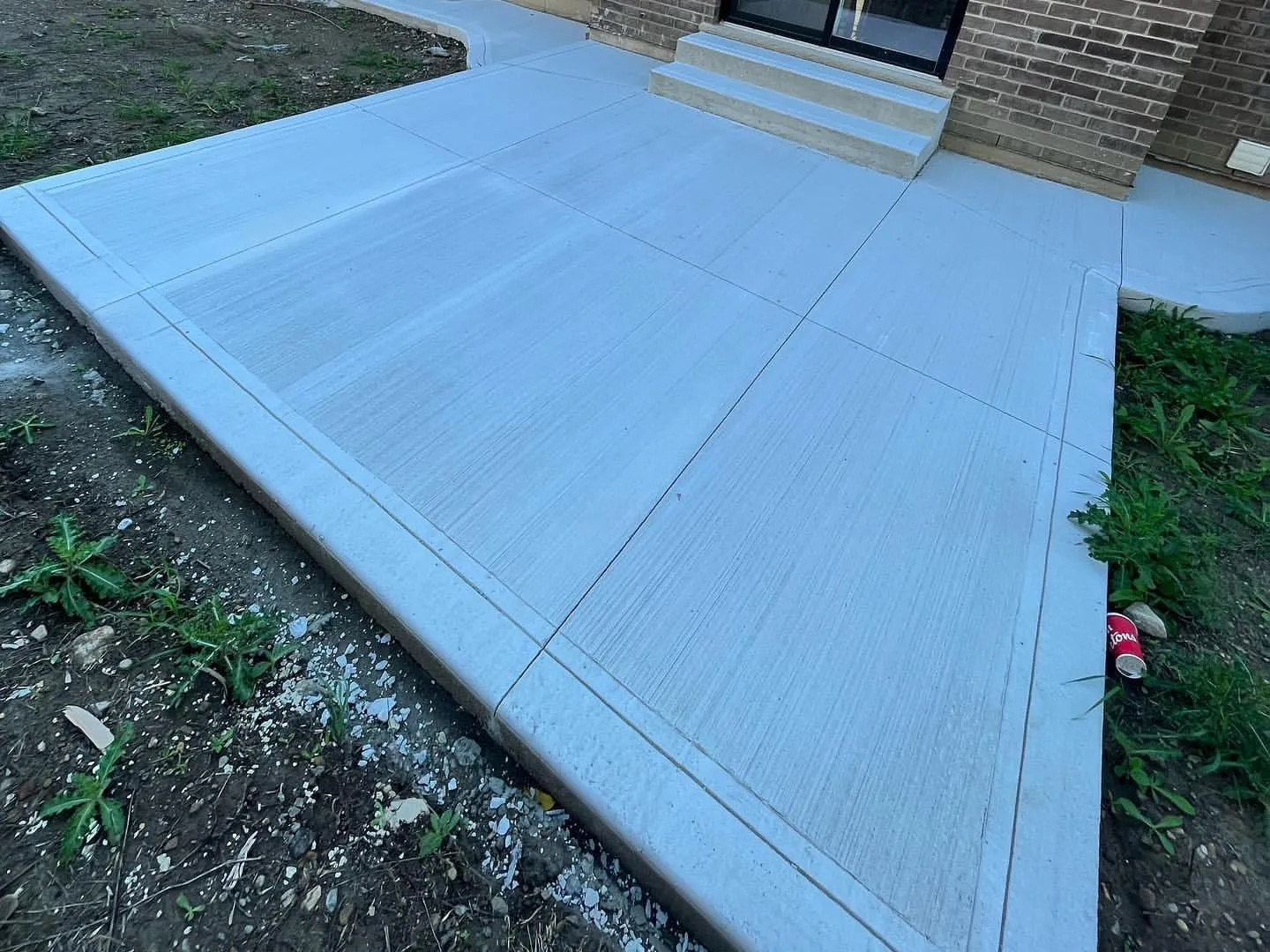
Key Takeaways
- Concrete costs more to install, roughly $12 to $30 per square foot depending on finish versus a wood deck's wider $15 to $50 range, but a properly built concrete patio commonly reaches 25 to 30 years with little more than occasional sealing, while cost guides put a pressure-treated wood deck at 10 to 15 years.
- The bigger cost difference isn't the pour or the build, it's what happens every year after. A concrete patio can go years without attention. A wood deck needs its finish renewed on a much shorter cycle or it starts greying and splitting well before the structure itself fails.
- Grade decides more than price does. A patio sitting at grade generally skips the permit and guard requirements that an elevated deck triggers the moment it's more than 600 mm off the ground, which is often the real reason a sloped or walkout lot ends up with a deck regardless of what the 20-year math says.
The short answer
Your yard decides more of this answer than the price sheet does. A concrete patio costs more to pour but asks almost nothing of you afterward for decades. A wood deck costs less to build in its simplest form but comes with a recurring maintenance bill, a shorter working life, and one real structural advantage neither concrete nor money can match: it can sit six feet in the air over a sloped yard without an excavator involved.
Decks aren't work we take on ourselves, which means every wood figure below comes from a named cost guide rather than our own invoices, flagged that way throughout. That's the same standard we'd expect from a deck builder writing the concrete side of this comparison.
Quick comparison
| Concrete patio | Wood deck | |
|---|---|---|
| Typical install cost | $12 to $30/sq ft, finish-dependent | $15 to $25/sq ft (pressure-treated), $28 to $40/sq ft (composite), more once elevated |
| Typical lifespan | 25 to 30 years | 10 to 15 years (wood), around 20 (composite) |
| Maintenance | Little to none on broom or exposed aggregate; sealer every 2 to 5 years on coloured or stamped work | Recurring cleaning and refinishing on a much shorter cycle than a concrete sealer |
| Best sited | Flat or gently sloped yard, at or near grade | Sloped yards, walkouts, uneven grade, elevated decks over anything |
| Permit trigger | Usually none for an at-grade slab; zoning setback and coverage rules still apply | Typically required once attached to the house or elevated, guards required above 600 mm |
| Lowest 20-year cost of ownership | Concrete | |
| Lowest upfront cost on a flat, ground-level build | Wood deck |
What each one actually costs to install
Concrete patios currently run $12 to $20 per square foot for a broom finish, $15 to $25 for exposed aggregate, and $18 to $30 for stamped concrete, the same pricing we quote in Oakville, Waterloo, and St. Catharines, and Toronto-area jobs tend to sit toward the upper end of each range. Every one of those finishes is built to the same exposure class C-2 mix, 32 MPa and air-entrained, so the price difference is texture and forming labour, not durability. Our complete guide to outdoor concrete in Ontario breaks that spec down finish by finish.
Wood decks don't have a single number, because so much depends on whether the deck sits on the ground or in the air. Neither Canada nor Ontario publishes an authoritative residential deck price, so the closest usable figure is a U.S. cost guide: Fixr puts a pressure-treated wood deck at $15 to $25 per square foot installed and a composite deck at $28 to $40, with ground-level platform decks running as low as $10 to $30 and a raised deck with footings and railings climbing to $25 to $50. Those figures are in U.S. dollars, and Canadian labour typically pushes actual quotes toward the higher end. The spread exists because a deck's cost isn't really about square footage, it's about how much structure is holding that footage up: footings, joists, and railings get added to a raised deck that a patio, sitting on compacted base instead, never needs.
Verdict: concrete costs more for a comparable ground-level footprint, but the gap narrows or reverses the moment the deck has to be elevated.
How long each one actually lasts in an Ontario winter
Install cost is the smaller number here. Lifespan is where the two surfaces separate.
A concrete patio built to the standard spec commonly reaches 25 to 30 years, the same range we build our concrete driveways to, since the mix and the freeze-thaw exposure are identical even though a patio never carries a vehicle. Air-entrained concrete resists the freeze-thaw scaling that would otherwise flake the surface apart one winter at a time, and once that's built in correctly there's no clock running down the way there is on a wood surface.
A pressure-treated wood deck typically lasts 10 to 15 years, and a composite deck around 20, according to Fixr's cost analysis. Those figures aren't Ontario-specific, and our winters aren't gentle on exposed wood: freeze-thaw cycling works the fasteners and joints, snow load sits on the structure for months, and spring thaw finds every joint that wasn't flashed properly. A well-built and maintained deck lands at the top of that range. One that's neglected, or built on ledger flashing that was never sealed against the house, lands at the bottom of it, sometimes well before.
Verdict: concrete outlasts wood by a wide margin in this climate, built into how each material actually responds to a freeze-thaw winter.
What maintenance actually costs over 20 years
This is the number that changes the comparison, and the one homeowners underestimate most.
A broom-finished or exposed-aggregate patio needs essentially nothing to survive. An optional penetrating sealer every 3 to 5 years reduces staining and slows how much salt and water reach the surface, but skipping it doesn't threaten the slab the way skipping maintenance threatens a deck. A stamped or coloured patio does need a maintained film-forming sealer, on roughly a 2-to-3-year cycle, since the colour and pattern lines live at the surface where sun and de-icer reach them, the same logic behind sealing a concrete driveway. Over 20 years that's somewhere between zero and about eight sealer applications, a few hundred dollars each for a typical patio.
A wood deck's maintenance clock runs shorter than a concrete sealer's, full stop. The exact interval depends on stain type, wood species, and how much direct sun and rain the deck sees, but the practical reality is a wood deck needs its surface checked and likely refinished multiple times over the same 20 years a broom-finished patio needs almost nothing. Skip that upkeep and the deck doesn't fail quietly. It greys, splinters, and lets water sit in joints that start rotting the joists underneath, a structural repair rather than a cosmetic one.
Verdict: concrete's maintenance bill over 20 years is close to zero for a plain finish and modest for a decorative one. A wood deck's maintenance bill is recurring, visible, and compounds if it's ever skipped for a season or two.
Grade-level siting versus an elevated deck
Cost and lifespan assume you can choose either surface, and plenty of yards don't allow it.
A concrete patio wants a flat or gently sloped yard at or near the existing grade. It can be stepped down a slope with retaining work, but every added foot of grade change adds excavation, forming, and cost, and a patio can't float over a drop the way a deck can. That's the real reason a walkout basement or a house sitting well above its rear yard so often ends up with a deck rather than a patio: the deck's posts and beams span the height difference in a way poured concrete can't without becoming a retaining wall project first.
A wood deck's entire structural advantage is sitting above uneven or sloping ground on a handful of footings, which is also why its permit and safety requirements look nothing like a patio's. Once you're set on a patio and just working out layout on a smaller lot, small backyard concrete patio ideas covers that side of it, and where the water goes once the slab is in is its own question, covered in full in our guide to patio grading and drainage.
Verdict: on a flat lot, this is a genuine choice. On a sloped or walkout lot, the site itself often picks the deck before cost enters the conversation at all.
Permits, guards, and what triggers a call to the building department
An at-grade concrete patio usually doesn't trigger a standalone building permit, though zoning by-laws still cap lot coverage and set the slab back from property lines, and a heritage district or nearby watercourse can add its own review. A wood deck is a different case the moment it's attached to the house or lifted off the ground: decks, unlike at-grade patios, normally do require a permit. Ontario's guard rule, explained for homeowners by Green Building Canada, kicks in at a 600 mm rise above grade, requiring a rail at least 900 mm high up to a 1.8-metre drop and 1070 mm past that, the same threshold our guide to concrete steps and the building code walks through in full, since the rule applies to any raised walking surface, not just stairs. A deck footing also has to go below the frost line, the same 1.2-metre minimum that governs any unheated point support in this region, a real cost and schedule item a patio's compacted base doesn't carry.
None of this is universal by municipality, so confirm the exact permit threshold with your local building department before assuming either surface is exempt. The pattern holds regardless: a patio's approvals are mostly a zoning and drainage question, a deck's are a structural and life-safety question the moment it leaves the ground.
Resale and appraisal: does either one add more value
Neither surface comes with a fixed, guaranteed dollar-for-dollar return, and any number claiming otherwise is a rough industry average, not an appraisal. Appraisers accredited through the Appraisal Institute of Canada weigh an outdoor structure as part of the property's overall condition and its comparables in that market, not as a line item with its own markup, so a well-built patio and a well-built deck both help a sale mostly by making the yard read as usable space, not because either appraises for a guaranteed premium.
What does show up consistently is that the higher-maintenance option carries more resale risk once it's neglected. A grey, splitting deck reads as deferred maintenance to a buyer's inspector in a way a plain concrete patio, which doesn't age the same way structurally, usually doesn't.
Who should choose what
A flat or gently sloped backyard, and you want to deal with the surface once: concrete. The higher install cost is offset by decades of minimal upkeep, and that math gets better the longer you plan to own the house.
A sloped yard, a walkout basement, or a rear yard well below the house: a deck, largely because concrete can't span that height change without becoming a retaining-wall job first. Budget for the guard, the footings, and a real maintenance routine going in.
A tight renovation budget and a flat yard: a ground-level wood deck is genuinely the cheaper entry point, provided you're realistic about the refinishing schedule that comes with it.
A pool in the yard: most pool surrounds in this climate are concrete rather than wood, since a wet, barefoot surface next to chlorinated water favours a textured, slip-resistant slab over decking that stays damp and slick longer after use.
Frequently asked questions
Is a concrete patio always cheaper than a wood deck long-term?
Almost always for a comparable ground-level footprint, since concrete's 25-to-30-year lifespan and minimal upkeep beat a wood deck's shorter life and recurring refinishing over any 20-year window. The exception is a deck elevated well above grade, where the extra structure narrows the price gap on day one even if concrete still wins on upkeep afterward.
Can I build a concrete patio on a sloped yard?
Yes, with retaining work or a stepped design, but every added foot of grade change adds excavation, forming, and cost. Past a certain slope, a deck's posts and beams handle the height change more economically than poured concrete does.
Does a wood deck really need a permit if a patio doesn't?
Generally yes. An at-grade patio is mostly a zoning and drainage question, while a deck attached to the house or raised off the ground typically needs a permit, plus a guard once it's more than about 600 mm above grade. Confirm the exact threshold with your local building department before assuming either way.
Bottom line
Concrete costs more to pour and wood costs more to keep. Over 20 years, a properly built patio asks for little beyond occasional sealing, while a wood deck carries a recurring maintenance bill and a shorter working life in this climate, even before the guard and footing requirements that come with any deck built more than 600 mm off the ground. The deciding factor is often the yard itself: flat ground makes this a genuine cost-and-maintenance decision, while a sloped or walkout lot tends to pick the deck before either number matters. If concrete is the fit, see what we build across the region or browse our concrete patio service for finish and pricing details.