A kitchen renovation quote usually arrives as one number. What's harder to get is a sense of how that number splits up: how much is cabinets, how much is labour, and how much is the electrical work nobody thinks about until the panel needs upgrading. That split matters because it shows where a budget has room to flex and where it doesn't. Cut the wrong line item and you save almost nothing. Cut the right one and you keep the kitchen you actually wanted.
Key Takeaways
- Cabinetry is the single largest line item in almost every kitchen renovation budget, typically 25 to 40 percent of the total, followed by labour and appliances.
- Ontario kitchen renovations currently run roughly $150 to $400+ per square foot, with most mid-range projects landing between $250 and $350. Toronto and the surrounding GTA run 10 to 25 percent higher than smaller Ontario cities.
- Permits, electrical and plumbing rough-in, and Ontario's 13 percent HST are real costs that a lot of first-pass estimates leave out of the headline number, and they add up to more than people expect.
- A contingency of 10 to 15 percent isn't optional padding. It's the line that absorbs what a wall opens up to reveal, which on an older Ontario home is close to a certainty rather than a risk.
Where the money actually splits, by category
The National Kitchen and Bath Association tracks how renovation dollars divide across a typical project, and its breakdown is the closest thing the industry has to a standard reference. The percentages below come from NKBA's published cost guidelines, cited by Kitchen Cabinet Kings and echoed across the trade:
| Category | Share of total budget |
|---|---|
| Cabinetry and hardware | 29% |
| Installation and labour | 17% |
| Countertops | 10% |
| Appliances and ventilation | 14% |
| Flooring | 7% |
| Lighting | 5% |
| Walls and ceiling | 5% |
| Design fees | 4% |
| Faucets and plumbing | 4% |
| Doors and windows | 4% |
| Other | 1% |
Cabinetry alone accounts for close to a third of the budget on a typical project. Some sources put its realistic range as wide as 25 to 40 percent, depending on whether the cabinets are stock, semi-custom, or fully custom. That single category usually determines more of the final number than any other decision in the project, including the appliance package.
Two things are worth noting about this table before applying it to a real budget. First, it's a national average built mostly from U.S. data, so it's a starting shape for a budget, not a substitute for a quote against a specific Ontario kitchen. Second, it describes a full kitchen renovation with new cabinets, counters, and appliances. A refresh that keeps the existing cabinet boxes and only replaces doors, counters, and hardware moves these percentages considerably. The largest line item shrinks to a fraction of what a full cabinet replacement costs.
What a real Ontario kitchen renovation costs today
Percentages only mean something once they're attached to a real number, and that number has moved. Ontario kitchen renovations currently run $150 to $400 or more per square foot, with most mid-range projects landing between $250 and $350. A basic refresh sits toward the low end of that range; a full gut with custom cabinetry and mechanical changes sits at the high end. A small kitchen typically costs more per square foot than a large one, because plumbing, electrical, and appliances don't get cheaper just because the room is smaller.
Regional differences inside Ontario are real too. Toronto and the immediately surrounding GTA municipalities typically run 10 to 25 percent higher than smaller Ontario cities, driven by higher labour rates and permit costs. Homeowners in Guelph, Waterloo, and Oakville are working with different baseline costs even for the same scope of work. That's part of why a single national average is a rough guide at best. Each of those city pages has our current pricing for that market. It's worth checking those numbers against the ranges here rather than assuming one city's pricing applies to another.
At the national level, the 2025 U.S. Houzz Kitchen Trends Study put the median spend on a major kitchen remodel at $60,000, with the top 10 percent of spenders putting in $180,000 or more. Kitchens of 250 square feet or larger run higher still: a median of $72,000 for a major remodel, and $200,000 or more at the top end. That range is a reminder that "average kitchen cost" covers an enormous span depending on scope, finish level, and square footage, not a single expected number. Angi's 2025 cost data puts a typical U.S. kitchen remodel between $14,592 and $41,595, averaging around $27,013. That range sits below Ontario's current per-square-foot numbers once local labour and permit costs are factored in.
The costs that don't show up in the first estimate
A lot of early budgets are built around cabinets, counters, and appliances because those are the visible, easy-to-price decisions. Three costs consistently get underestimated or left out entirely until later in the process.
Permits and trade permits. A kitchen renovation that moves plumbing, changes electrical, removes a wall, or alters the layout needs a building permit. Municipal permit fees in Ontario generally run $10 to $15 per $1,000 of construction value, on top of separate trade permits. An Electrical Safety Authority permit for the electrical work typically costs $150 to $400, and a plumbing permit runs roughly $100 to $300. In several GTA municipalities, trade permits for electrical, plumbing, or HVAC work add another $475 to $1,085 per trade once that scope exceeds $5,000 in value. None of that is optional if the work genuinely touches those systems. All of it needs to be a line in the budget, not an afterthought.
Electrical and plumbing rough-in. A kitchen renovation that relocates the sink, adds an island with its own circuits, or upgrades an aging panel involves real rough-in labour before a single cabinet goes in. This is part of the 17 percent labour and 4 percent plumbing lines in the table above. It's easy to underestimate how much of that work happens behind the walls before anything visible changes.
HST. Ontario charges 13 percent HST on a contractor's full invoice, labour, materials, and project management included. A $60,000 renovation quoted before tax becomes $67,800 once HST is added. It's worth confirming up front whether a quote is presented before or after tax. That gap is often the difference between a budget that holds and one that runs short in the last month. Most kitchen renovations don't qualify for Ontario's substantial renovation HST rebate, which requires replacing 90 percent or more of a home's interior. Budgeting for the full 13 percent is the safer assumption for a kitchen-only project. How homeowners actually cover that full number, cash, a HELOC, or a renovation-specific loan, is its own set of tradeoffs. Financing a kitchen renovation in Ontario walks through what's actually available.
The line items that move the number most
Cabinetry: the biggest lever, in both directions
Because cabinetry is close to a third of a typical budget, it's also where scope decisions have the most leverage. Stock cabinets, semi-custom, and fully custom cabinetry can differ by a wide margin for the same layout. Refacing existing cabinet boxes rather than replacing them outright can cut this line item dramatically while keeping the same visual result. Whether that trade-off is worth it depends partly on how long the current homeowner plans to stay, and on how much a buyer would actually notice at resale. Kitchen renovation ROI and what buyers actually notice covers which finish decisions tend to hold their value and which don't.
Appliances: a package decision, not a per-unit one
At 14 percent of a typical budget, appliances are usually bought and installed as a package rather than piece by piece. The range within that package is enormous: a basic four-piece stainless set versus a panel-ready, integrated set can be multiples apart in cost for the same footprint. Appliance package budgeting for a kitchen renovation breaks down what actually drives that range and where the money is well spent versus where it isn't.
Countertops: material grade drives most of the variance
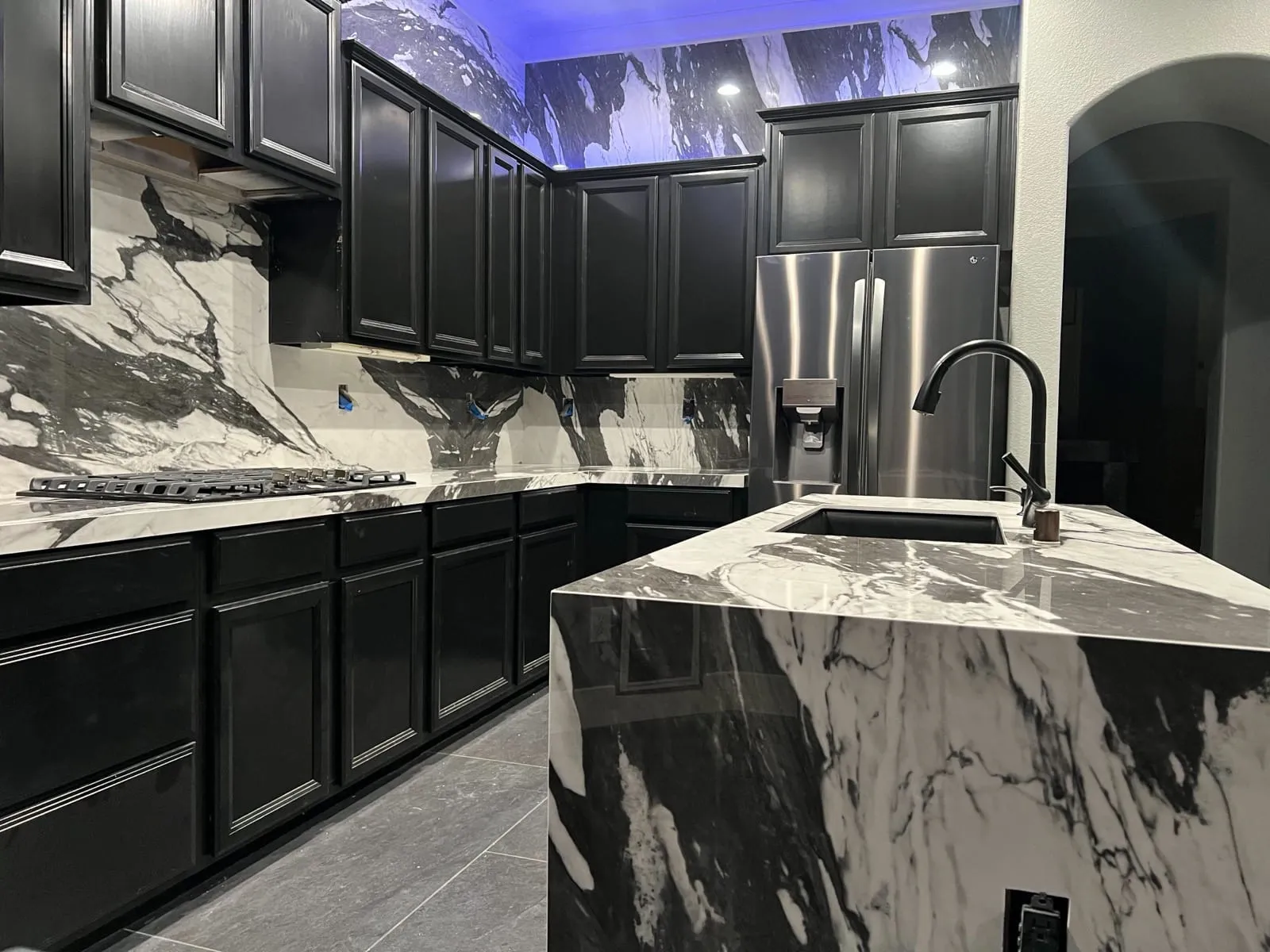
Countertops sit at roughly 10 percent of budget, but that number hides a wide spread depending on material. Laminate, quartz, and natural stone occupy very different price tiers for the same square footage. Edge profiles, seams, and a waterfall island edge all add labour on top of the material cost itself.
Labour: the line that scales with complexity, not size
Installation labour, at 17 percent, is driven more by how much the layout changes than by how big the kitchen is. Moving a sink, relocating an island, or opening a wall between the kitchen and an adjacent room adds labour hours that a same-footprint refresh never touches. That holds even if the finished square footage is identical.
Building in a real contingency
Every one of the categories above assumes nothing unexpected turns up once demolition starts. On an older Ontario home, that assumption rarely survives contact with an opened wall. Outdated wiring, a subfloor that needs replacing, or plumbing that doesn't match the original drawings are common enough that a contingency isn't a hedge against bad luck. It's a standard part of budgeting for this kind of project.
A contingency of 10 to 15 percent of the total project cost is the range worth planning around. It should sit untouched until something specific in the scope requires it, not get absorbed into upgrading finishes along the way. That contingency is tied to timeline too: a project that runs longer than expected often means paying for that extra work on top of the original schedule. How long a kitchen renovation actually takes in Ontario is worth reading alongside the budget itself, because the two rarely move independently of each other.
Frequently asked questions
What percentage of a kitchen renovation budget should go to cabinets?
Industry data from the NKBA puts cabinetry at around 29 percent of a typical full kitchen renovation. The realistic range is 25 to 40 percent, depending on whether cabinets are stock, semi-custom, or fully custom. It's consistently the single largest line item in the budget.
How much does a kitchen renovation cost per square foot in Ontario?
Current Ontario pricing runs roughly $150 to $400 or more per square foot, with most mid-range projects landing between $250 and $350. Toronto and the surrounding GTA typically run 10 to 25 percent higher than smaller Ontario cities because of higher labour and permit costs.
Do kitchen renovation quotes in Ontario include HST?
Not always, and it's worth confirming directly with the contractor. Ontario charges 13 percent HST on the full invoice, labour and materials included, so a quote presented before tax needs that amount added before it reflects the real cost.
How much should I budget for permits and electrical or plumbing work?
Municipal permit fees generally run $10 to $15 per $1,000 of construction value, with separate electrical permits around $150 to $400 and plumbing permits around $100 to $300. Trade permits in several GTA municipalities add $475 to $1,085 per trade once that scope passes $5,000 in value. These are separate from the design and construction budget and easy to leave out of a first estimate.
Is a 10 percent contingency enough for an older Ontario home?
For a straightforward refresh with no structural changes, 10 percent is often adequate. For a full renovation that opens walls, moves plumbing, or touches an older electrical panel, 15 percent is the safer planning number. Older homes more often reveal something that wasn't visible before demolition started.
Where this fits into planning the whole project
A budget breakdown only holds up once it's attached to the full scope of the actual project: permits, layout changes, timeline, and financing included, not just the finish selections. Kitchen renovation in Ontario: a complete budgeting and planning guide walks through that full process from first decision to final walkthrough. It's the place to start before locking in numbers against any of the categories above.