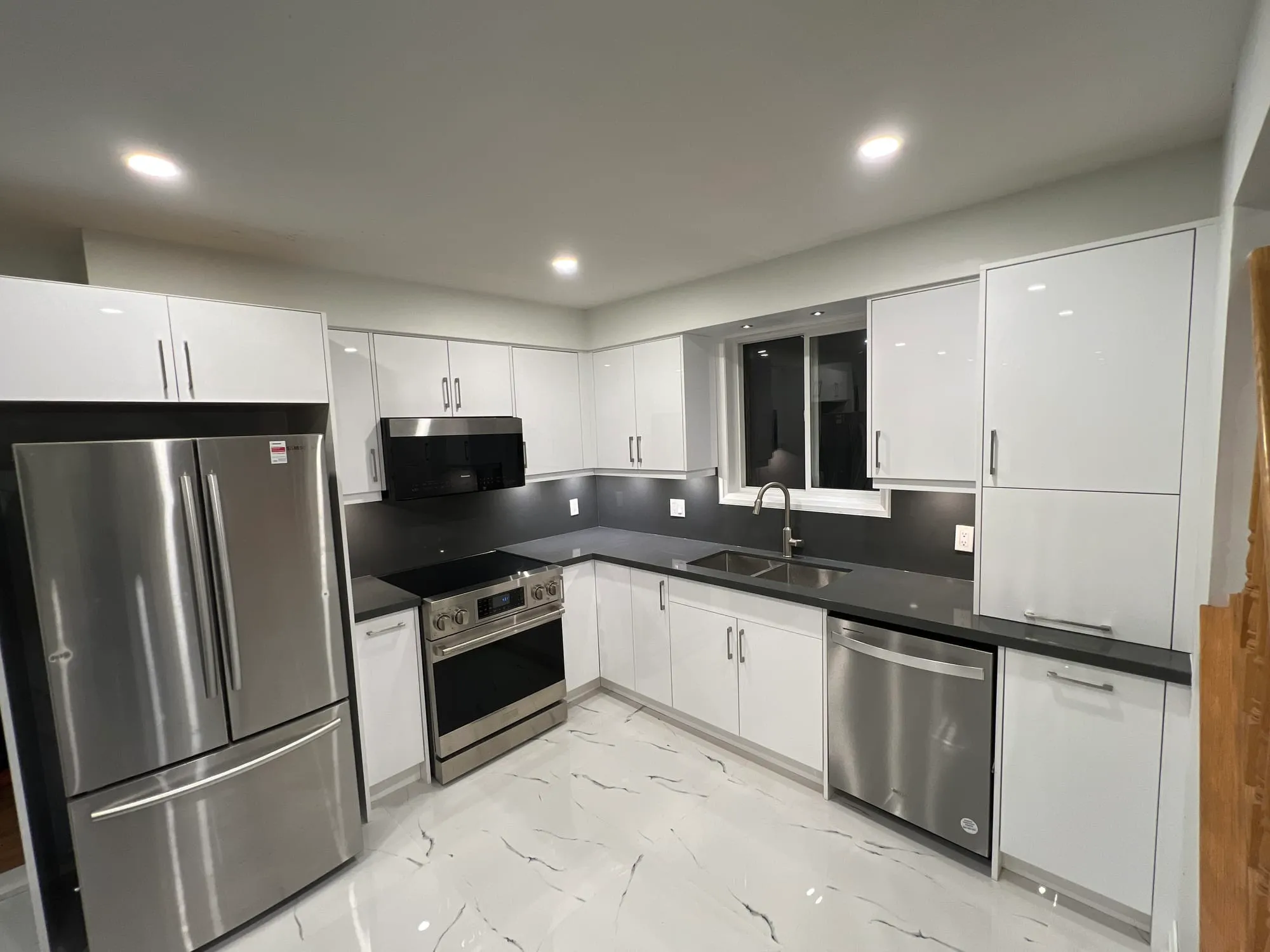
Appliances get picked last in a lot of kitchen renovations, which is backwards. A refrigerator's width sets the cabinet opening next to it. A range's depth decides how far the countertop overhangs. A panel-ready dishwasher needs a cabinet front ordered specifically for it, months before delivery. Lock the appliance package before cabinetry is finalized and the kitchen goes together in order. Pick it after cabinets are built, and you're living with a gap, paying for a rework, or settling for whatever fits.
Key Takeaways
- Appliance packages generally fall into three tiers, builder-grade, mid-range, and premium or panel-ready, and the price difference between the top and bottom tier is easily $15,000 to $20,000 or more.
- Appliance selection has to happen before cabinet shop drawings are finalized, not after. Panel-ready units, integrated fridges, and even standard depth differences all change cabinet openings.
- Gas and induction aren't a wash on cost. Gas needs a licensed fitter and often a TSSA-permitted line; induction can mean an electrical panel upgrade if your service doesn't have the spare capacity.
- A full package (fridge, range, dishwasher, hood, microwave or built-in oven) realistically runs anywhere from about $3,000 on the low end to $25,000 or more, depending on tier and how many pieces are panel-ready.
The three appliance tiers, and what actually separates them
"Builder-grade," "mid-range," and "premium" get thrown around loosely, but the practical differences are specific enough to budget against.
Builder-grade
This is the tier a spec-home builder installs by default: a basic stainless or black stainless fridge, a freestanding range, a standard dishwasher, and often a low-cost over-the-range microwave doing double duty as the vent hood. Individually, a refrigerator in this tier runs $600 to $2,300, a range $600 to $1,300, and a dishwasher $400 to $1,200, based on current retail pricing ranges (HomeGuide). Bundled together, a full builder-grade package for a fridge, range, dishwasher, and microwave typically lands around $2,100 to $5,400 (HomeGuide). Retailers often knock another 10 to 30 percent off that total when you buy the set together rather than piece by piece.
Builder-grade isn't a knock on function. These appliances cook, cool, and clean the same food and dishes a premium unit does. What you're not getting is the finish level, quiet operation, and capacity headroom that come standard higher up.
Mid-range
Mid-range is where most kitchen renovations actually land: name-brand stainless appliances with better insulation, quieter dishwasher decibel ratings, a real vented range hood instead of a microwave doing the job, and a range with more even heat distribution or convection. A stylish, above-builder-grade kitchen appliance set in 2026 typically prices out between $9,000 and $15,000 for the core package (Yale Appliance). That range covers a lot of ground, a straightforward stainless package sits at the low end of it, while one with a better range hood, a wine fridge, or a higher-capacity fridge pushes toward the top.
Premium and panel-ready
At the top end, panel-ready and integrated appliances are built to disappear behind custom cabinet fronts rather than show their own finish. A panel-ready refrigerator alone, before panels or installation, ranges from budget options under $2,000 up to $13,000 or more for premium models from brands like Bosch, JennAir, Thermador, and Sub-Zero (sixstoreys.com). On top of the unit itself, budget another $1,000 to $3,000 for the custom panels and $500 to $2,000 for professional installation (sixstoreys.com). A panel-ready fridge alone can cost double or triple what a comparable freestanding stainless model costs, which is the premium you're paying for the built-in look, not for keeping food any colder.
Add a panel-ready dishwasher and a professional-style range or induction cooktop, and a full premium package for smart, high-end appliances (fridge, range, dishwasher, plus laundry) can run as high as $24,400 (HomeGuide).
| Tier | What's included | Typical package cost |
|---|---|---|
| Builder-grade | Freestanding fridge, range, dishwasher, microwave hood | $2,100 to $5,400 |
| Mid-range | Name-brand stainless set, real vented hood, better insulation and finish | $9,000 to $15,000 |
| Premium / panel-ready | Panel-ready fridge and dishwasher, professional range or induction cooktop, ducted hood insert | $15,000 to $25,000+ |
Treat this table as a planning range, not a quote. The number that matters is the one from an actual appliance dealer once you've picked models, since features, sizing, and current promotions move it in either direction.
Sequencing: pick appliances before cabinets, not after
The single most common budgeting mistake isn't picking the wrong tier, it's picking appliances in the wrong order relative to the rest of the kitchen. Cabinet shop drawings and countertop templates are both built around exact appliance dimensions. Change the appliance after either one is finalized, and you're paying for a cabinet modification or a countertop re-cut, not a simple swap.
The order that avoids that:
- Pick the tier and the specific models first. Even if delivery is months out, lock the make and model, or at minimum the exact width, depth, and door-swing dimensions, before cabinet design starts.
- Flag anything panel-ready or integrated to the cabinet shop immediately. A panel-ready dishwasher or fridge needs a cabinet front built and hung to that specific appliance's frame, with custom hinge locations, panel dimensions, and sometimes a reveal gap. That's a different cabinet order than a standard opening for a freestanding unit.
- Confirm the range or cooktop width against the countertop cutout before the slab is templated. A range that's a few inches narrower or wider than what the cabinetry was drawn for either leaves a gap or won't fit the opening, and a countertop already cut is not adjustable.
- Confirm sink and faucet clearance against the dishwasher's final width, since dishwashers on the low end of a size range and the high end of it can differ enough to crowd an adjacent sink base cabinet.
- Order last, install last, once cabinets and counters are already sized around the appliances chosen at step 1.
Reversing this order, cabinets and counters built first, appliances picked after, is how a homeowner ends up with a panel-ready fridge that needs a custom cabinet retrofit. If you're working through a full renovation timeline, our kitchen renovation budget breakdown covers where appliances sit relative to cabinetry, countertops, and labour, and where a homeowner over or underspends most often.
Gas vs. electric vs. induction: the cost question people skip
Fuel type is treated as a taste decision, gas for cooking feel, induction for speed and cleanup, but it carries real cost and permit implications that belong in the budget conversation from the start, not after the range shows up.
Gas: the line and the fitter, not just the appliance
A gas range or cooktop itself is competitively priced with electric, often $400 to $1,300 for a basic unit. The cost that catches people off guard is what it takes to get gas to a location that doesn't already have it, or to modify an existing line for a different range position. In Ontario, gas line installation and modification has to be done by a licensed gas fitter registered with the Technical Standards and Safety Authority. Most installations also require a TSSA or municipal permit, which the licensed technician handles as part of the job. This isn't optional paperwork. Unlicensed gas work carries real safety risk (leaks, carbon monoxide, fire) and fines that can reach $50,000 for an individual. If your kitchen layout moves the range to a wall that never had a gas line, or adds gas where there wasn't any before, budget for that line run and permit as its own item. It's not a rounding error on the appliance price.
Induction: the appliance cost is close, the panel question is the real one
Induction cooktops run roughly $900 on the low end to $2,400 for a typical mainstream model, which overlaps with a comparable gas or electric unit at the low end and costs more at the high end (cooktophunter.com). The cost question with induction isn't the appliance, it's whether your home's electrical service and panel have the spare capacity for a dedicated high-amperage circuit. Where a panel doesn't have room, an electrical panel upgrade in Ontario, commonly a 100A to 200A service upgrade, runs $2,500 to $4,500 including the panel, labour, an Electrical Safety Authority permit, and inspection (Ottawa Electric Service). That's a cost that has nothing to do with the appliance you're buying and everything to do with the house you're buying it for. Have an electrician confirm panel capacity before you commit to induction, not after the cooktop is on order.
Ventilation follows the fuel choice
Whichever fuel you land on, the range hood question is a separate budget line. A gas range benefits more from a properly ducted hood given the combustion byproducts, while induction produces less airborne grease and heat, though a ducted hood still performs better for odor and moisture control either way. A basic ducted range hood installation, including any needed ductwork and electrical, runs roughly $650 to $2,500, with $1,750 as a reasonable planning midpoint (HomeGuide); a simple recirculating hood without new ductwork comes in well under that but does the job less completely. If the hood is a ducted insert hidden inside custom cabinetry at the premium tier, the cabinetry and duct chase both need planning around it from the cabinet design stage, not as an afterthought once the range is already installed.
Realistic price bands, all in
Putting the tiers and the fuel and ventilation questions together, here's what a full kitchen appliance package (refrigerator, range or cooktop plus wall oven, dishwasher, range hood, and microwave where applicable) realistically costs once installation and any required electrical or gas work is included:
- Builder-grade package: roughly $3,000 to $6,500 installed, assuming no gas line changes or electrical upgrades are needed.
- Mid-range package: roughly $10,000 to $17,000 installed, including a real vented hood and standard installation.
- Premium or panel-ready package: roughly $18,000 to $28,000 or more installed, once panels, professional-style ranges, and ducted hood inserts are factored in, and before any gas line or panel upgrade work.
Add $1,800 to $5,000 on top of any of these tiers if the renovation involves a panel upgrade for induction, or a new or relocated gas line for a range. Those are compliance and capacity costs, not appliance costs, and they don't scale down just because you picked a cheaper fridge.
If your renovation plan is still in the scoping stage, our permits guide for a kitchen renovation covers when electrical and gas work specifically triggers a permit versus when it doesn't, which is worth reading before you assume a fuel switch is a same-day swap.
Where appliances fit inside a realistic renovation budget
Appliances typically make up somewhere between 15 and 25 percent of a full kitchen renovation's total budget, with cabinetry, countertops, and labour taking the larger shares. That means an appliance decision made in isolation, upgrading from builder-grade to premium without adjusting the rest of the budget, can pull disproportionately from what's left for cabinetry or countertop grade. The tiers aren't meant to be picked independently of the rest of the kitchen; they're meant to be picked as one line inside a full budget that's been built out room by room.
We've built appliance packages across all three tiers for clients in Oakville, Waterloo, and Hamilton. In Oakville, panel-ready and integrated kitchens show up more often given the housing stock and price point. In Waterloo, mid-range packages tend to be the sweet spot for a full kitchen refresh. In Hamilton, builder-grade to mid-range upgrades are the more common request on older housing stock. The tier that makes sense for your kitchen usually comes down to the same conversation as everything else in the renovation: what the rest of the budget looks like, and what the kitchen needs to be able to do.
Frequently asked questions
Should I buy appliances before or after signing off on cabinet drawings?
Before. Cabinet shop drawings are built around exact appliance widths, depths, and door-swing clearances, and panel-ready units need cabinet fronts built specifically for them. Picking appliances after cabinets are finalized risks a mismatch that costs more to fix than choosing in the right order would have.
Is induction actually more expensive than gas once everything is factored in?
Not necessarily on the appliance itself, entry-level induction and mid-range gas ranges are priced close to each other. The real cost swing is whether your electrical panel has spare capacity. If it does, induction can come in cheaper overall since it skips a gas line and permit. If it doesn't, a panel upgrade can add $2,500 to $4,500, which may exceed what a gas line extension would have cost.
How much more does a panel-ready refrigerator cost than a standard stainless one?
Often double to triple the price of a comparable freestanding stainless model, before adding $1,000 to $3,000 for the custom panels themselves and installation on top. That premium buys the built-in look, not additional cooling capacity or features.
Do I need a permit just to swap a gas range for an induction cooktop?
The appliance swap itself isn't usually the permit trigger, but removing an active gas line, or any electrical panel or circuit work needed to support induction, generally is. A licensed electrician or TSSA-registered gas fitter handling either side of that swap will confirm what's required for your specific job.
How much of a kitchen renovation budget should go toward appliances?
Roughly 15 to 25 percent of the total budget is a reasonable planning range, with cabinetry, countertops, and labour typically taking the larger shares. Where your kitchen lands in that range depends on the tier you choose and whether panel-ready or professional-style units are part of the plan.
Read next: the full kitchen renovation budget guide
Appliance tier is one of the biggest single levers in a kitchen renovation budget, and one of the easiest to get expensive by accident if it's decided in isolation from cabinetry, countertops, and the electrical or gas work a fuel choice might trigger. For the full picture of how appliances fit alongside every other cost in the project, from cabinetry grade to layout changes, see our complete guide to kitchen renovation budgeting and planning in Ontario.