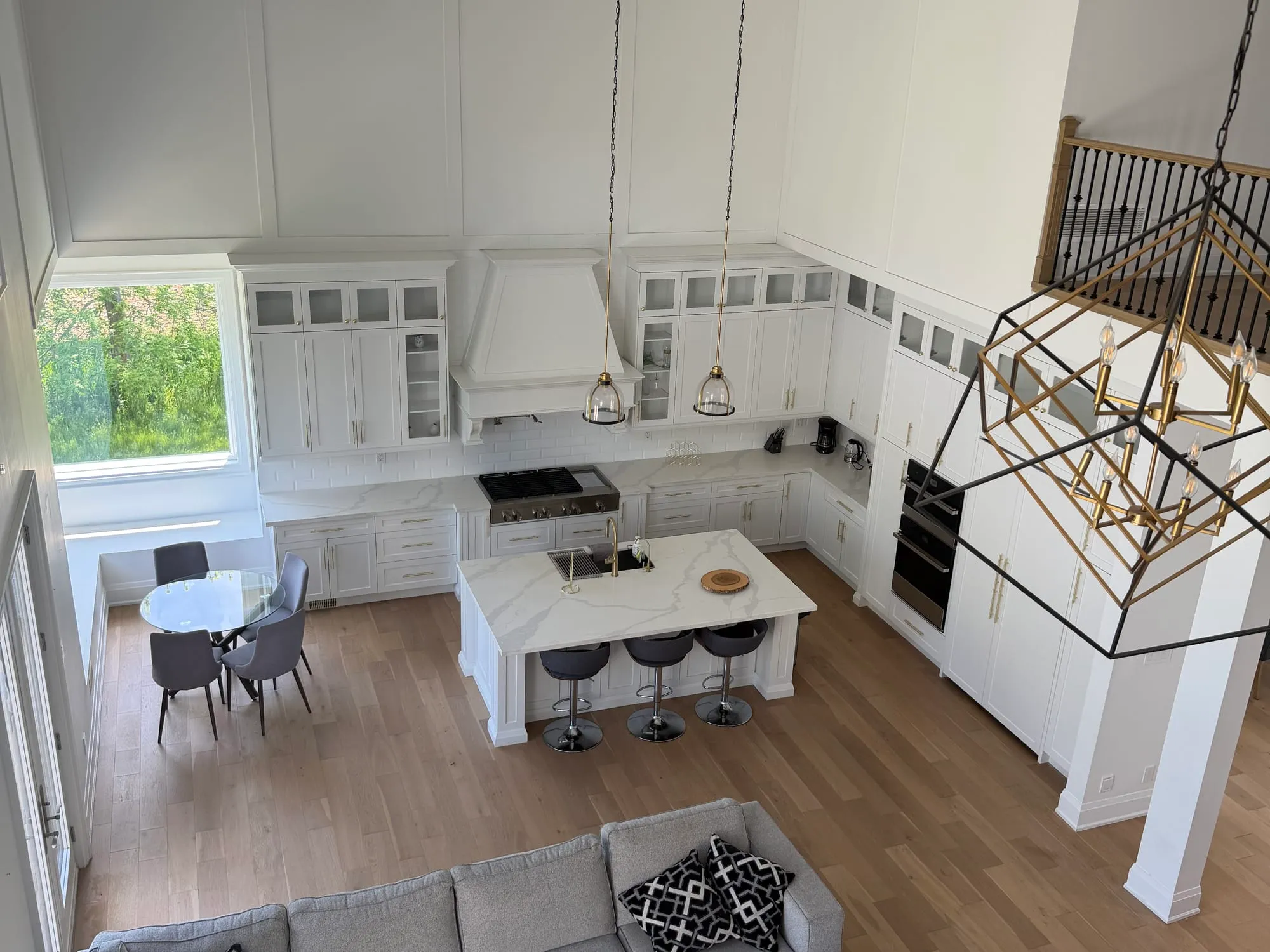
Ask five homeowners what a kitchen renovation is worth at resale and you'll get five different answers, most of them optimistic. The real data is more specific than "kitchens sell houses." It says which scope of kitchen renovation recoups its cost and which one doesn't, and it says buyers and appraisers notice a fairly narrow list of things: layout, cabinet condition, countertop material, appliance grade, and lighting. Everything else is closer to personal taste than to resale value. Here's what the actual numbers and the people who set them, appraisers and real estate agents, say about the gap between what you spend and what you get back.
Key Takeaways
- A minor, cosmetic kitchen update (refaced cabinets, new counters, mid-grade appliances) recoups more of its cost than a full gut renovation does, according to both US cost-vs-value data and Canadian broker surveys.
- Royal LePage's national survey of real estate professionals put a well-executed kitchen renovation's value impact at around 20% of a property's value, the highest of any single room.
- Buyers and appraisers respond to layout, cabinet quality, counter material, and lighting. They largely ignore custom one-off features and penalize choices that read as impractical, like removing upper cabinets for open shelving.
- What a kitchen renovation is worth also depends on what's typical for the street it's on. A kitchen that outspends its neighbourhood rarely gets the difference back.
What the cost-vs-value data actually says
The most detailed public data on renovation ROI comes from the US, where Zonda's Cost vs. Value report has tracked contractor-reported costs against appraiser-estimated resale value across more than 100 markets for close to 40 years. Canada doesn't have an equivalent study run at that scale, but the pattern it shows, that scope changes ROI more than finish quality does, matches what Canadian brokers report as well.
The gap between a light kitchen refresh and a full renovation is the single biggest number in this data:
| Renovation scope | Typical cost (US data) | Cost recouped at resale |
|---|---|---|
| Minor kitchen remodel (reface cabinets, new counters, appliances, flooring) | ~$28,000-$30,000 | 112-113% |
| Major kitchen remodel, midrange finishes | ~$82,000 | ~51-56% |
| Major kitchen remodel, upscale finishes, full gut | ~$164,000 | ~36-38% |
Source: Zonda's 2025 Cost vs. Value Report, US national averages.
That's not a small gap. A minor remodel is the only interior project that regularly returns more than it costs. A full gut renovation, walls moved, layout rebuilt, high-end finishes throughout, typically returns less than 40 cents of every extra dollar spent past the midrange. The National Association of Realtors' 2025 Remodeling Impact Report lands in a similar place: a complete kitchen renovation recovers about 60% of its cost, even though kitchens score highest of any project on the report's homeowner satisfaction scale. The satisfaction is real. The cost recovery is a separate, lower number.
Canadian data points the same direction without the same granularity. A Royal LePage survey of real estate professionals found a well-executed kitchen renovation has the potential to add around 20% to a property's value, more than any other single room. A separate RE/MAX brokers survey found 93.5% of brokers named kitchen renovations as the improvement giving the best return, more than any other project category. Different studies, same shape: the more of the kitchen you rebuild from scratch, the less of each incremental dollar comes back.
Why minor updates outperform major ones
The reason isn't that appraisers dislike nice kitchens. It's that a full gut renovation's cost is loaded with things a buyer and an appraiser genuinely cannot see: moved plumbing lines, structural changes to open up a wall, electrical service upgrades, permit and design fees. None of that shows up as visible value at a showing, even though it was necessary to do the work. A minor remodel spends almost every dollar on the surfaces a buyer's eye actually lands on, cabinet fronts, countertops, a new backsplash, updated appliances, which is exactly why it recoups so much more efficiently.
This is also why "renovate the whole kitchen" is the wrong question to start with. The better one is what specific problem the current kitchen has: outdated cabinet doors and hardware, a countertop material buyers read as dated, appliances that look tired next to comparable listings, or a layout that genuinely doesn't work. The first three are minor-remodel fixes. Only the last one justifies opening up walls. Even then, it's worth pricing what a layout change actually buys against what it costs, since that's the move most likely to land in the 36-51% recovery range rather than the 100%-plus one.
For a full breakdown of where a typical renovation budget actually goes by line item, cabinets versus counters versus labour versus appliances, see Kitchen Renovation Budget Breakdown: Where the Money Actually Goes. If the budget itself is the obstacle rather than the scope, Financing a Kitchen Renovation in Ontario: What's Actually Available covers the loan and line-of-credit options homeowners actually use to fund the project.
What buyers and appraisers actually notice
Both groups are looking at a narrower list of things than most homeowners assume, and it's worth knowing what's actually on it before spending on anything else.
Layout
A functional, efficient layout is the first thing an appraiser and a buyer's agent both register, and it's the one thing a cosmetic refresh can't fix. A kitchen that puts the sink, stove, and fridge in a workable triangle, with enough counter space next to each, reads as move-in ready even with modest finishes. A kitchen with an awkward flow, a fridge blocking a walkway, no landing space next to the stove, reads as needing work no matter how new the countertops are. If layout is the actual problem, that's the case for a full renovation rather than a cosmetic one, since no amount of surface-level work fixes a floor plan.
Cabinets and storage
Cabinet condition and configuration matter more than most homeowners expect, and this is where a well-known Canadian data point cuts against a popular design trend. Open shelving in place of upper cabinets is a genuine resale liability in buyer research: it looks current in a photo, but it removes storage capacity that most buyers, especially anyone shopping with a family, actively want back. Full-height cabinets with soft-close hardware and functional storage (pull-out pantries, drawer organizers) consistently register better with buyers than an open, styled shelf ever does.
Countertops and surfaces
Material matters here more than colour or pattern. Quartz has become the default expectation in most of our service area, durable, low-maintenance, and consistent enough that buyers don't second-guess it. Laminate reads as dated almost regardless of condition. Natural stone can work but comes with a maintenance story (sealing, staining risk) that a buyer's agent will sometimes flag, particularly to a first-time buyer unfamiliar with it.
Appliances
Mid-grade stainless steel or an integrated panel-ready package reads as current. Mismatched appliances, especially an old white or bisque unit sitting next to newer stainless pieces, is one of the fastest ways a kitchen reads as unrenovated even if everything else has been updated. Buyers notice a full matching appliance package even when they can't identify the brand.
Lighting
Layered lighting, task lighting under the upper cabinets, a fixture over an island, general ceiling coverage, is a comparatively inexpensive upgrade that shows up disproportionately well in listing photos and in person. A kitchen lit by a single centre fixture reads as older no matter what else has been done, and it's one of the cheapest items on this whole list to fix.
What doesn't move the number
Some choices that feel significant to the person making them don't register the same way with a buyer or an appraiser, and a few actively work against resale value.
- Highly personalized or trend-specific choices. A bold accent colour, an unusual tile pattern, or a niche design statement can be exactly what a homeowner wants to live with and still read as a liability to a buyer who has to imagine living with someone else's specific taste. Appraisers and agents both note that neutral, broadly appealing finishes hold value better than a strongly personalized kitchen, even when the personalized version cost more to build.
- Over-improving for the street. A $150,000 kitchen in a neighbourhood of $600,000 homes rarely returns the difference, because comparable sales in that price bracket cap what an appraiser can support regardless of what's actually in the house. This is the single biggest reason a full gut renovation underperforms a minor one in the data above: it's often sized to a budget rather than to what the neighbourhood's other sales will support.
- Invisible infrastructure work, on its own. A new electrical panel or updated plumbing is necessary and sometimes unavoidable, but it doesn't show up as visible value at a showing the way a countertop does. It's worth doing when the kitchen needs it, just not worth expecting it to move the resale number the way a countertop or an appliance package will.
Where this plays out differently by city
The finishes buyers expect, and the price bracket they expect them at, aren't uniform across our service area. Our kitchen renovation work in Toronto sees higher-end finish expectations and tighter comparable-sales brackets, where a well-scoped minor-to-midrange renovation tends to track closer to the top end of the recovery ranges above. In Oakville, where average home values run higher and buyers are often comparing several recently renovated listings at once, a kitchen that looks dated relative to the competition, rather than dated in absolute terms, is often the bigger resale drag. In St. Catharines, where price brackets are lower, the over-improvement risk described above is the more common mistake we see: a kitchen renovated to a GTA standard on a house that won't appraise to match it.
None of that changes the underlying pattern: cosmetic and layout-focused work recoups more efficiently than a full gut. It does change where the ceiling sits on any given street. That's why a firm answer on "will this pay for itself" only comes after someone's looked at the specific house and its comparables, not from a national average alone.
Frequently asked questions
Does a kitchen renovation always increase a home's resale value?
Not automatically, and not by the full amount spent. A well-scoped renovation, particularly one focused on cabinets, counters, appliances, and lighting, tends to add real value. An oversized renovation relative to the neighbourhood's other homes, or one built around highly personalized finishes, can add far less than it cost, and in the most extreme cases doesn't fully return even at a higher list price.
Is it worth doing a full gut renovation before selling?
Usually not just for resale. Cost-vs-value data consistently shows a major kitchen renovation returning roughly 36-56% of its cost, well below a minor remodel's recovery rate. A full renovation makes more sense when the layout itself is the problem, or when you plan to live in the home for years afterward and want the kitchen for yourself, not primarily as a resale move.
What's the single best thing to upgrade in a kitchen before selling?
For most homes, it's the combination of cabinet fronts, hardware, and countertops, since that's the fastest way to make a dated kitchen read as current without opening up the layout. Lighting is the next highest-value, lowest-cost item on the list. Appliances matter most when the current set is visibly mismatched or aged.
Do buyers care about matching appliances more than premium brands?
Generally yes. A matching, mid-grade stainless or panel-ready set reads better to most buyers than a mismatched kitchen with one high-end piece and older units around it. Consistency reads as "renovated." A single expensive appliance in an otherwise dated kitchen tends to read as an afterthought rather than an upgrade.
How does this connect to planning an actual kitchen renovation budget?
The ROI numbers above are only useful once you know what a realistic renovation actually costs to plan against, which is the starting point covered in our complete guide to kitchen renovation in Ontario. That guide walks through budgeting and planning a renovation from the ground up, resale value is one input into that decision, not the whole of it.
Planning around resale value, not just against it
The data is consistent enough to plan around: a cosmetic-to-midrange kitchen renovation, focused on layout function, cabinets, countertops, appliances, and lighting, recoups more of its cost than a full gut renovation does, and buyers and appraisers respond to a fairly specific, fairly narrow list of visible details rather than to how much was spent overall. Whether that means a light refresh or a full renovation for your specific house depends on your kitchen's actual condition and your neighbourhood's comparable sales, not a national average. For the fuller picture of planning and budgeting the project itself, see our complete guide to kitchen renovation in Ontario.