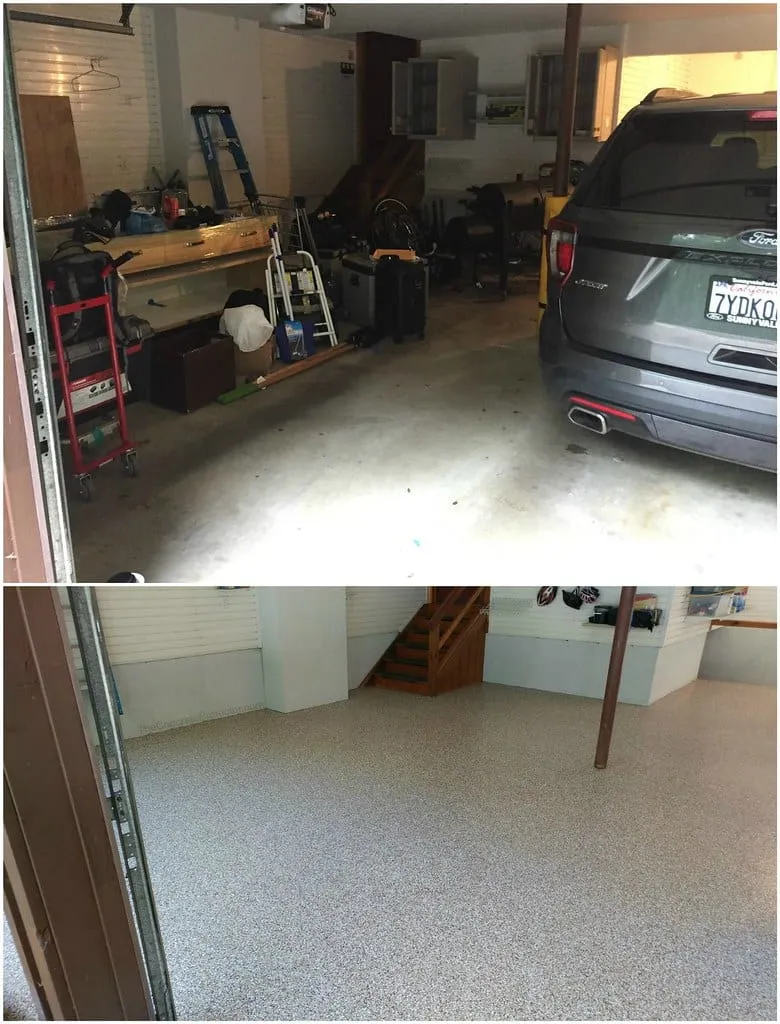
Key Takeaways
- Bare concrete doesn't fail in a garage the way it does outside. It stains, dusts, and pits from salt brine sitting in one spot, but the real long-term threat is moisture pushing up from underneath, not freeze-thaw scaling.
- A coating only lasts as long as the surface prep under it. Moisture testing and mechanical grinding decide whether epoxy or polyaspartic holds for a decade or peels in a season, more than which product you choose.
- Epoxy and polyaspartic aren't competing for the same job. Epoxy cures slowly enough to be built as a real moisture-managing base coat; polyaspartic cures in hours and stands up to hot tires and UV far better as the topcoat.
The short answer
Bare, sealed concrete is the lower-cost, lower-maintenance choice for a garage that mostly holds vehicles and storage and doesn't bother anyone with a grey slab. A coating system is worth the extra cost when you want a floor that resists stains, hides tire marks, and is genuinely easier to clean, but only if the slab has been tested for moisture and prepped properly first. Skip that step and it doesn't matter which coating you pick, it fails the same way.
We build and coat garage slabs across Mississauga, Toronto, and Guelph, and the pattern is consistent: the floor itself is rarely the hard part. What happens to it over the following winters is.
A garage slab is interior concrete, not the exterior flatwork we cover in our guide to outdoor concrete in Ontario. It doesn't need the same air-entrained mix built for open freeze-thaw exposure, but it still sees enough salt and temperature swing through an unheated garage to make the surface decision a real one, which is why this is a coating question rather than a mix question.
Quick comparison
| Bare, sealed concrete | Epoxy coating | Polyaspartic coating | |
|---|---|---|---|
| Upfront cost | Lowest, sealer only | Mid to high | Mid to high |
| Stain and chemical resistance | Fair, sealer-dependent | Good to excellent | Excellent |
| Hot-tire pickup risk | None, nothing to lift | Higher if under-cured | Lower, but not zero |
| Cure before vehicle use | Same day to a few days | Several days per coat | Often next-day |
| Moisture tolerance | Most forgiving | Least forgiving | Moderate |
| Typical lifespan before redo | Reseal every few years | 5 to 10+ years, prep-dependent | 5 to 10+ years, prep-dependent |
What bare concrete actually does in a garage over time
An attached garage isn't a heated, sealed room the way most homeowners picture it. An unheated attached garage tracks the outside temperature closely enough to go through real freeze-thaw cycling, and the salt brine dripping off a car concentrates on one narrow strip of floor by the tires and the door instead of spreading out the way it would on an open driveway. That's a different exposure pattern than a driveway sees, not a milder one, since the same volume of salt and moisture lands on far less surface.
What that produces on bare concrete is mostly cosmetic in the short run: white mineral staining where brine evaporates and leaves salt behind, dusting on the surface from repeated wetting and drying, and sometimes small pop-outs where a chip of aggregate near the surface pushes loose. The chemistry behind that kind of surface damage is the same freeze-thaw and salt mechanism that scales an exterior driveway, and we've covered exactly how that reaction works in our breakdown of winter salt damage on concrete rather than repeating it here.
The bigger long-term issue on a garage slab specifically is moisture coming up from below, not down from above. Vapour retarders meeting ASTM E1745 are specified beneath a slab specifically to protect against that kind of moisture migration when the floor is going to be covered with a moisture-sensitive coating, protection that was not universal residential practice on older pours. A garage built before that became standard keeps drawing moisture from the ground for as long as it's there. Bare concrete handles that fine, it just looks a little damp or discoloured in patches. A coating sealed on top of that same slab without checking for it is a different story.
What epoxy and polyaspartic coatings do differently
Epoxy and polyaspartic aren't two versions of the same product competing for the same job. They solve different halves of the same problem.
Epoxy cures slowly, typically over a day or more per coat, and that slower chemistry is what lets it be formulated as a real moisture-managing base coat. Some epoxy systems are built specifically to bond to a slightly damp slab and hold moisture vapour back rather than trap it. That makes epoxy the right layer to put down first on an older, untested, or borderline slab, but the same slow cure is a liability on its own: it stays soft longer, so it's more vulnerable to hot-tire pickup and general wear if the garage goes back into use too soon.
Polyaspartic cures within hours rather than days, which is the main reason it's become the default topcoat on a lot of newer garage floor jobs. It resists hot-tire pickup and UV yellowing noticeably better than standard epoxy on its own, and a garage floor sees plenty of both, tires warmed by a drive, and sunlight through a west-facing garage door for half the afternoon. What it doesn't do well on its own is manage rising moisture, since its fast cure doesn't give vapour the same time or pathway to escape that a slower epoxy base does.
The two systems paired together, an epoxy base handling moisture where testing calls for it, with a polyaspartic topcoat carrying the actual wear, is a common combination for exactly this reason: each one covers the other's weak point. Decorative flake or quartz broadcast can go into either system as a colour and texture layer; if you're weighing the look rather than the chemistry, our rundown of colour and stain options for outdoor concrete covers the same integral-versus-topical colour tradeoffs, even though that piece is written for exterior flatwork rather than a garage slab.
Surface prep and moisture testing: the real determinant
Almost every coating failure we get called out to fix traces back to one of two things, and neither one is the product that was used.
Moisture testing. A slab can look dry, feel dry, and still be releasing water vapour from underneath at a rate that will eventually blister any coating sealed over it. This gets measured before coating, not assumed. The two quantitative methods used across the flooring and coatings trade are an anhydrous calcium chloride test, with acceptable emission generally capped at 3 to 5 pounds of moisture per 1,000 square feet per 24 hours, and an in-situ relative humidity probe, typically targeting 75 to 80 percent. Exact thresholds still vary by coating manufacturer, but the point is the same either way: know what the slab is doing before you seal it, instead of finding out after.
Mechanical grinding. A new slab commonly carries a curing compound left over from the original pour, and it's invisible to the eye but stops a coating from bonding to the surface. An older slab usually has years of sealed-in dust, oil drips, and tire residue working the same way. Diamond grinding removes that layer and opens the surface pore structure so the coating has something to actually key into. A coating rolled over a surface that's only been cleaned, not ground, is adhesion built on a layer that was never designed to hold anything down.
Skip either step and the coating you chose is almost beside the point. A premium polyaspartic system over an untested, ungrounded slab will fail before a mid-range epoxy system over one that was properly tested and prepped.
Hot-tire pickup and other adhesion failures
Hot-tire pickup is the most common complaint we hear on a coated garage floor, and it isn't dirt or a defect in the coating, it's a chemical reaction. As a tire heats up from driving, plasticizers in the rubber migrate to the tire's surface and can bond into a coating that hasn't fully cured, leaving dark, tacky marks exactly where the car sits. There's no workaround for it beyond giving the coating its full cure window, whatever that window is for the specific product, before the vehicle goes back in. Moving the car back in a day early is the single most common way a brand-new coating gets its first blemish.
Beyond hot-tire marks, the other adhesion failures we see are almost always downstream of the two prep issues above: blistering and lifting from trapped moisture, and delamination in sheets where the coating never actually bonded to a smooth or contaminated surface. Neither shows up as damage to the coating itself, both show up as the coating separating from the slab it was supposed to be protecting.
Cure and downtime
Downtime is one of the more underestimated parts of a coating project, because it means the garage, and often the driveway approach to it, is out of service for the duration.
Bare concrete with a penetrating sealer is the fastest by far: the sealer dries to light foot traffic within hours and full service within a day or two, since there's no film buildup that needs to fully harden before it can take weight. An epoxy system, particularly a multi-coat system with a moisture-managing base layer, commonly needs several days between coats and before the garage sees vehicle traffic again, since each layer needs to reach enough of its cure before the next goes on or a car returns. Polyaspartic dramatically shortens that timeline for the topcoat itself, often allowing traffic the next day, but an epoxy base underneath it still sets its own pace regardless of how fast the topcoat cures.
Anyone timing a project around when they need the garage back should ask about the full cure schedule, not just the topcoat's cure time, since the slowest layer in the system determines when the car actually goes back in.
Cost per square foot
An uncoated, sealed garage slab typically runs in the $10 to $15 per square foot range installed, putting a typical 24 by 24 foot two-car garage in the roughly $5,900 to $7,800 range for the concrete work itself. That's the floor, not the finish.
Coating is quoted separately, and for good reason: the price depends on how many coats go down, whether the system includes a decorative flake or quartz broadcast, and what the moisture testing turns up, since a slab that needs a moisture-managing epoxy base costs more to coat than one that doesn't. Get the moisture test done before asking for a coating quote, not after, since it's the single biggest variable in what the coating side actually costs.
When sealing bare concrete beats coating it
A coating isn't automatically the better answer. Sealing bare concrete is usually the right call when the garage is used hard for storage, tools, or a workshop rather than as an extension of living space, when the budget doesn't stretch to a full coating system this year, or when the slab hasn't been tested and there isn't time or appetite to do that properly before winter. A well-chosen penetrating sealer on clean, sound concrete resists salt staining reasonably well and costs a fraction of a coating system, even if it doesn't deliver the same look or the same resistance to oil and chemical stains.
Coating earns its cost when the floor gets daily use as more than storage, when the finish matters because the garage doubles as a workspace or a showcase for a vehicle, or when an existing slab already shows staining and dusting that sealing alone won't fix. In both cases, the decision should follow from the moisture test and the slab's condition, not from which option sounds nicer on paper.
Frequently asked questions
Do I need to coat my garage floor at all?
No. A properly sealed, bare concrete slab is a durable, low-maintenance floor on its own. Coating is an upgrade for stain resistance, cleanability, and appearance, not a requirement for the slab to hold up structurally.
Can I coat an older garage floor myself?
You can, and plenty of DIY kits exist, but the moisture testing and mechanical grinding steps are the ones most commonly skipped in a DIY job, and they're the steps that determine whether the coating lasts. A DIY coating over an untested, unground slab carries the same failure risk as a professional one skipped the same steps.
Is my garage really exposed to freeze-thaw damage if it's attached to the house?
Yes, if it's unheated. An unheated attached garage swings with the outside temperature closely enough to see the same freeze-thaw cycling as an open driveway, just concentrated on a smaller area where tires and salt brine sit.
How long should I wait before parking on a new coating?
It depends entirely on the specific product and system used, and it's worth getting that number in writing from whoever applies it rather than assuming. Moving a car back in before the coating has finished curing, not just dried to the touch, is the most common cause of early hot-tire marks and scuffing.
Bottom line
The product you choose, bare and sealed, epoxy, or polyaspartic, matters less than whether the slab was tested for moisture and properly ground before anything went down. Get that right and either coating system, or a good sealer, will hold up for years. Get it wrong and the most expensive coating on the market fails the same way the cheapest one does.