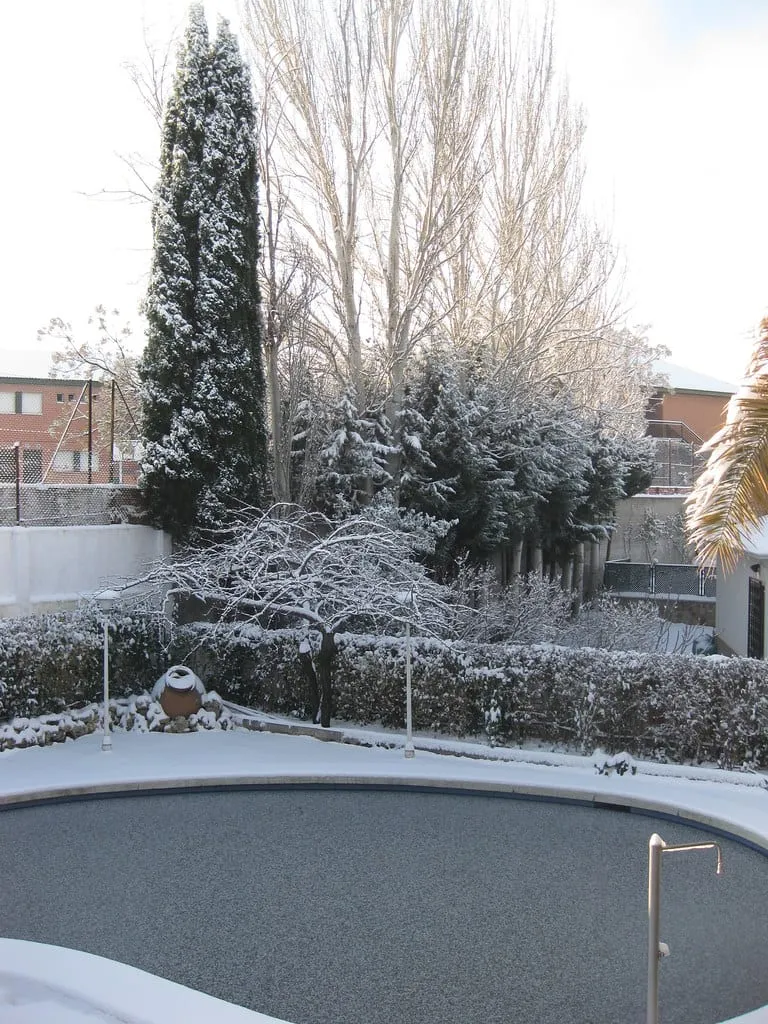
Key Takeaways
- The pool closes for the season. The deck doesn't get that option, it sits under snow and ice and keeps going through every freeze-thaw cycle from November to April. Most of what shortens a pool deck's life happens in that stretch, not during the swimming season.
- De-icing salt is the single biggest mistake we see on a pool deck, worse than on a driveway, because the runoff and splash carry chloride straight to the coping, the hardware anchored into the deck, and the pool itself. Sand is the right tool for grip near a pool.
- The coping joint, the cover anchors, and the ladder or rail sockets are the wear points that actually fail first. A five-minute check before the first hard freeze and another one in spring catches almost everything before it becomes a repair.
Why a pool deck needs its own winter routine
Once the pool closes, the deck is still outside, still exposed, and still cycling through freeze and thaw every time an Ontario winter does what it does. That's five or six months of a slab sitting unused, uninspected, and often unswept, right before spring brings the exact conditions, meltwater, thaw cycles, the first hard rain, that expose whatever went wrong over the winter.
We cover how a pool deck actually gets built, the finish that grips when wet, the isolation joint at the coping, and how colour and texture change surface heat, in pool deck concrete: slip resistance, coping, and heat considerations. This post picks up where that one leaves off: once the deck exists, what keeps it sound through the part of the year nobody's standing on it. It's the same underlying slab we cover across all the outdoor concrete we pour, patios, walkways, steps, in our guide to outdoor concrete in Ontario, whether that deck sits in St. Catharines, Niagara Falls, or Kitchener.
Closing week: what the deck needs before the pool does
Pool closing is mostly about the pool itself: dropping the water level below the skimmer, blowing water out of the return and skimmer lines, plugging them, and setting an ice compensator or air pillow under the cover so expanding ice has somewhere to go besides the shell. None of that is deck work, but two things that happen during closing week matter for the concrete around the pool just as much as for the water in it.
First, whatever gets splashed, hosed, or tracked onto the deck during closing shouldn't be left sitting at the coping line. That's the lowest point on the deck and the one place water pools longest, and standing water at a joint that's about to see its first hard freeze is exactly the setup for the coping joint to start failing early. A final rinse and squeegee toward a drain, done on closing day rather than whenever the weather cooperates next, costs nothing and matters more than almost anything else on this list.
Second, clear the control joints and the coping joint of leaves, seed pods, and the fine grit that blows in over a season, before that debris gets rained on, frozen solid, and left to hold water against the joint sealant all winter. A joint packed with debris can't compress the way it's supposed to when the slab and the coping move independently, which is the entire reason that joint exists in the first place.
Never put de-icing salt on a pool deck
We've written separately about why de-icing salt attacks concrete at all, the freeze-thaw and chloride mechanism behind winter scaling, in winter salt damage on concrete: what actually causes scaling. That mechanism doesn't change on a pool deck. What changes is where the runoff goes.
Salt spread on a driveway eventually washes into the lawn or a storm drain. Salt spread on a pool deck washes toward the coping, and from there it's one hard rain or one spring thaw away from ending up in the pool water and against every piece of metal anchored into that deck, ladder brackets, handrail sockets, a diving board base. Chloride accelerates corrosion on steel generally, and a pool deck is the one surface in the yard where that runoff has a direct path to hardware that's already dealing with chlorine or salt-chlorinator exposure from the pool side. There's no upside to adding a second chloride source on top of that just to melt an inch of ice.
Sand does the actual job, traction, without any of that. It doesn't melt anything, which is the point: a pool deck in the off-season doesn't need to be bare and dry, it needs to not be slick, and sand handles that without putting chloride anywhere near the coping or the water. If a homeowner insists on some melting power somewhere on the property, Ontario's ready-mix trade association notes that plain sodium chloride is the more concrete-friendly option next to magnesium- or calcium-based products, but that's a driveway answer, not a pool deck one. Around a pool, skipping de-icer altogether is the simpler and safer call.
Reseal before winter, not after
A penetrating sealer is what keeps water and any stray chloride from soaking into the concrete in the first place, and timing matters more than most homeowners assume. NRMCA's guidance on preventing concrete scaling points to late summer, with a run of dry days beforehand, as the ideal window to apply a silane or siloxane sealer to exterior flatwork, so the coating has time to cure before the first freeze rather than going down over a damp, cooling slab in late fall.
A pool deck earns a shorter check-in cycle than a driveway's typical few years between resealing. It sees chlorine and saltwater splash-out on almost every day it's used, on top of the same freeze-thaw exposure a driveway gets, so it's worth walking the deck each spring specifically looking for dulling, water that no longer beads, or a chalky surface, rather than assuming a driveway's calendar applies to a slab that works this much harder.
Snow and ice removal that won't scar the surface
A broom finish, an exposed-aggregate deck, or a knockdown texture coating all rely on surface texture for their grip, and that same texture is easy to damage with the wrong tool. A metal-edged shovel or a steel ice chipper concentrates force on a narrow edge, and dragged across a textured or coated pool deck it can scratch, chip, or peel a thin acrylic coating faster than a single winter of weather would on its own.
A plastic or poly-blade shovel and a rubber-edged pusher clear snow just as effectively without that risk. For ice, patience and sand beat force, chipping at bonded ice with a metal tool is one of the more common ways we see a deck's surface get damaged by the homeowner rather than by the winter itself.
The cover, the ladder, and the other hardware wear points
Everything bolted, anchored, or set into a pool deck, the cover's spring-loaded anchors, a ladder's deck sockets, a handrail base, a diving board footing, sits on hardware that's exposed to the same freeze-thaw cycling as the concrete around it, and those anchor points are usually the isolation joints we cover in the slip-resistance and coping post above: a fixture on its own footing, sitting next to a deck slab that moves independently of it.
Anchors that were snug in the fall can work loose after a winter of the deck and the anchor expanding and contracting at slightly different rates. A quick check each fall, before the cover goes on, and again each spring, before anyone's using the ladder, catches a loose anchor while it's a five-minute fix rather than a hardware failure with someone standing on it.
Freeze protection for deck drains and plumbing penetrations
A deck drain, and any skimmer or return line that runs through or under the slab, is a cold path straight into ground that's supposed to be protected below frost depth. Ontario's Building Code sets that depth at 1.2 metres for clay or undefined soil with good drainage, the same number that governs footings for steps and other structures around the house, and any plumbing that isn't buried to that depth, or isn't otherwise insulated, is exposed to the same expansion pressure that cracks an underprotected footing.
The practical version of this: confirm the pool's lines were actually blown clear and plugged during closing, not just drained by gravity, and if a deck drain or equipment line runs shallow anywhere near the surface, that's worth insulating or heat-tracing rather than trusting to luck for a season. A cracked line under the deck is a spring discovery, usually after the ground around it has already heaved.
Spring: the inspection checklist before opening day
Before the cover comes off for the season, walk the deck and check these specifically, in roughly the order they tend to show problems first:
- The coping joint. Is the sealant still flexible and intact, or has it cracked, pulled away, or gone hard and brittle over the winter? A failed isolation joint here is the single most common repair we see on an otherwise sound pool deck.
- Cracks anywhere in the slab. Note whether they're new, whether they follow a control joint (expected) or run somewhere random (worth a closer look), and whether either side sits level with the other.
- Hardware. Ladder anchors, handrail sockets, diving board bolts, and cover anchors, check that all of them are still tight and free of visible rust or pitting.
- Drains and joints. Confirm the deck drain and control joints are clear of ice, debris, and standing water before the spring thaw sends more water through them.
- Sealer condition. Water that no longer beads on the surface is the plainest sign it's time to reseal before the deck goes back into daily chlorine and sun exposure for the season.
Most of what turns up on that list is a same-day fix. A coping joint that's failed along its full length, hardware that's visibly corroded rather than just loose, or a crack with any vertical offset is where it's worth having someone look at it before the pool reopens rather than after.
Frequently asked questions
Can I use any de-icer on a pool deck if I stay away from the coping?
Not really. Runoff and foot traffic move salt around a deck regardless of where it was applied, and the coping is the lowest point, so it's where that salt ends up either way. Sand for traction is the straightforward answer that avoids the question entirely.
Does a pool deck need to be sealed every year?
Not necessarily every year, but it needs checking every year. How long a sealer lasts depends on chlorine exposure, sun, and how much foot traffic the deck sees, and a pool deck's chemical exposure means that check matters more than it does on a patio that just gets rained on.
What's the single most important thing to check before opening the pool in spring?
The coping joint. It's the seam where the deck and the pool shell meet, it moves every winter because the two structures move independently, and a joint that's failed there is the repair that gets expensive fastest if it's left to keep letting water track down behind the coping.
Keeping the deck ready for the season it actually gets used
A pool deck spends more of the year closed than open, and the winter routine here, clearing debris before freeze-up, keeping salt off it entirely, resealing on a schedule that matches its real exposure, and checking the coping joint and hardware each spring, is what keeps that longer closed season from quietly costing more than the swimming season ever does. We build and maintain concrete pool decks across the region, and the winter mechanics don't change from one city to the next, only how long the shoulder seasons run on either side of it.