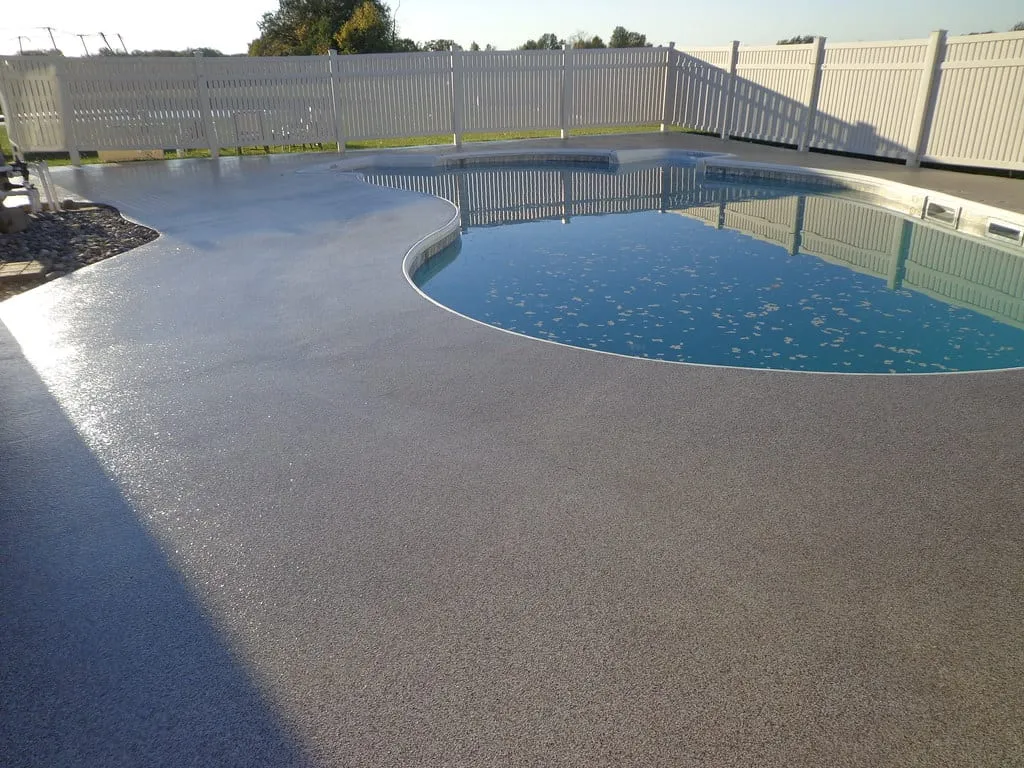
Key Takeaways
- Slip resistance on a pool deck is a safety decision first, not a style decision. A smooth trowel finish or a glossy sealed stamp pattern is the wrong answer no matter how it looks in a photo, because both are worst exactly where the deck is always wet, at the coping line.
- The joint where the deck meets the pool coping is not a normal construction seam. It is an isolation joint that has to stay flexible for the life of the pool, because the shell and the surrounding slab settle and move independently of each other.
- Colour and finish both change barefoot surface temperature more than most homeowners expect. A dark, dense, smooth-troweled surface in July sun will run noticeably hotter underfoot than a lighter, textured one, even at the same air temperature.
Why a pool deck is a different build than a patio
A pool deck is still a concrete slab, the base preparation, air entrainment, and jointing logic are the same fundamentals that apply to any exterior flatwork we cover in our outdoor concrete guide. What changes is what the surface has to survive. A patio gets rained on. A pool deck gets soaked constantly, walked on barefoot when wet, splashed with pool chemicals every season, and built directly against a shell that expands, contracts, and settles on its own schedule. Those conditions, wet bare feet, chemical splash, and a structure next to it that moves independently, are what drive the spec decisions below, whether we're pouring a deck in St. Catharines, Niagara Falls, or Toronto.
Slip resistance and surface texture: the real tradeoffs
The surface right at the pool's edge is wet essentially every time it's used, from splash-out, from a swimmer stepping out, from a pool toy dripping across it. That's a fundamentally different condition than a patio, which is only wet when it rains. A finish that reads as perfectly fine on a dry patio can be genuinely dangerous, wet, at a pool.
The flooring and tile trade tests wet slip resistance with a standardized dynamic coefficient of friction measurement, and that same wet-traction thinking is the right gut check for a pool deck finish: a surface that only performs when dry has no business at a pool edge, because a pool deck is functionally never dry.
In practice, that rules a few finishes out and points toward others:
| Finish | Wet traction | Barefoot heat | Real tradeoff |
|---|---|---|---|
| Broom | Reliable, grip comes from the texture | Moderate | Cheapest option, reads plainer than the rest |
| Exposed aggregate | Reliable, grip doesn't wear down over years | Runs cooler than a dense finish | Higher upfront cost for a texture that lasts |
| Knockdown "cool deck" coating | Good, and easy to recoat later | Coolest, pairs texture with light colour | Thin coating, needs eventual recoating |
| Stamped, matte sealer only | Fair, sealer-dependent | Depends on colour chosen | Never use a high-gloss wet-look sealer here |
| Steel-trowelled or high-gloss | Poor, dangerous wet | Not the deciding factor | Should not be used at a pool, full stop |
The tradeoff running through all of these is the same: the texture that grips best when wet is rarely the smoothest or most photogenic option, and a contractor who leads with looks over traction on a wet-use surface isn't doing the homeowner a favour.
Coping, and the joint everyone gets wrong
Coping is the cap that runs around the top edge of the pool shell, poured concrete, precast pavers, or natural stone set on a mortar bed, and it's the piece that actually meets the water. The deck slab butts up against the coping on its outside edge, and that meeting point is the single most important joint on the whole project, more consequential than any of the deck's regular control joints.
Here's why. The pool shell, whether it's a vinyl liner over a wall system, a fibreglass shell, or a shotcrete gunite shell, sits on its own footing and moves on its own schedule as the soil around it settles and as it goes through the same freeze-thaw cycling the deck does. The deck slab is a separate structure on its own base. If the two are poured or set tight together with a rigid bond, any differential movement between them, and there will be some, has nowhere to go except into a crack, usually right at the coping line, which is also the wettest, most visible spot on the deck.
The fix is an isolation joint at that interface: a compressible filler strip between the coping and the deck slab, capped with a flexible, pool-chemical-resistant sealant rather than a rigid mortar or grout. That joint has to be inspected and eventually resealed, because a failed isolation joint doesn't just look bad, it lets water track down behind the coping and under the deck's edge, exactly the kind of trapped moisture that drives freeze-thaw damage fastest. A deck that's sound everywhere except a crumbling seam right at the pool's edge almost always traces back to that joint never being detailed as an isolation joint, or being detailed correctly and never maintained.
Surface temperature: what actually changes how hot bare feet get
Ontario pool season means direct summer sun on the deck for hours at a stretch, and surface temperature is a real comfort and safety issue, not a minor annoyance, for anyone walking barefoot from the pool to a lounge chair.
Two things drive it, and colour is only one of them. Darker, less reflective materials absorb more solar radiation and run measurably hotter in direct sun than lighter ones, the same principle the EPA's research on pavement surface temperature documents for paving generally. But finish matters just as much: a dense, smooth-troweled surface holds heat where feet contact it, while a broom, exposed-aggregate, or knockdown-textured surface has more surface area and micro-shadow, and reads noticeably cooler underfoot in the same colour and sun. That's why a light-toned, textured "cool deck" coating is such a common pairing on pool decks, it addresses both variables at once rather than colour alone.
If colour is part of the plan, it's worth choosing the lightest tone that still meets the aesthetic brief and pairing it with a textured rather than dense finish. We cover the actual colouring methods, integral colour, dry-shake hardener, and stain, and how each behaves over an Ontario winter, in our guide to colour and stain options. The point here is narrower: on a pool deck, colour is a heat and glare decision as much as a design one, and a dark integral colour on a smooth-troweled base is close to the worst combination for barefoot comfort in July.
Drainage: getting water away from the pool, not just off the deck
A regular patio needs to shed rainwater away from the house. A pool deck needs to shed water away from the pool itself, in every direction, because water sitting against the coping is water that's constantly wicking under it and constantly refreshing the freeze-thaw cycle right at that vulnerable isolation joint.
The deck should slope away from the pool edge on all sides, a gentle grade that isn't noticeable underfoot but is enough to move splash-out and rainwater off the surface rather than letting it pond. On a larger deck, or one where the far edge can't drain to open ground, a linear deck drain or catch basins set into the surface intercept that water before it travels back toward the pool or equipment. A section that reads flat rather than actively sloped is enough to keep the coping joint wet far more than it should be, which shortens the life of the sealant and the concrete around it.
Expansion and isolation joints around the rest of the deck
Beyond the coping joint, a pool deck needs the same regular control jointing as any exterior slab. NRMCA's guidance on slab joints puts maximum contraction joint spacing at 24 to 36 times the slab's thickness, cut or tooled in so shrinkage cracking happens in a straight, planned line rather than randomly. The same guidance is explicit that isolation joints belong wherever a slab meets a fixed structure, a wall, a footing, a column, or a driveway meeting a walkway or curb, which is exactly the coping situation above applied to everything else touching the deck: a diving board footing, a ladder anchor, an equipment pad, or a walkway tying in from the house. Anything on a different structure than the main slab needs a flexible gap, not a rigid tie.
A pool deck usually has more of these isolation points clustered into a small area than a driveway or patio does, coping, equipment pads, sometimes steps down from the house. Getting the joint layout right before the pour is considerably cheaper than diagnosing why one corner keeps cracking two years in.
Chemical exposure a pool deck sees that a patio never does
A patio deals with rain, UV, and the occasional spilled drink. A pool deck deals with chlorine splash and saltwater chlorination residue on essentially every day the pool is open, plus sunscreen, body oils, and standing water in shaded, damp corners that a patio rarely has.
Chlorinated splash-out that's allowed to dry repeatedly on unsealed concrete can bleach and lightly etch the surface over a season, more cosmetic than structural, but it accelerates on a poorly sealed surface. Saltwater pools, which run a chlorine generator off dissolved salt rather than adding chlorine directly, put a low but constant level of salt onto the deck through splash-out, and that residue behaves like any other chloride on unsealed concrete: it draws moisture and, over years, contributes to surface wear around the pool's edge specifically, in a way the rest of the yard never sees. A sealer suited to chemical and chloride exposure matters more on a pool deck than on almost any other slab we pour, precisely because that exposure is constant rather than occasional.
That maintenance schedule, sealing frequency, what to use instead of road salt near a pool deck in winter, and the full fall-closing sequence, is its own subject. We cover it in full in caring for a concrete pool deck through an Ontario winter, including why de-icing salt specifically should never be used on a pool deck even though it's fine on a driveway.
Frequently asked questions
What is the best concrete finish for pool deck slip resistance?
Exposed aggregate and broom finish both give reliable, durable traction because the grip comes from the surface texture itself rather than a coating. A light-toned knockdown or "cool deck" acrylic texture coating over a broom base is also common on pool decks because it manages both traction and surface heat at once. A hard steel-trowelled or high-gloss sealed finish should not be used anywhere near a pool.
Why does the concrete crack right where it meets the pool coping?
That joint is almost never a normal construction seam, it's an isolation joint, because the pool shell and the surrounding deck slab move independently of each other. If that joint was poured or grouted rigid instead of filled with a compressible, flexible sealant, differential movement between the shell and the deck has nowhere to go but into a crack right at that line.
Does concrete colour actually affect how hot a pool deck gets?
Yes, but colour is only half the story. A dark colour absorbs more heat than a light one at the same sun exposure, and a dense, smooth-troweled finish holds that heat at the surface more than a textured one does. The combination that runs coolest underfoot is a light tone paired with a textured finish, not colour alone.
Do saltwater pools damage the concrete deck around them?
The salt concentration from a saltwater chlorination system is much lower than road de-icing salt, but the residue behaves similarly on unsealed concrete: it draws moisture and, over repeated seasons, contributes to surface wear right around the pool's edge specifically. A sealer rated for chemical and chloride exposure, maintained on a schedule, is the practical answer.
Getting the spec right before the pour
A pool deck fails in different ways than a patio or a driveway does, and the reasons trace back to the same handful of decisions covered here: a finish chosen for looks over wet traction, a coping joint poured rigid instead of isolated, colour and texture picked without accounting for barefoot heat, drainage that doesn't actively move water away from the shell, and a sealer schedule that treats a pool deck like any other slab when its chemical exposure is anything but ordinary. Homeowners in St. Catharines, Niagara Falls, and Toronto are all building around the same pool shell mechanics regardless of the yard, and a deck specified with those four conditions in mind from the start holds up in ways a deck that was simply poured and finished like a patio never quite does. See the full concrete pool decks lineup for how a pool deck fits alongside every other surface we build.