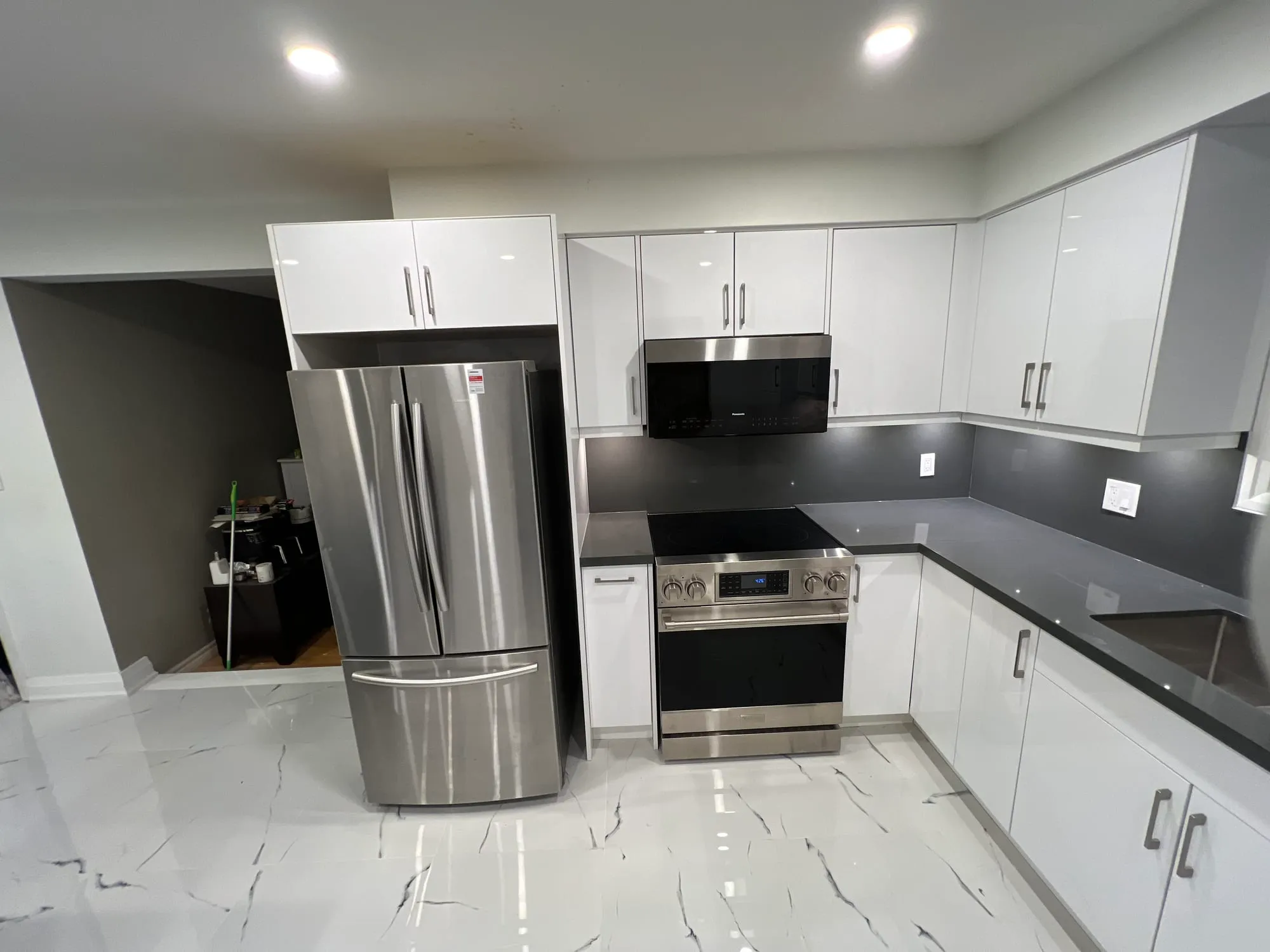
Cabinet refacing and full cabinet replacement solve the same complaint, tired-looking cabinets, from two completely different starting points. Refacing keeps your existing cabinet boxes in place and replaces the doors, drawer fronts, and exposed surfaces. Full replacement tears the whole thing out, boxes included, and starts over. They land in different price brackets, run on different timelines, and only one of them is an option if your layout needs to change. Here's how to tell which one actually fits your kitchen.
Key Takeaways
- Refacing keeps your cabinet boxes and only replaces what you see: doors, drawer fronts, and exposed panels. It only works if those boxes are square, solid, and in a layout you want to keep.
- Refacing runs roughly $3,000 to $13,500 (national average around $8,250) for a typical kitchen and wraps in three to five days. Full replacement runs from about $4,000 for stock boxes to well past $30,000 for custom work, and takes several weeks once you count fabrication and installation.
- Full replacement is the only route if you're moving the sink, changing the footprint, or dealing with water-damaged, out-of-square, or particleboard boxes that won't hold new hardware.
- Cosmetic kitchen work, which is most of what refacing covers, topped the 2025 Cost vs. Value report as the only interior renovation in the top five for return on investment nationally.
What refacing actually changes, and what it doesn't
Refacing leaves your cabinet boxes exactly where they are. A contractor strips or covers the exposed box surfaces with a matching veneer, replaces every door and drawer front, and swaps the hinges, pulls, and knobs. From the front, a refaced kitchen can look indistinguishable from a full replacement. Underneath, it's the same boxes that were there before, in the same layout, at the same height.
That's both the appeal and the limit. Refacing changes what you touch and see every day. But it can't move a cabinet run, add storage where there wasn't a box before, or fix a layout that never worked. If your real complaint is that the kitchen feels cramped or the island is in the wrong place, refacing won't solve that, no matter how good the new doors look. If your complaint is that the cabinets look dated but the layout is fine, refacing solves exactly that problem for a fraction of the cost.
What full replacement changes
Full replacement removes the boxes along with the doors, down to bare walls and floor in the cabinet footprint. That opens up everything refacing can't touch: a different layout, new cabinet heights, and extra storage built into a redesigned run. Boxes get made to whatever size and configuration the new plan calls for, rather than whatever was installed originally.
It also means dealing with everything a demolition uncovers. Pulling old cabinets off the wall exposes the wall and floor behind them, which sometimes reveals water damage, outdated wiring, or plumbing that needs to move anyway. None of that is a reason to avoid replacement. It's often the reason a kitchen needed replacement rather than refacing in the first place. But it's also part of why replacement projects run longer and carry more built-in uncertainty than the demolition step alone suggests.
Cost: what the numbers actually look like
Cabinet refacing for a typical kitchen runs about $3,000 to $13,500, averaging around $8,250, or roughly $100 to $450 per linear foot depending on the door material. Laminate refacing sits at the low end of that range, while solid wood doors and drawer fronts push it toward the top and can run higher on a large kitchen.
Full replacement covers a much wider range because it depends entirely on the cabinet line. Stock cabinets run $100 to $300 per linear foot installed, semi-custom cabinets run $150 to $650 per linear foot, and fully custom work runs $500 to $1,200 per linear foot. A full kitchen of stock cabinets can land close to what refacing costs. A kitchen of semi-custom or custom cabinets runs well past it, often two to five times as much. That's once you add installation, new hardware, and any incidental repairs the demolition turns up.
The honest comparison isn't refacing versus a single replacement number, it's refacing versus whichever cabinet tier you'd actually choose for a full replacement. If you'd replace with stock boxes, the cost gap to refacing is smaller than people expect. If you're set on semi-custom or custom cabinetry, the gap is large enough that it should be the deciding factor on its own for a lot of budgets.
Timeline: days versus weeks
Refacing is fast because the boxes never leave the wall. A typical refacing project wraps in three to five days, and the kitchen stays mostly usable throughout, since there's no full demolition phase.
Full replacement runs longer for structural reasons, not just because more work happens. New cabinets, especially semi-custom or custom lines, have to be fabricated and shipped before installation can start. That lead time alone often runs several weeks before a single box goes in the wall. Once cabinets are on site, installation, counter templating and fabrication, and any plumbing or electrical work add more time on top. A realistic total for a full kitchen cabinet replacement runs from several weeks to a couple of months. The kitchen is largely unusable for a meaningful stretch of that window, not just the install days.
If you're planning around a deadline, a holiday, a sale closing, a new tenant, that timeline gap is often the deciding factor before cost even enters the conversation.
When refacing is the right call
Refacing makes sense when the bones of the kitchen are good and the complaint is purely visual. Specifically:
- The layout works. You're not moving the sink, adding an island, or wishing for a different footprint.
- The boxes are structurally sound. No water damage, no particleboard that's swelled or delaminated, no sagging or racking in the frames.
- The boxes are square and in good condition. New doors and hinges need a true opening to hang correctly. A box that's out of square will show it in every door gap after refacing, the same way it did before.
- Budget and timeline both favour a faster, lower-cost project. Refacing gets most of the visual upgrade of a full remodel for a fraction of the cost and disruption.
We walk this exact assessment on-site as part of our kitchen renovation work in Waterloo. The only way to know if a box will take refacing well is to look at it directly, not from a photo or a phone call.
When full replacement is the right call
Full replacement is the right call when refacing can't reach the actual problem:
- The layout needs to change. Moving plumbing, adding storage, or reconfiguring the room isn't something refacing can do, since the boxes stay put by definition.
- The boxes are damaged or built from materials that won't hold up. Water damage, swollen particleboard, or a box that's already out of square are all reasons a refaced door won't sit right no matter how good the new hardware is.
- You want a materially different storage plan. Deeper drawers instead of shelves, a pantry cabinet where there wasn't one, appliance garages, none of that is achievable by resurfacing an existing box.
- The kitchen is part of a larger renovation anyway. If walls are already coming down or flooring is being replaced, the incremental cost of new cabinets over refacing is smaller than it would be as a standalone decision.
This is the more common path for our kitchen renovation projects in Cambridge and kitchen renovation projects in Hamilton. Older housing stock in those areas often means the layout itself needs to change, not just the finish.
Refacing vs. full replacement at a glance
| Cabinet refacing | Full replacement | |
|---|---|---|
| What changes | Doors, drawer fronts, exposed box surfaces, hardware | Everything, boxes included |
| Typical cost | $3,000 to $13,500 for an average kitchen | $4,000 (stock) to $30,000+ (custom) |
| Typical timeline | 3 to 5 days | Several weeks to a couple of months, including fabrication lead time |
| Can change layout | No | Yes |
| Requires sound existing boxes | Yes | No, boxes are removed |
| Kitchen usability during project | Mostly usable | Largely unusable for the bulk of the project |
| Best fit | Good layout, good boxes, cosmetic complaint | Layout change, damaged boxes, or part of a larger remodel |
What happens to the countertops and backsplash
Refacing usually leaves the countertop and backsplash in place, since neither one depends on the cabinet box being removed. That can be a real advantage if you already like your counters, but it also means a refacing project won't fix a countertop or backsplash you're unhappy with. If those are also due for a change, our comparison of quartz, granite, and laminate countertops and comparison of backsplash materials cover what to weigh alongside the decision. Both projects are usually easiest to plan together rather than as two separate jobs months apart.
Full replacement almost always disturbs the countertop and backsplash regardless of whether you're changing them, since both typically need to come off to remove the boxes underneath. Budgeting for at least a reset of the backsplash, even if the tile itself is reused where possible, is realistic for most full replacements.
A note for smaller kitchens
In a small kitchen, the refacing-versus-replacement decision often comes down to whether the existing layout is actually wasting space, not just looking dated. A cramped galley kitchen with good storage utilization is a strong refacing candidate. A cramped galley kitchen where half the cabinets are dead corner space is a case for replacement, since that's a layout problem refacing structurally can't fix. Our guide to small kitchen renovation ideas goes through the layout changes that make the biggest difference in a tight footprint. It's worth reading before committing to either path if space is the real constraint.
Frequently asked questions
Can I reface cabinets myself to save money?
Some homeowners do the veneer and door swap themselves. But getting a clean, durable result depends on the boxes being perfectly square and the veneer application going on without bubbles or gaps at the seams. A professional refacing job also typically includes new soft-close hinges and drawer slides, which matter more to how the kitchen feels day to day than the surface finish does. A DIY reface can work on simple, square boxes; it's a harder job than it looks on boxes with any wear or slight misalignment.
Does refacing work on painted cabinets or only stained wood?
Both. Refacing can finish in either paint-grade or stain-grade materials, and the choice is about the look you want, not a technical limit of the process. What matters more is the substrate underneath, a veneer or new door needs a stable surface to bond to or hang from regardless of the final colour.
How do I know if my cabinet boxes are good candidates for refacing?
Check three things. The boxes should be square (measure diagonals corner to corner; they should match). There should be no soft or swollen material anywhere, especially at the base near the floor. And the frames shouldn't be racked or pulling away from the wall. A contractor doing an on-site assessment checks all three before recommending refacing over replacement, since a box that fails any of them won't hold a refaced finish well.
Is refacing a good idea before selling a house?
Often yes. Cosmetic kitchen updates, the category refacing falls into, delivered roughly 113% of their cost back at resale nationally in the 2025 Cost vs. Value report, the strongest return of any interior renovation category measured. That number reflects a full minor kitchen remodel rather than refacing in isolation, but cabinet fronts are the largest single visual element in that scope of work.
If I'm already planning a bigger kitchen renovation, does refacing still make sense as part of it?
It can, if the layout in your plan is staying the same and only finishes are changing. But if a bigger renovation already involves moving plumbing, changing the footprint, or opening walls, the incremental cost of new boxes over refacing shrinks considerably. Most of the disruption and labour is happening either way. That's the point where full replacement usually wins on value even if refacing alone would have been cheaper as a standalone project.
Where this fits in a full kitchen renovation
Refacing and full replacement are really two different budgets and two different timelines for solving the same visible problem: cabinets that don't look or work the way you want anymore. Get the layout and box condition assessed honestly before picking one. The wrong choice either overspends on a kitchen that only needed a cosmetic update, or underdelivers on a layout problem no amount of new doors will fix. For the full picture of how cabinets fit into budgeting, sequencing, and planning a kitchen renovation from start to finish, see our complete guide to kitchen renovation in Ontario.