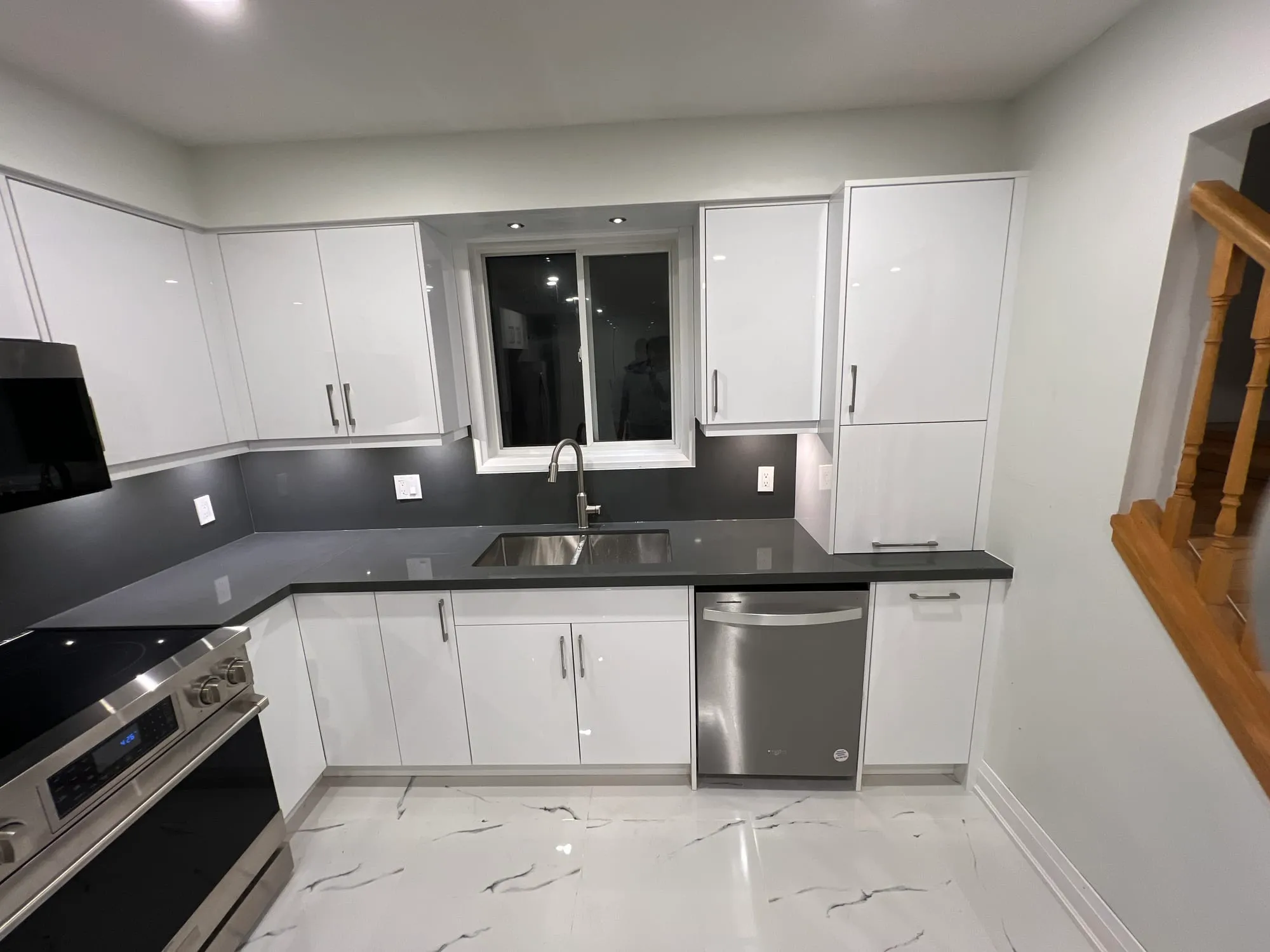
A backsplash is one of the smaller line items in a kitchen renovation by square footage, usually 30 to 40 square feet total. It still carries an outsized share of the visual decision-making, because it sits at eye level behind counters and range. It's also one of the few surfaces in the kitchen where the material choice genuinely changes what daily maintenance looks like, not just how the room photographs. Standard subway tile, porcelain, natural stone, glass, and a full-height quartz slab all solve the "protect the wall behind the counter" problem differently, at different price points and different long-term upkeep.
Key Takeaways
- Cost per square foot varies more than most homeowners expect. Standard ceramic subway tile can run under $10 per square foot installed, while a full-height quartz slab backsplash lands closer to countertop pricing, often $80 to $150 per square foot.
- Porcelain tile and quartz slab are the lowest-maintenance choices. Natural stone looks similar but needs regular sealing to perform the same way.
- Glass tile is the hardest of the common options to install well and the easiest to chip during that install. That's why it usually carries a higher labour cost than the material price alone suggests.
- A full-height quartz or stone slab backsplash removes grout lines entirely, which is a big part of why it's become a popular high-end option in recent kitchen designs.
What actually drives backsplash cost
Backsplash pricing has two separate components: material cost per square foot and labour. The gap between a budget and premium choice usually shows up more in labour than in the tile itself. A straightforward field of 3x6 subway tile in a single line up to the upper cabinets is fast to lay out and cut. A herringbone pattern, a large-format porcelain slab, or anything installed edge to edge in glass takes longer per square foot no matter what the material costs on the shelf.
Total spend across the market is wide. Installed backsplash projects typically run $15 to $40 per square foot, with a full kitchen project landing somewhere between $500 and $1,700 depending on material and pattern. Within that range, the material families below spread out quite differently on cost, upkeep, and how much can go wrong during install.
Subway tile and standard ceramic
Ceramic subway tile is the default backsplash choice for a reason: it's inexpensive, widely available, and forgiving to install. Materials run roughly $2 to $15 per square foot, with labour adding another $5 to $20 depending on pattern complexity, for an installed range around $7 to $35 per square foot.
Standard ceramic isn't as moisture-tolerant as porcelain. Ceramic falls into the non-porcelain category under ASTM C373 water-absorption testing, meaning it absorbs more than 0.5 percent of its weight in water. Porcelain's 0.5 percent or less under that same standard is what classifies it as impervious. Behind a kitchen counter, away from constant direct water contact, that difference rarely matters in practice. It matters more directly behind a sink or a range where splashing is frequent. Maintenance is otherwise simple: grout is the only part that needs periodic attention, since it stains and can crack over years if never sealed. A classic subway layout in a running bond or herringbone pattern is also one of the easiest choices to keep timeless for a homeowner renovating a kitchen they plan to sell into eventually. It reads as neutral rather than trend-specific.
Porcelain tile
Porcelain is a denser, more refined version of the same fired-clay family as ceramic, and its main advantage over ceramic is durability and moisture resistance rather than looks alone. Materials cost more, generally $4 to $20 per square foot, with labour running $12 to $40 per square foot. Porcelain is harder and takes more effort to cut cleanly, especially in large-format slabs.
That density is also what makes porcelain the more durable choice of the two. Water absorption of 0.5 percent or less under ASTM C373 means porcelain resists staining, doesn't wick moisture the way ceramic can, and holds up to scratching better over the life of a kitchen. Large-format porcelain panels, some manufactured thin enough to run a full backsplash height in one or two pieces, have become common for a simple reason: they remove most of the grout lines a standard tile field would otherwise need. That gets closer to the look of a slab without the stone price. For a kitchen going through a full renovation where counters, cabinets, and backsplash are being planned together, our kitchen renovation work in Guelph usually specs porcelain over standard ceramic on exactly this durability trade. The labour premium is smaller than the material premium once porcelain is already scheduled alongside cabinet and counter installation.
Natural stone
Marble, travertine, and slate give a kitchen a look no manufactured material fully replicates, and that's the entire case for choosing them. The trade-off is maintenance. Marble and travertine are naturally porous, and both need periodic resealing to keep oils, wine, and general kitchen splashing from staining the stone itself. Marble needs it roughly every 6 to 12 months, travertine as often as every 6 months in higher-moisture spots. Marble also etches from acidic contact: a dulled or dish-shaped mark from something as ordinary as lemon juice or vinegar left too long. That etching isn't something a reseal fixes after the fact.
Cost sits at the high end, generally comparable to or above porcelain per square foot once slab-cut stone and skilled installation are factored in. It climbs further for a bookmatched or full-slab layout. Slate is a partial exception: it's naturally less porous than marble or travertine and holds up with less frequent sealing, though it still needs some. Natural stone is the right call when the look is the priority and a homeowner is genuinely willing to reseal on schedule. It's the wrong call for a low-maintenance kitchen, since skipping resealing is how a marble backsplash ends up permanently etched within a few years.
Glass tile
Glass tile is the most visually distinct option here, translucent and reflective in a way no ceramic or stone product matches, and it's also the hardest to install well. It costs $5 to $25 per square foot in materials, similar to mid-range ceramic, but installed pricing runs up to $45 per square foot because of the labour involved. Glass chips easily during cutting and needs a diamond wet saw and a slow, precise hand to get a clean edge without shattering the piece. A contractor without glass-specific experience produces visibly rougher cuts and more wasted tile than the same job in ceramic or porcelain.
Once installed, glass holds up reasonably well day to day: it doesn't stain or absorb moisture, and cleaning is simple since nothing soaks in. The risk is concentrated almost entirely in the install itself and in point impacts afterward. A dropped pan or a hard knock can chip an individual tile in a way that's more visible on glass than on a textured ceramic surface. Glass makes the most sense as an accent strip or a feature area behind a range rather than a full wall-to-wall field. That's both for cost reasons and because a smaller area limits how much of the harder cutting work is needed.
Quartz slab, the full-height backsplash
The newest shift in backsplash choices isn't a new material, it's a new way of using an existing one. Running the same quartz slab used for the counter straight up the wall behind it, a full-height or "waterfall" backsplash, has become a popular high-end kitchen design choice in recent renovation work. It eliminates grout lines entirely and reads as one continuous surface from counter to upper cabinet.
Cost is the trade-off, and it's a real one. A quartz slab backsplash prices closer to countertop work than to tile, generally $80 to $150 per square foot installed, several times what porcelain or subway tile costs per square foot. Quartz is engineered rather than quarried, which means it's non-porous and needs no sealing, unlike a natural stone slab used the same way. It also needs to be templated and cut precisely against the existing countertop for the seam to disappear, which is a fabrication step rather than a tile-setting one. If you're comparing quartz against granite or laminate for the counter itself before deciding whether to extend it up the wall, our comparison of quartz, granite, and laminate countertops is a useful next read. It covers how those three hold up against each other on the same cost and durability questions. A full-height quartz backsplash is usually decided at the same time as the counter. Ordering it as a separate slab later means matching a seam and colour lot that may no longer be in production.
Comparing the options side by side
| Material | Installed cost per sq ft | Maintenance | Install complexity | Durability |
|---|---|---|---|---|
| Ceramic subway tile | $7-$35 | Low; grout needs periodic cleaning or sealing | Low; straightforward cutting and layout | Good; more porous than porcelain |
| Porcelain tile | Roughly $16-$60 | Very low; effectively moisture-proof | Moderate; harder material, more cutting effort | Excellent; outlasts standard ceramic |
| Natural stone (marble, travertine, slate) | Comparable to or above porcelain | High; regular resealing required | Moderate to high depending on slab size | Good if maintained; etches and stains if not |
| Glass tile | $10-$45 | Low once installed; doesn't stain or absorb | High; chips easily, needs a diamond wet saw | Good day to day; vulnerable to point impacts |
| Quartz slab (full height) | $80-$150 | Very low; non-porous, no sealing | High; precise templating and fabrication | Excellent; no grout lines to maintain |
Frequently asked questions
What's the cheapest backsplash material that still holds up well?
Standard ceramic subway tile is the least expensive option that performs reliably behind a counter, generally $7 to $35 per square foot installed. Porcelain costs more but is worth the difference directly behind a sink or range, where its lower water absorption matters more.
Does a full-height quartz backsplash cost more than tile because of the material or the labour?
Both, but the material is the bigger factor. Quartz slab pricing already runs close to $80 to $150 per square foot as a countertop material. Using it as a backsplash adds precise templating against the existing counter rather than changing the material price itself.
Is natural stone a bad choice for a busy family kitchen?
Not automatically, but it demands more upkeep than most families realize going in. Marble and travertine need resealing on a schedule, roughly every 6 to 12 months, and marble specifically etches from acidic splashes in a way that isn't reversible. If the household isn't going to keep up with sealing, porcelain or quartz gives a similar upscale look without that maintenance requirement.
Can I mix backsplash materials, like tile behind the counter and quartz behind the range?
Yes, and it's a common way to control cost. A field of porcelain or ceramic across most of the run, with a small glass or quartz feature area behind the range or over the sink, gets most of the visual impact of the premium material. It does so at a fraction of the total square footage cost.
Does the backsplash choice affect the rest of the kitchen renovation budget?
It's usually one of the smaller line items by square footage, but it interacts with cabinet and counter decisions since all three typically get finalized and installed together. Our complete guide to kitchen renovation budgeting and planning in Ontario breaks down where backsplash and other finishes fit against the bigger costs like cabinetry and layout changes.
Where backsplash fits in the bigger renovation
Backsplash material is one of the last decisions made in a kitchen renovation, but it's worth deciding early enough that it doesn't get rushed against a cabinet or counter delivery date. If cabinets are also on the table, our comparison of cabinet refacing against a full replacement is a useful companion read. The scope of that decision affects how much wall is actually exposed for a new backsplash to cover. We've run this decision alongside full kitchen renovations in Oakville and Cambridge. The right material usually comes down to how the household actually uses the kitchen day to day, not just which one looks best in a showroom sample.