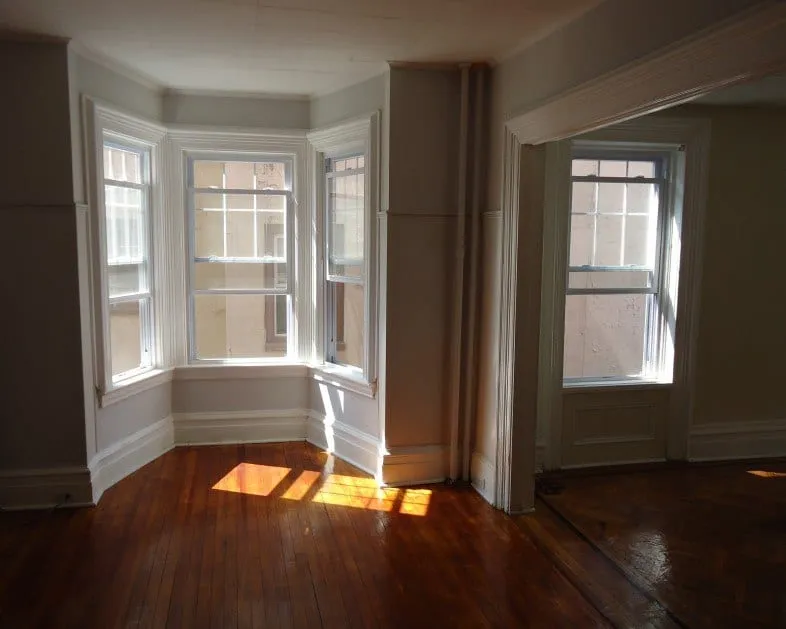
If you've already ruled out laminate and vinyl and decided this floor is going to be real wood, the next question is which kind of real wood. Engineered and solid hardwood look close to identical once they're installed and finished, and that's exactly what makes the decision harder, not easier. The difference is underneath the surface: how the plank is built, what it tolerates, and what happens to it fifteen years from now. If you're still weighing wood against laminate or vinyl in the first place, our comparison of hardwood, laminate, and vinyl flooring for Ontario homes is the better starting point. This one assumes you're past that and picking between the two kinds of hardwood.
Key Takeaways
- Solid hardwood is one piece of milled wood top to bottom; engineered hardwood is a real hardwood wear layer bonded over cross-laminated plywood, which is what lets it handle humidity swings a solid board can't.
- Installed cost runs roughly $9 to $20 per square foot for engineered against $11 to $25 for solid, and most of that gap is labour: engineered's click-lock and glue-down methods install faster than nailing solid boards one at a time.
- A solid floor can typically be sanded and refinished 4 to 6 times over a 75-to-100-year life; an engineered floor's refinishing count depends entirely on wear layer thickness, and anything under about 2.5mm can't be sanded at all.
- Solid hardwood has no place in an Ontario basement or over a concrete slab. Engineered can work there, but only with a tested slab, real vapour management, and summer dehumidification, and even then it's a narrower fit than upstairs.
- Engineered installs by floating, glue-down, or nail-down over almost any subfloor including concrete; solid is nailed or stapled to a wood subfloor and generally can't go over slab at all.
| Solid hardwood | Engineered hardwood | |
|---|---|---|
| Construction | One piece of milled hardwood, full thickness | Real hardwood wear layer over cross-laminated plywood core |
| Installed cost | Roughly $11-$25 per sq ft | Roughly $9-$20 per sq ft |
| Installation methods | Nail-down or staple-down, wood subfloor only | Floating, glue-down, or nail-down; works over concrete |
| Refinishing | 4 to 6 sandings over its life | Depends on wear layer; 1 to 4 sandings, sometimes zero |
| Typical lifespan | 75 to 100+ years | 20 to 40 years, wear layer dependent |
| Below-grade / over slab | Not recommended | Possible in tested, dehumidified conditions only |
| Humidity tolerance | Moves the most with seasonal RH swings | More stable; cross-laminated core resists movement |
How the two are actually built
Solid hardwood is exactly what the name says: a single piece of hardwood, usually 3/4 inch thick, milled with a tongue on one edge and a groove on the other so boards lock together edge to edge. Every fibre in that board runs the same direction, top to bottom, which is also why it moves the way it does with humidity. There's nothing engineered about the structure beyond the tongue-and-groove profile itself.
Engineered hardwood starts with a real hardwood veneer, the wear layer, the part you actually walk on and eventually sand. That veneer is bonded over a core of several cross-laminated plywood plies, each layer running its grain perpendicular to the one below it. That cross-lamination is the whole point: it's the same principle that makes plywood more dimensionally stable than a solid plank of the same species, and it's why an engineered floor resists cupping and gapping that a solid floor doesn't.
The wear layer is also the number that decides an engineered floor's ceiling. A thin veneer, in the 1 to 2mm range, is essentially a finish-life floor: no sanding, ever. A thicker veneer, 4mm or more, closes the gap with solid wood on refinishing and lifespan while keeping the stable core underneath. Two floors that look identical in a showroom can have very different veneers, so ask the specific number rather than assuming "engineered" means one standard product.
Cost per square foot: what's actually driving the gap
Pricing for both materials spans a wide range depending on species, grade, and finish, but the pattern holds across sources: engineered runs roughly $9 to $20 per square foot installed, and solid runs roughly $11 to $25, according to HomeGuide's cost comparison of engineered versus solid hardwood. Material cost alone is closer between the two than the installed total suggests. Most of the real gap is labour: engineered's floating and glue-down systems install considerably faster than nailing solid boards down one row at a time, which is where a meaningful chunk of the price difference actually comes from rather than the wood itself.
That labour difference also shows up in how disruptive the job is. A floating engineered floor over an existing subfloor can sometimes go down in a day or two for a single room; solid hardwood, nailed board by board and often site-finished afterward, runs longer. For a broader breakdown of where flooring costs actually come from across every material, not just these two, our flooring cost per square foot comparison walks through the full range.
Installation method and what's underneath the floor
This is where the two materials genuinely part ways, not just in preference but in what's physically possible. Solid hardwood is nailed or stapled down through the tongue, and it needs a wood subfloor to nail into. It generally can't be glued or floated over concrete, which rules it out for a slab-on-grade room without a wood subfloor already built over that slab.
Engineered hardwood isn't tied to one method. It can float, with planks clicking together over an underlayment and no fastener touching the subfloor at all, which is the fastest install and the most forgiving of a subfloor that isn't perfectly flat. It can glue down directly to concrete, which is the standard approach when there's no wood subfloor to nail into. And thicker engineered products can still be nailed down over wood subfloors the same way solid hardwood is, when a fully rigid, no-flex feel matters more than install speed.
That flexibility is also why engineered is the wood floor that goes over radiant heat, when it goes over hardwood at all. The cross-laminated core handles the gentle, sustained warmth of a heated subfloor better than a solid board, which expands and contracts more with every heating cycle. If radiant heat is part of the plan, our guide to radiant heating under new flooring covers which floor types actually pair with it and which don't.
Older housing stock changes this calculation. A lot of homes with original strip hardwood under later carpet or vinyl were built on wood subfloors, sometimes diagonal board rather than plywood, and in those houses refinishing what's already there can beat tearing it out for something new. That's common enough that a hardwood flooring installation in Hamilton, where close to a third of the housing stock predates 1960, often starts with pulling back the existing floor covering to see what's underneath before quoting anything new.
Moisture and humidity tolerance: the part Ontario actually tests
Wood is hygroscopic. It absorbs moisture from humid air and releases it in dry air, and it changes dimension doing both. The generally accepted comfort band for hardwood flooring is 35 to 55 percent relative humidity year-round, and Ontario's climate makes that band harder to hold than it looks on paper: a below-grade room can sit at 60 to 70 percent through an Ontario August, then swing to a dry, heated 20-something percent by February. That swing, not the average, is what actually drives cupping in summer and gapping in winter, and solid hardwood is the material that shows it most.
That's also why solid hardwood generally doesn't belong in an Ontario basement, according to Alexanian's guide to hardwood flooring in a basement, which notes that no installation method corrects for the dimensional movement a below-grade humidity swing causes in solid wood. Engineered can work below grade, but only in a narrow set of conditions: a slab tested and passing a calcium chloride moisture test (manufacturers typically cap it around 3 to 5 lbs per 1,000 square feet per 24 hours), a proper vapour barrier, and summer dehumidification to keep the room inside that 35-to-55 band rather than drifting toward the 60-to-70 percent an untreated basement reaches on its own. Even then, it's a "safer, not safe" answer, not a guarantee. Our own breakdown of flooring options for a below-grade basement goes deeper into which materials actually hold up down there.
This isn't only a basement issue. Guelph draws most of its municipal water from groundwater wells over limestone and dolomite bedrock, and a slab there with no vapour barrier beneath it releases moisture regardless of the geology sitting above it, which is exactly the condition that makes flooring installation in Guelph a place where we test slab moisture before installing anything bonded to concrete, solid hardwood included. The same logic applies to any concrete-slab main floor, not just a finished basement: if there's a slab under the subfloor anywhere in the plan, that's the point in the job where solid hardwood needs a second look.
Refinishing limits: how many times, and for how long
Solid hardwood's value proposition over decades comes down to this: a 3/4-inch board has enough material above the tongue and groove to be sanded and refinished 4 to 6 times over its life, and with that care it can last 75 to 100 years or more. Each sanding removes roughly 1/32 inch of wood, so the board needs a real margin above the tongue to survive more than a couple of passes.
Engineered hardwood's refinishing life is set entirely by its wear layer thickness, and the National Wood Flooring Association's sand-and-finish guidelines put a hard floor under that number: a wear layer under roughly 2.5mm (3/32 inch) shouldn't be sanded at all. Above that threshold, the math is fairly linear. A 3mm wear layer generally supports one standard refinish. A 4mm layer supports around two. A 5mm-plus wear layer, the kind found on premium engineered lines, can support roughly four refinishes before dropping below the safe threshold, which starts to close the gap with solid wood's own lifespan. That range is also why engineered hardwood's overall lifespan is quoted so much more broadly than solid's, typically 20 to 40 years, with the thicker-veneer end of that range doing meaningfully better than the thin end.
The practical takeaway: if refinishing capacity matters to you, don't take "engineered" as a single answer. Ask for the wear layer thickness in millimetres before you buy, the same way you'd ask a tile setter about grout type. It's the one spec that tells you what this floor's second and third decade actually look like.
Resale perception
Buyers and their agents generally treat both as "real wood" rather than drawing a hard line between them. Where the perception gap shows up is in the specific room. Solid hardwood in a main-floor living or dining room reads as the traditional, expected finish in an older or higher-end home, especially one where original hardwood is part of the property's actual history. Engineered reads as an entirely normal, often preferred choice in newer builds, condos, and any room where a concrete subfloor makes solid impractical in the first place, which describes a meaningful share of the units in a flooring project in Mississauga, where postwar suburban construction and a significant share of condo and high-rise living put wood subfloors and no-slab installs at a premium.
Where the perception does turn negative is a mismatch between the floor and the room: solid hardwood installed over a basement slab that later cups and gaps reads as a renovation mistake, not a design choice, and that's a worse resale outcome than either material handled correctly would have produced.
Which one actually fits your floor
Choose solid hardwood if the room is above grade, over a wood subfloor, in a home where the character of a nailed, site-finished floor matters, and you're planning to own the house long enough to get real value out of multiple refinishing cycles.
Choose engineered hardwood if there's a concrete slab anywhere in the installation path, the room sits below grade or over radiant heat, you want a faster and less disruptive install, or you're renovating a condo or newer build where a floating or glue-down system is the only realistic option in the first place.
Either choice interacts with the rest of the room, and the house, more than the flooring aisle makes it look. If you're weighing where this decision fits into a larger renovation plan, our complete guide to flooring and interior painting for Ontario homes covers how flooring choices line up with paint, trim, and the rest of the room around it. If you want a straight answer on which one fits your specific subfloor and budget, we can walk the space and test what's actually underneath before you commit to either.
Frequently asked questions
Can engineered hardwood be refinished as many times as solid hardwood?
Not usually. Solid hardwood typically supports 4 to 6 sandings over a 75-to-100-year life because there's a full 3/4 inch of material to work with. Engineered hardwood is capped by its wear layer: a 3mm veneer supports roughly one refinish, a 5mm-plus veneer can support around four, and anything under about 2.5mm can't be sanded at all. Ask for the wear layer thickness in millimetres before buying if refinishing matters to you.
Is engineered hardwood actually cheaper than solid?
Usually, yes, installed. Engineered typically runs $9 to $20 per square foot installed against roughly $11 to $25 for solid, and most of that gap comes from labour rather than materials, since engineered's floating and glue-down systems install faster than nailing solid boards one at a time.
Can I put solid hardwood in a basement if I run a dehumidifier?
Not recommended, even with dehumidification. Solid hardwood's dimensional movement in a below-grade humidity swing isn't something an installation method or a dehumidifier reliably corrects for. Engineered hardwood is the material that can work below grade, and only with a tested slab, a real vapour barrier, and consistent summer dehumidification, not as a substitute for solid.
Does engineered hardwood look cheaper than solid hardwood?
Not once it's installed and finished. The wear layer on a quality engineered floor is real hardwood, sanded and finished the same way solid wood is, and most people can't tell the two apart by looking at the surface. The visible difference, if there is one, usually comes from a thin, low-grade veneer rather than the engineered category itself.