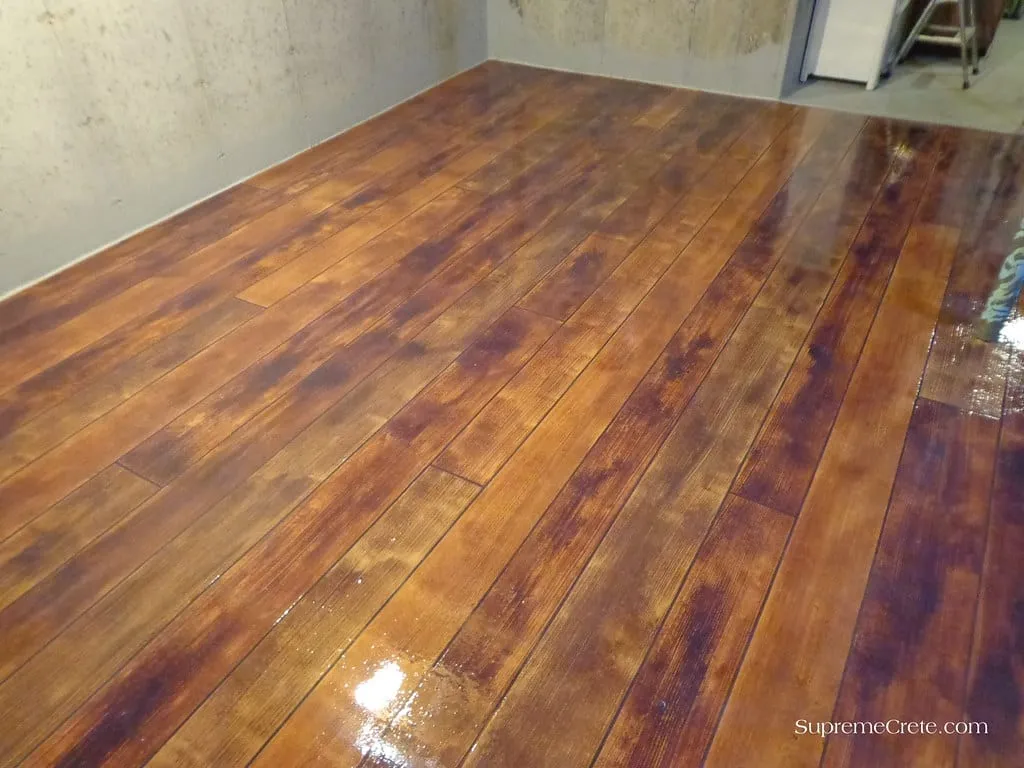
A basement floor sits directly on a concrete slab that's below grade, in contact with soil, and cooler than any floor upstairs even in a basement with no active water problem. That combination rules out one common flooring choice outright and changes how the rest perform: comfort, durability, and what happens if the slab ever gets damp again. This assumes the moisture source itself is already fixed. If it hasn't been, start with basement waterproofing before finishing, because no flooring choice below survives a wall or slab that's still actively wet.
Key Takeaways
- Solid hardwood is a poor fit below grade. It wasn't engineered for the moisture and temperature swings a basement slab produces, and it can cup, gap, or warp even over a slab that looks and tests dry.
- Luxury vinyl plank and rigid core products handle basement conditions the best of the widely available options: fully waterproof, stable through temperature swings, and reasonably priced.
- Engineered hardwood can work below grade, but only a version specifically rated for it, with a moisture-resistant core and a click-lock or fully-adhered install. Standard engineered hardwood sold for main-floor use is not automatically safe down there.
- Porcelain and ceramic tile are the most moisture-tolerant option of all, at the cost of a cold, hard surface underfoot unless paired with in-floor heat.
Why below-grade flooring is a different problem
A main-floor room sits over a joist bay with air on both sides of the subfloor. A basement floor sits on a slab poured against soil, and that soil holds moisture year-round. Even a basement with a properly diagnosed and fixed water problem, sound weeping tile, a working sump, no active seepage, still has a slab that runs cooler than the air above it. That slab can wick a small, steady amount of moisture upward through the concrete by capillary action. That's normal. It's also exactly the condition a flooring material either tolerates or doesn't.
Two other factors compound it. Basements run higher baseline humidity, especially in summer when warm, humid air meets a cool slab. And a below-grade room sees less airflow and daylight, so trapped moisture in a flooring assembly takes longer to dry out than it would upstairs. None of this means a basement can't have good flooring. It means the flooring has to be chosen for that environment, not carried down from what worked on the main floor.
Why solid hardwood doesn't belong below grade
Solid hardwood is a single piece of wood, and wood is hygroscopic: it absorbs and releases moisture from the air around it, expanding and contracting as it does. Manufacturers rate solid hardwood for installation on or above grade, over a wood subfloor with air movement underneath, because that's the environment it was engineered to move within. A basement slab doesn't give it that. Moisture coming up through the concrete, even at levels too low to see or smell, is enough to swell the wood from below while the drier basement air pulls moisture out of the top face at a different rate. The result is cupping (the edges of each board rising higher than the center), or in bad cases, boards that lift, buckle, or separate at the seams.
This can take a while to show up, which is part of why it catches people off guard. A solid hardwood floor installed in a basement can look fine through a full winter, before the following summer's humidity or a wet spring finally moves enough moisture through the slab to start the cupping. By then it's a full floor replacement, not a touch-up. The National Wood Flooring Association's installation guidelines state plainly that solid wood flooring should not be installed below grade unless a manufacturer specifically recommends otherwise, and it's the actual failure mode we've seen in basements finished before the client called us.
Luxury vinyl plank and rigid core
Luxury vinyl plank, and the stiffer rigid-core and SPC (stone plastic composite) products built on the same idea, are made from layers of PVC or composite material with a printed wood or stone-look wear layer on top. None of that is moisture-sensitive the way wood is. A quality LVP or rigid-core product is fully waterproof through its full thickness. It doesn't care that the slab beneath it runs cooler or carries a bit of ambient moisture, and it doesn't expand and contract with humidity the way wood does.
Underfoot, it's warmer than tile and more forgiving than a hard surface, though not as soft as carpet. Most basement LVP installs go down as a floating floor with a thin foam or cork underlayment, adding a bit of cushioning and sound dampening. Where an existing slab isn't perfectly flat, floating LVP is also more forgiving of minor unevenness than a fully adhered product, without an expensive self-leveling pour first.
Cost sits in the budget-to-mid range of the options here, and durability is strong: a good wear layer resists scratches and dents well enough for daily basement use, pets included. This is the flooring we install most often in finished basements across our service area, flooring in Waterloo included, because it clears the moisture concern without a tile-level premium.
Engineered hardwood, but only the below-grade-rated kind
Engineered hardwood is a real wood veneer bonded over layers of plywood or high-density fibreboard, and that layered construction is more dimensionally stable than solid wood, since each layer's grain runs a different direction and resists the wood's natural tendency to move. That stability is why engineered hardwood can work below grade at all. It is not why every engineered hardwood product is safe to install there.
The distinction that matters is whether the specific product is rated by its manufacturer for below-grade installation. A below-grade-rated engineered product typically pairs a moisture-resistant core (rather than a standard plywood or MDF core that can still swell) with a floating click-lock installation or a fully adhered method using a moisture-blocking adhesive. Both limit how much ambient moisture the flooring actually contacts. A standard engineered hardwood sold for a main-floor kitchen or living room, even with a real wood veneer that looks identical, often uses a core and installation method never tested against basement conditions. Installing it down there voids the manufacturer's warranty outright, even where it happens not to fail.
Read the actual product specification, not the marketing photo, before buying engineered hardwood for a basement. If a product doesn't explicitly say it's approved for below-grade use, treat it the same as solid hardwood and rule it out. Where it is rated correctly, it gives a basement the warmer, more traditional look of real wood that LVP's printed wear layer can't fully match, at a cost premium over LVP and with less forgiveness for a slab that isn't flat.
Porcelain and ceramic tile
Tile is the most moisture-tolerant flooring option that exists for a basement, full stop. Porcelain and ceramic are fired clay products, inert to water. Industry testing under ASTM C373 classifies porcelain tile as impervious, with water absorption of 0.5% or less. A properly installed tile floor with good grout and a below-slab vapour barrier already in place handles ambient basement moisture with essentially no risk of the material itself failing. That makes tile the default answer for a basement bathroom, laundry area, or mechanical room, anywhere water might actually reach the floor directly rather than just move through the slab from below.
The tradeoff is comfort. Tile is hard and cold, more so in a basement than upstairs, since it's sitting directly on the coolest surface in the house. A basement family room floored entirely in tile reads as noticeably less comfortable than the same room in LVP or engineered hardwood, especially in bare feet in winter. In-floor radiant heat under the tile solves that and is a common enough pairing in basement bathrooms to budget into the same project, since retrofitting it under an already-installed floor means tearing the floor back out.
Cost runs from mid to premium depending on the tile and layout complexity (a straight grid lays cheaper than a herringbone or a large-format tile needing a dead-flat substrate). Durability is excellent; a well-installed porcelain floor outlasts every other option here, with cracked grout being the most common maintenance issue over time rather than the tile itself failing.
Basement-rated carpet tile
Carpet tile built specifically for below-grade use is a different product from residential broadloom carpet. It uses a backing designed to resist moisture wicking and mold growth. Because it's installed in modular squares rather than one continuous roll, a section that gets wet, from a rare backup or a spill, can be lifted and replaced individually instead of forcing a full floor tear-out. That modularity is the real advantage over broadloom in a basement, not the look.
Comfort is the strongest case for carpet tile: it's the warmest, softest option underfoot on this list, which matters in a basement used as a playroom, home gym, or media room where people sit or lie on the floor directly. It's a poor choice anywhere moisture is a realistic risk beyond ambient dampness, a basement bathroom or an area near a sump pit, since even a moisture-resistant backing isn't the same as the fully waterproof construction LVP offers. Cost is generally budget to mid-range. Standard residential carpet, the kind sold for a bedroom upstairs, should be treated the same way as solid hardwood here: not designed for this environment, and prone to trapping moisture against the slab in a way that shows up as a musty smell before it shows up as visible damage.
Comparing the options side by side
| Flooring | Moisture tolerance | Comfort underfoot | Relative cost | Durability |
|---|---|---|---|---|
| Luxury vinyl plank / rigid core | Fully waterproof, handles ambient slab moisture well | Warm-ish, some cushioning with underlayment | Budget to mid | High; scratch- and dent-resistant wear layer |
| Engineered hardwood (below-grade rated only) | Good, if the specific product is rated for it | Warmest of the hard-surface options | Mid to premium | High if installed correctly; voids warranty if misused |
| Solid hardwood | Poor; not designed for below-grade moisture or temperature swings | Warm | Mid to premium | Prone to cupping, gapping, warping below grade |
| Porcelain / ceramic tile | Excellent; effectively moisture-proof | Cold and hard without in-floor heat | Mid to premium | Excellent; outlasts every other option here |
| Basement-rated carpet tile | Moderate; resists wicking but not a wet event | Warmest and softest option | Budget to mid | Good; individual tiles replace without a full tear-out |
Frequently asked questions
Can I put any laminate flooring in a basement?
No. The same distinction that applies to engineered hardwood applies to laminate. Standard laminate uses a fibreboard core that swells if it takes on moisture, and most laminate isn't rated for below-grade use, per the North American Laminate Flooring Association's own guidance on moisture-sensitive installations. Waterproof laminate and rigid-core products built for wet or below-grade areas exist and perform closer to LVP, but check the manufacturer's rating rather than assuming a laminate aisle product is basement-safe by default.
Does a waterproofed basement still need moisture-tolerant flooring?
Yes. Waterproofing fixes active leaks and manages water at the wall and slab, but a below-grade slab still runs cooler and carries some baseline moisture through capillary action even when everything else works correctly. Flooring choice is a second, separate layer of moisture management on top of a waterproofed basement, not a substitute for it.
Is heated flooring worth it in a basement?
For tile, often yes, since it solves the one real drawback of an otherwise excellent basement material. For LVP or engineered hardwood, it's less necessary since both already run warmer underfoot, though some homeowners still choose it for an even more comfortable family room or bedroom.
What flooring is best for a basement with a history of moisture problems?
Fix the moisture source first, always. Once that's done, luxury vinyl plank or rigid core is generally the safest choice for a basement with any history of dampness, since it tolerates ambient slab moisture without the risk profile of wood-based products, and a section can be replaced individually if damaged.
Can I mix flooring types in one basement?
Yes, and it's common. Tile in a basement bathroom or laundry area, LVP or engineered hardwood through the main living space, is a normal split that matches each material to what that room actually needs rather than flooring the whole basement in one material for consistency alone.
Getting the floor right on top of everything else
Flooring is the finish layer, but it only performs as well as everything underneath it: a slab with a working vapour barrier, a moisture problem actually diagnosed and fixed rather than covered over, and a subfloor system suited to whichever material you choose. Get those right and luxury vinyl plank, a properly rated engineered hardwood, tile, or basement-rated carpet tile can all be the right call depending on the room. Get them wrong and no flooring choice on this list will save the project. For the actual slab-testing steps, vapour barrier requirements, and how to choose between a raised subfloor panel and an epoxy coating, see how to test and prep a basement slab before flooring goes down.
For the fuller picture of how flooring fits into a basement renovation start to finish, layout, permits, ceiling height, moisture control, see our complete guide to basement renovations in Ontario. If you're planning a basement project in Kitchener or St. Catharines, we can walk the space and tell you which of these options actually fits your slab.