Key Takeaways
- A straight walkway is right when the shortest route is also the one people actually want to take. A curve earns its place when it follows how the yard is used, not because it looks softer on a drawing.
- Curves cost more than the concrete itself accounts for. Forming a bend eats more material, more stakes, and more layout time than a straight run of the same length, before a bag of cement changes hands.
- A curve changes joint layout, screeding technique, and how the edge reads next to planting. Those are decisions made before the pour, not finishing touches added after.
Straight or curved: what actually decides it
Most homeowners pick a shape first and ask questions later. That's backward. Three things decide whether a walkway should run straight or curve: how people already move between the two points it connects, how much yard the curve is going to take up, and what the walk ties into at each end. Get those three right and the shape almost picks itself.
This post is about form, straight versus curved, and what each one actually takes to build well. It's not about how wide the walk should be or what slope it needs to shed water. Those are separate questions with separate answers, and we've written about them in full in our guide to walkway width and code requirements. Settle the dimensions there first. Everything below assumes you already know how wide you're pouring.
1. Follow the desire line before you follow the property line
Watch a worn track of dirt cutting across a lawn next to a paved path. That's a desire line: the route people actually walk when the built path doesn't match how they'd naturally get from one point to another. A 2019 study in Landscape and Urban Planning mapped more than 5,680 of these unofficial footpaths across Detroit's vacant land, totalling over 150 miles. Every one of them was someone voting with their feet against the route actually built for them. Pedestrians are stubborn about this. Research on pedestrian behaviour in the Journal of Urban Planning and Development found people keep choosing the shorter, more direct route even when it's fenced off or signed closed, not just when it's simply unpaved.
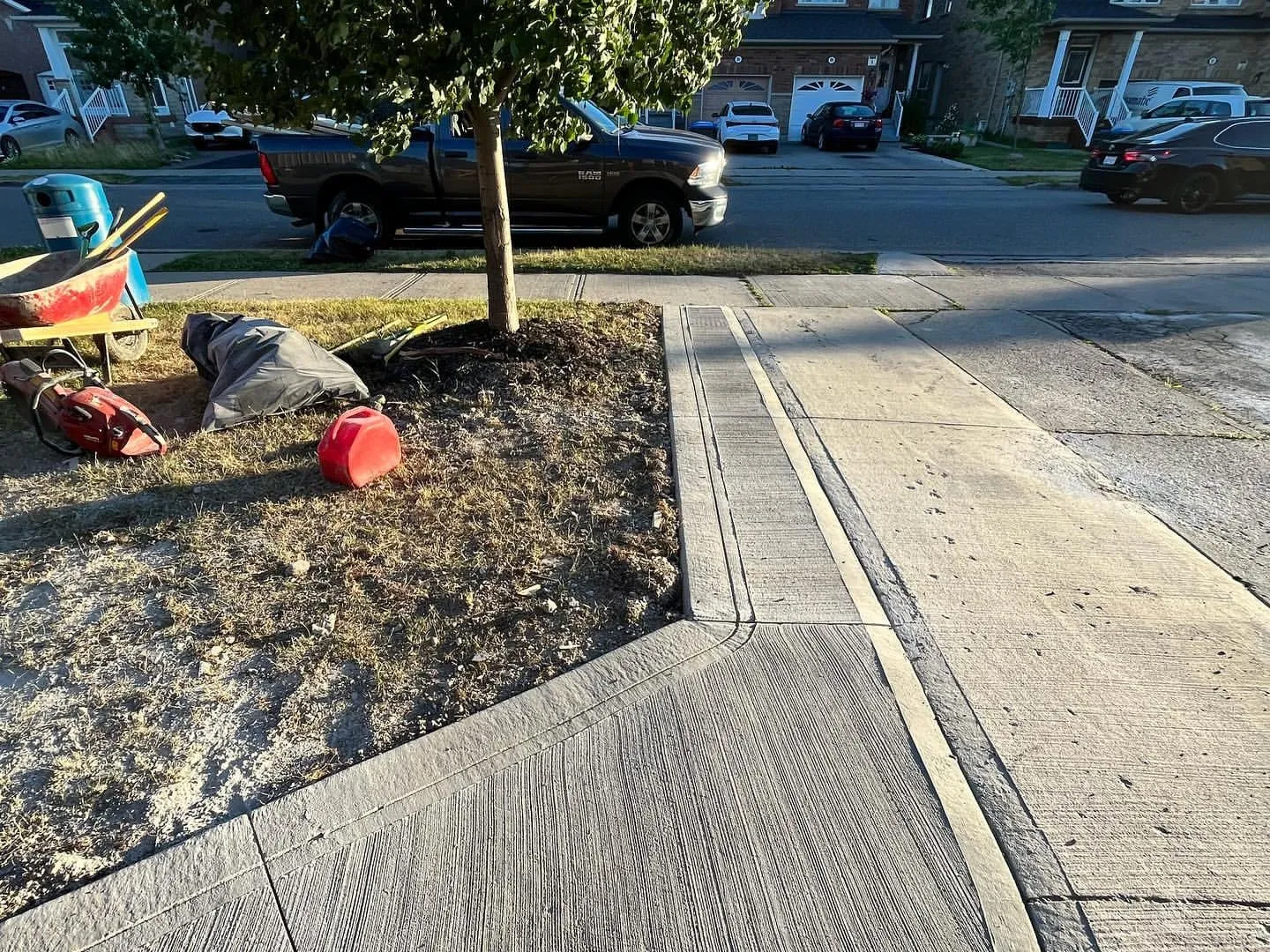
A front walkway is a much smaller version of the same problem. Say your straight line from the driveway to the door has a corner in it, or angles away from where people naturally step off a car. Expect a worn patch of lawn at that corner within a season, no matter how good the concrete is. The fix isn't a "no shortcuts" sign. It's laying the walk on the line people already walk, whether that line is straight or curved, before you decide what the finished path should look like. Stand where the walk starts, watch where your own feet want to go, and mark that line before you call a contractor.
2. A tight curve costs more to form than a straight run
Concrete doesn't know the difference between straight and curved, it takes the shape of whatever holds it while it's wet. The cost difference between the two is entirely in that holding: the forms, the stakes, and the time it takes to lay them out correctly. A straight run gets two long boards, a string line, and a handful of stakes. A curve needs the form material bent and held to a consistent radius for the entire length of the bend, checked and re-checked before the pour. Skip that check and a form that creeps even slightly under the weight of wet concrete leaves a visible flat spot in an otherwise smooth curve.
The tighter the curve, the more that holding work adds up. Standard dimension lumber, the same boards used on every straight run, only bends so far before it either cracks or fights the stakes out of line. Past that point, the curve needs different forming material, and more of it per linear foot than a straight section would. Here's the honest answer to "how much more does a curve cost": more in forming labour and material, not more in concrete. The yardage difference between a straight and curved run of equal length is negligible. A gentle sweep barely notices that difference, while a tight, serpentine path with multiple bends adds real time before the truck ever shows up.
3. Flexible forming is what makes a curve buildable
Which forming method fits depends on how tight the bend is:
- Wide, gentle sweep: standard boards scored partway through with a saw, which lets the wood flex without splitting.
- Tighter curve: thin, flexible hardboard or bendable form strip made to hold a curve without cracking.
- Either way: more stakes per foot than a straight run, since there's more force trying to push the form back toward flat.
This is also where a curve either looks intentional or looks like a mistake. A form that isn't held tight and consistent telegraphs straight through to the finished edge: a wavy line where you wanted a clean arc, or a series of short straight segments faking a curve instead of one continuous sweep. A curve is only as good as the form that shaped it. That form only holds if it's checked before the pour starts, not adjusted after the concrete is already in.
4. Curves change your joint layout, not just your edge
Control joints on a straight walkway are the easy case: cut them perpendicular to the direction of travel, spaced to match the slab's thickness, and they're done. A curve breaks that rule immediately, because "perpendicular to the direction of travel" keeps changing direction along the length of the walk. So joints on a curved section get laid out as a series of short radial cuts that follow the bend, closer together than on an equivalent straight run. That keeps each panel small enough that the concrete's natural shrinkage doesn't fight the curve and crack it somewhere you didn't plan for.
Screeding changes too. A straight walk gets screeded in long, even passes along a fixed straight edge. A curved section can't use that same straight screed board, since it would ride high in the middle of the arc and low at the ends. Crews finishing a curve work in shorter sections instead, following the radius rather than fighting it. That takes more passes, and more attention, to keep the surface flat and consistent across a shape that keeps changing direction. It's slower work, part of why a curved walk takes a bit longer on pour day than a straight one of the same length.
5. Banding and border treatments that actually read as designed
A contrasting border earns its keep on a curve in a way it never quite does on a straight run. On a straight walkway, a banded edge just repeats a straight line twice. On a curve, that same treatment, a darker integral colour, an exposed-aggregate strip, or a broom-finished field inside a smooth-troweled border, draws the eye along the bend and makes the shape look deliberate instead of accidental. Form the border with the same care as the main slab. A wavy or inconsistent band width is more noticeable on a curve than on a straight run, since there's nothing else on a curved path to distract from it.
Keep the border width consistent the entire length of the curve, and keep the contrast in the finish rather than piling on too many different textures at once. One clean line following the bend does more work than three competing treatments.
6. Plan the transition to steps and driveway before the curve
A walkway rarely runs in isolation. It starts somewhere, usually a driveway or a porch. It ends somewhere, usually the front door or a set of steps. Both ends have to resolve cleanly no matter what the middle does. A curve that sweeps nicely through the yard but slams into a straight driveway edge at an awkward angle looks unfinished, even when every other part of the job was done well.
Decide the transition points first: where the walk meets the driveway, and where it meets the bottom step. Then design the curve to arrive at both on a clean, natural angle rather than forcing a straight tie-in at the last minute. Steps are worth an exception. The last few feet leading into them are usually worth straightening even on an otherwise curved path, since a person's stride squares up before climbing, and a curve running right to a step's base reads as unfinished.
7. Lighting and planting finish the curve, they don't create it
An edge that isn't just one straight line is exactly what makes a curve worth lighting and planting well. Low path lighting set just off a curved edge follows the bend and reads as a continuous line of light rather than a row of dots, harder to pull off on a straight run where the same fixtures just look evenly spaced. Planting along the outside of the bend, low groundcover or a soft-edged bed rather than a sharp hedge line, reinforces the shape instead of fighting it. It's also a natural way to hide where the border treatment ends and the lawn begins.
None of that works if the curve itself is weak. Lighting and planting highlight a well-formed bend, they don't rescue a flat spot or a wobble in the edge. Get the form and joint layout right first, then treat landscaping as the finishing touch. A curve pays off most in exactly this kind of tight spot: it does more to make a compact backyard feel larger than a straight path covering the same footage, the same principle behind layout ideas for small backyard concrete patios.
Straight vs. curved: what actually changes
| Factor | Straight run | Curved run |
|---|---|---|
| Forming | Straight boards, string line, minimal stakes | Scored or flexible form material, more stakes per foot |
| Joint layout | Perpendicular cuts at regular spacing | Short radial cuts following the bend, tighter spacing |
| Screeding | Long, even passes | Shorter passes worked to the radius |
| Layout time | Fastest to lay out and check | Slower, needs checking before and during the pour |
| Concrete volume | Baseline | Roughly the same for an equal length, difference is negligible |
| Best fit | Direct, short connections; formal entries | Yards with an obvious desire line, tight lots, informal entries |
Every finished walkway, straight or curved, still uses the same mix and base spec. That part doesn't change with shape, and it's covered in full in our outdoor concrete guide for Ontario, which walks through the exposure class, air entrainment, and base compaction every exterior slab in our service area gets poured to.
Frequently asked questions
Does a curved walkway always cost more than a straight one?
Usually, yes, but the difference comes from forming labour and layout time, not from extra concrete. A gentle, single-bend curve adds a modest amount to the job. A tight, multi-curve path adds more, since it needs flexible forming material and closer joint spacing along its full length.
How tight can a concrete walkway curve be?
There's no fixed number that applies to every job, it depends on the forming material and how much time is budgeted for layout. A wide, gentle sweep is straightforward with standard scored form boards. A tight, near-hairpin bend needs purpose-made flexible forming and more stakes, and it shows on-site as more time spent checking the form before the pour rather than a different concrete mix.
Should a curved walkway match the shape of the driveway?
They don't need to match exactly, but the two should meet at a clean angle rather than fight each other. A curved walk that ties into a straight driveway edge at an awkward point looks unresolved even when both surfaces are well built individually. Deciding that meeting point before forming the curve avoids the problem entirely.
Bottom line
Straight and curved walkways aren't a style preference decided at the end. A straight run is the right call when the shortest path is genuinely the one people want to walk. A curve is worth the extra forming and joint work when it follows a real desire line, fits a tight or informal lot, or ties two points together at an angle a straight line can't resolve cleanly. Either way, the shape has to be decided before forming starts, since joint layout, screeding, and the edge treatment all follow from it. If you're planning a walkway in Hamilton, Cambridge, or St. Catharines, we'll work the shape out with you on-site before a single form board goes down.