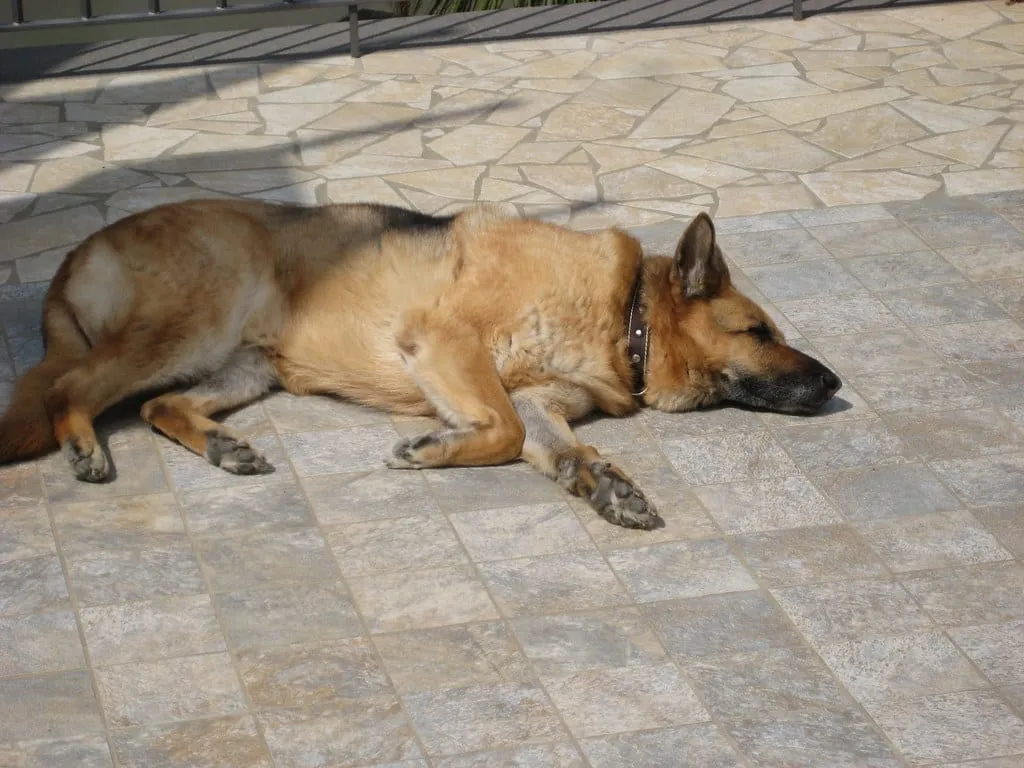
A pet doesn't wear a floor down the way a family of four does. Claws scratch a finish that shoes never touch, an accident soaks into a seam or a grout line long before anyone notices, and an older dog's back legs need actual traction, not just a floor that looks clean in photos. Most flooring is rated for foot traffic and moisture, not for any of that, which is why a floor that held up fine in a showroom sample can start showing claw marks within a year of a dog moving in. Here's what actually accounts for pets, material by material, and what to steer around no matter how good the finish looks on day one.
Key Takeaways
- A rigid-core LVP or SPC floor with a wear layer of at least 20 mil is the most pet-durable flooring available at a mainstream price, since claws can't scratch through a layer that thick and the core itself is fully waterproof.
- If you want real wood, choose a harder species with a wire-brushed or hand-scraped texture, not a smooth high-gloss finish; the texture hides the scratches a smooth surface shows immediately.
- Pet urine is more damaging than a spilled drink because it's acidic and finds its way into seams, grout lines, and any porous core, so the material's non-porosity matters as much as its hardness.
- A slippery floor is a real health risk for an aging or large-breed dog, not just an inconvenience, and matte or textured finishes matter here as much as durability does.
1. Rigid-core LVP or SPC with a thick wear layer
Luxury vinyl plank and the stiffer stone-plastic composite (SPC) products built on the same construction are made from layered PVC or composite material with a printed wear layer bonded on top, and none of it is affected by moisture the way wood is. The number that actually predicts how it holds up to claws is the wear layer's thickness, measured in mil. A 6 mil wear layer, the kind found on the cheapest end of the category, scratches through in a year or two in a home with a dog. A 20 mil wear layer is generally accepted as the point where claws stop leaving visible marks in daily use, and 28 mil commercial-grade products go further still, which is worth paying for if the household includes a large or high-energy breed. Check the spec sheet, not just the sample underfoot in a showroom, since two planks that look identical can carry very different wear layers.
This is also the floor that handles an older subfloor gracefully. A floating LVP install doesn't need the subfloor perfectly flat the way a fully adhered product does, which matters in the postwar plywood subfloors that show up constantly in flooring installations in Kitchener, where a large share of the housing stock dates to that same 1960s-to-1980s building boom. If you're comparing it against laminate or engineered hardwood for a specific room, our full comparison of hardwood, laminate, and vinyl flooring walks through the tradeoffs beyond just the pet question.
2. A harder wood species, in a textured finish
If the goal is real hardwood and not a vinyl substitute, two decisions matter more than anything else: the species and the finish texture. Wood hardness is measured on the Janka scale, the force needed to press a steel ball halfway into the surface, and the common flooring species span a wide range. Red oak sits around 1,290 lbf, white oak around 1,360, and hickory around 1,820, roughly 40 percent harder than red oak (Bruce, "Understanding the Janka Rating", retrieved 2026-09-04). A harder species resists denting from a dog dropping onto the floor or a cat landing from a counter, but no wood species is scratch-proof against claws, so the finish matters just as much as the species. A wire-brushed or hand-scraped texture puts fine grooves into the surface on purpose, and those grooves hide new claw scratches the way a smooth, high-gloss finish never can, since a gloss surface shows every mark as a bright line against the sheen.
This is the option we bring up most with clients doing flooring installation in Cambridge, where original strip hardwood under later carpet or vinyl turns up in the older Galt, Preston, and Hespeler housing stock more often than in newer builds. Refinishing that original floor with a harder site-applied finish and a lightly textured sheen, rather than a high-gloss lacquer, is often the better call for a household with pets than tearing it out for something new.
3. Porcelain or ceramic tile, with epoxy grout
Tile is the most water-and-urine-proof flooring option that exists, full stop. Porcelain and ceramic are fired clay, chemically inert to liquid, and porcelain specifically tests as impervious under ASTM C373, with water absorption of half a percent or less. That matters more with pets than with people, since pet urine is acidic and, unlike a spilled drink that gets wiped up in minutes, an accident behind a couch or under a bed can sit against a floor for hours before anyone finds it. Tile itself won't stain or hold odour from that. The grout lines are the actual weak point: standard cement grout is porous enough to absorb a stain or an odour over repeated accidents, where epoxy grout is non-porous and resists both. It costs more, generally another $0.50 to $1.00 per square foot over cement grout, but for a mudroom, kitchen, or dedicated pet washing area it's worth specifying up front rather than resealing standard grout every year.
We've priced exactly that tradeoff on jobs around flooring in St. Catharines, where a lot of the postwar housing stock has plywood subfloors consistent enough to take large-format tile without extensive levelling first, which keeps the labour side of a tile upgrade from ballooning the budget the way it can on an older, uneven subfloor.
4. Cork, if joint comfort matters more than moisture risk
Cork earns a place on this list for a narrower reason than the other options: it's genuinely softer and warmer underfoot than any hard-surface alternative, which makes a real difference for an older dog or a breed prone to joint problems, and its cellular structure gives it some natural bounce-back from dents and scratches that a rigid material doesn't have. It's also naturally antimicrobial, so it doesn't harbour mould the way some porous materials do.
The tradeoff is moisture. Urine and vomit that sit on cork can work into the seams and weaken the adhesive underneath over time, and repeated exposure can cause warping or staining that a sealed hard surface wouldn't show (iCork Floor, "Is Cork Flooring Good for Dogs?", retrieved 2026-09-04). Glued-down cork tile handles this better than a floating floor, since there's no open seam at the edges for liquid to travel into, and a durable sealant reapplied on schedule closes most of the remaining gap. Cork is a reasonable choice for a household that's more worried about a senior dog's hips than about a puppy who isn't reliably housebroken yet, not the other way around.
5. A matte or textured finish, for a dog's actual footing
This is the item on the list that isn't about durability at all, and it's the one most homeowners don't think to ask about. A smooth, glossy floor, whether it's tile, laminate, or a high-sheen hardwood, gives a dog's paw pads almost nothing to grip. The effect compounds with age. An older dog's joints and muscle control are already declining, so a floor a younger dog crossed without thinking becomes one an older dog approaches cautiously or avoids.
This isn't a cosmetic concern. A prospective cohort study published in the American Journal of Veterinary Research found that puppies exposed to slippery flooring before weaning had meaningfully higher odds of developing hip dysplasia later in life (Krontveit et al., "Housing- and exercise-related risk factors associated with the development of hip dysplasia," American Journal of Veterinary Research 73(6), 2012, retrieved 2026-09-04). A matte finish on LVP, a textured porcelain tile rated for slip resistance, or a wire-brushed hardwood all give measurably more grip than their glossy equivalents. It's a spec worth asking about directly, rather than assuming any two floors in the same material perform the same underfoot.
6. What to skip regardless of how the sample looks
Two categories cause the most regret, and both look fine in a showroom. Solid hardwood in a high-gloss finish shows every claw mark from the first week, and once it's scratched, refinishing means sanding down the wear layer, not a quick touch-up. Wall-to-wall carpet is the other: it looks and feels the best on day one, but a pet accident that isn't caught immediately soaks through the fibres into the padding and sometimes the subfloor underneath, and that's a smell and a stain that carpet cleaning alone often can't fully reverse. Neither is unusable with pets, but both need a level of vigilance, fast cleanup every single time, that most households don't sustain for years on end. If either is already on the floor and reasonably intact, area rugs with rubberized backing over the highest-traffic pet zones buy real time; they just aren't a substitute for the underlying material once it's actually failing.
Frequently asked questions
Is laminate flooring okay for a home with dogs?
It can be, if the AC rating is high enough. The AC scale runs from AC1 to AC6 and measures a laminate's resistance to abrasion, impact, and staining under standardized lab testing; AC3 and up is generally the floor for a busy household, and AC1 or AC2 wears through fast under claws (ANSI, summarizing the NALFA white paper on wear resistance and AC ratings, retrieved 2026-09-04). Laminate's core is also wood-based, so unlike rigid-core LVP, a laminate floor still isn't fully waterproof at the seams, which matters more with a pet in the house than it would otherwise.
Does pet-friendly flooring cost more than a standard installation?
Not necessarily, and sometimes it costs less. Rigid-core LVP, the top recommendation on this list, runs roughly $4 to $16 per square foot installed depending on the specific product and labour market, which is squarely mid-range against the other options here rather than a premium tier (Angi, "How Much Does Vinyl Flooring Installation Cost?", retrieved 2026-09-04). The premium tends to show up in the details, a thicker wear layer, epoxy grout instead of cement, that add a modest amount to the material cost rather than changing the category. For a fuller room-by-room breakdown across materials, see our real-world comparison of flooring cost per square foot.
What's the single best flooring choice for a household with both a dog and a cat?
Rigid-core LVP or SPC, in most cases. It covers a dog's claws with a thick enough wear layer, it doesn't absorb a cat's litter tracking or the occasional accident the way a porous material would, and it's warmer and quieter underfoot than tile, which matters if the cat spends time on the floor as much as the dog does. Tile is the better call specifically in a dedicated pet washing or feeding area where standing water is a daily occurrence rather than an occasional accident.
Choose for the pet you have, not the floor you want
The right answer here depends less on which material sounds premium and more on which specific problem your household actually has: claws from an energetic dog, accidents from a puppy still learning, or failing traction under an older dog's back legs. Get that part right and the rest, wear layer thickness, finish texture, grout type, follows directly from it. For how flooring choices like these fit into a larger renovation alongside paint and finish decisions, see our full guide to flooring and interior painting for Ontario homes.