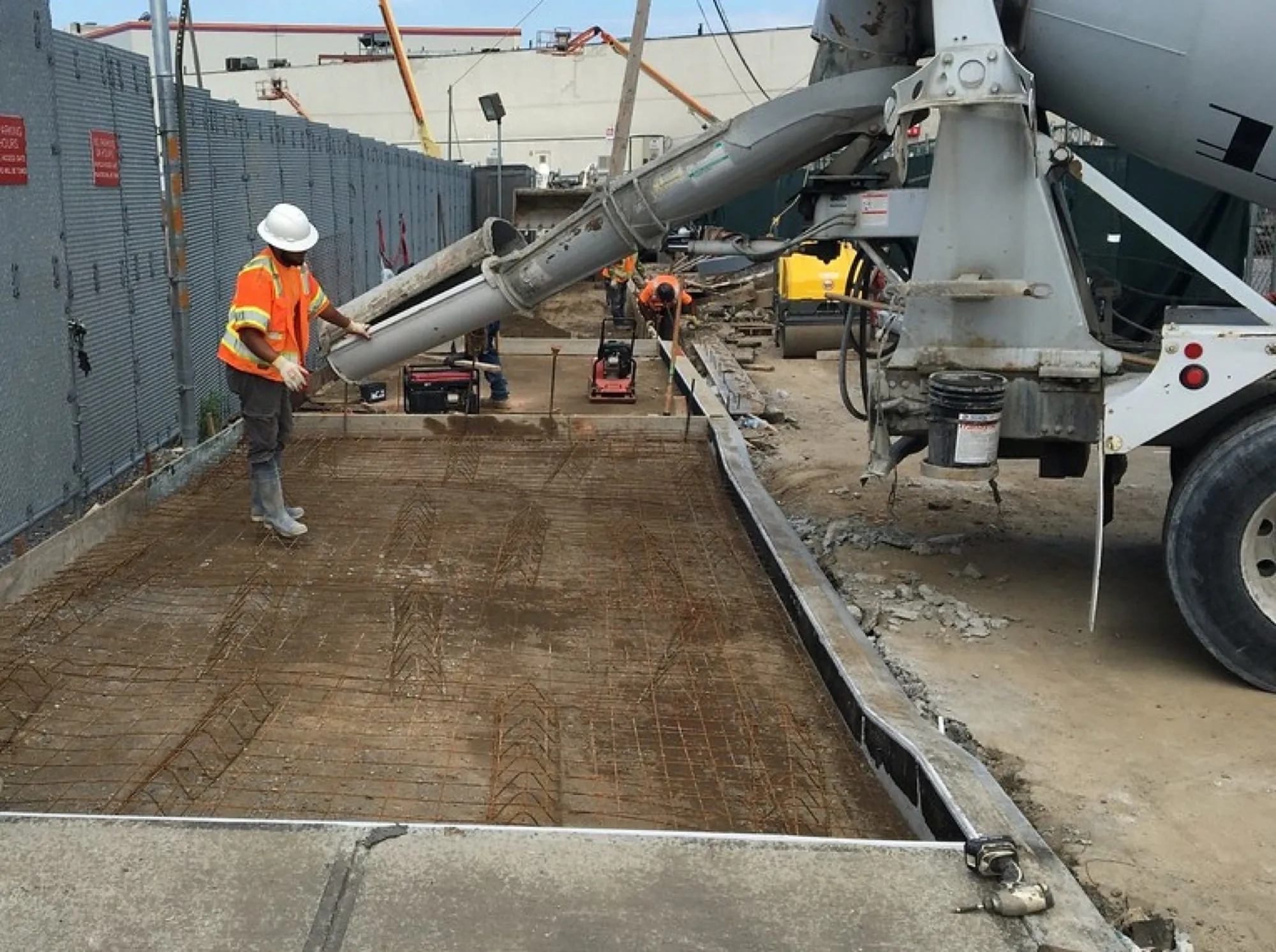
Two very different clocks run on a renovation and concrete project at the same time, and most homeowners only ever hear about one of them. The one they hear about is the lead time: the cabinets are eight weeks out, the tile is on backorder, the countertop template can't happen until the cabinets are set. That clock runs in weeks and it's mostly visible if you ask. The other clock runs in minutes, and it belongs to concrete. Ready-mix starts losing workability the moment it's batched at the plant, and by the time a driveway or a basement footing gets poured, that clock has already been running for however long the truck spent in traffic. Planning a project across the GTA, Kitchener-Waterloo-Cambridge, Guelph, Hamilton, and Niagara means designing around both clocks at once, and they don't behave the same way at all.
Key Takeaways
- Ready-mix concrete has a hard placement window from the moment it's batched, commonly cited as 90 minutes and extendable to 120 under CSA A23.1 with specific conditions, which makes plant proximity a real scheduling constraint, not a convenience.
- Flooring, cabinetry, and fixture lead times run in weeks, not hours, and stretch further for custom or imported product, which means the ordering decision has to happen months before install day, not after a demo starts.
- A crew that runs concrete and renovation together plans both clocks against one schedule. A homeowner coordinating two separate contractors is usually the one absorbing the gap between them.
- Sourcing decisions differ by region inside our own footprint: KWC and Guelph sit closer to a cluster of ready-mix plants than the Niagara peninsula does, and that changes how a pour day gets planned before a truck ever leaves the yard.
The concrete clock: why plant distance is a real design constraint
Ready-mix concrete isn't a stable material sitting in a truck waiting for a crew to be ready. From the moment water hits cement at the batching plant, hydration starts, and the mix has a limited window before it stiffens past the point where it can be properly placed, consolidated, and finished. The industry's working rule of thumb, sometimes called the 90-minute rule, holds that concrete should be discharged within about 90 minutes of batching, an interval that can be extended to 120 minutes under CSA A23.1 when no water has been added after the 90-minute mark and the concrete stays below roughly 90°F, since hot concrete and hot weather both accelerate the clock further and can shrink the usable window rather than extend it (Roseke, "Maximum Concrete Travel Time"). That's not a bureaucratic number picked to slow a job down. It's the actual chemistry of the pour, and it means the distance between a batching plant and a job site isn't a logistics footnote, it's baked into whether a driveway or a basement footing gets placed the way it was designed to be.
That's why plant proximity matters more than it sounds like it should. Concrete Ontario, the industry association representing roughly 96 percent of the province's ready-mix volume across its member producers, exists partly because that volume has to be produced close enough to where it's poured to matter (Concrete Ontario, "About Us"). A job an hour from the nearest plant is working with a fraction of the usable window a job fifteen minutes away has, once you account for loading, travel, site setup, and the actual discharge and finishing time. In practice, that means a pour day in Kitchener-Waterloo-Cambridge or Guelph, where the plant network sits closer to the job sites we work in, gives a crew more real working time per truck than the same job would have if it were staged from further out. Niagara and the far edges of Hamilton's service area sit at a different distance from that same plant cluster, which changes how a pour gets sequenced: smaller placements per truck, tighter coordination on truck spacing, and less margin if a truck gets delayed at a gate or in traffic on the way in. None of that shows up on a homeowner's quote as a line item, but it's exactly why a contractor who's poured in a region for years plans a pour day differently than one working there for the first time.
Hot weather compounds the same problem instead of being a separate issue. A summer pour in direct sun accelerates hydration and shrinks the working window further, on top of whatever the drive from the plant already used up, and a hard frost does the opposite kind of damage to a pour timed badly in the other direction. Our season-by-season guide to renovating in Ontario covers how that same weather calendar shapes timing decisions across a full renovation, not just a pour day. The practical answer to both pressures, distance and heat, is the same here: know the plant network in a region before committing to a pour date, and build the schedule around the actual travel time, not an assumed one.
The material clock: flooring and cabinetry run on weeks
Flip to the interior side of a renovation and the clock runs in the opposite direction entirely. Where concrete's problem is too little time, flooring, cabinetry, and fixtures have too much time built into the schedule if a homeowner doesn't plan for it early. Cabinet lead times in 2026 span an unusually wide range depending on what's ordered: stock cabinetry can ship in days, while semi-custom and full custom cabinetry commonly runs eight to sixteen or more weeks, since custom production slots are booked in advance and aren't something a supplier can compress once a job is already scheduled (Kraftersland, "Cabinet Lead Times 2026"). Flooring carries a similar spread. In-stock product can be installed within a couple of weeks of selection, but a special order, a discontinued colour run, or an imported tile pattern can stretch six to eight weeks or longer before it's even on a truck, and that's before installation starts (Quality Hardwoods of Michigan, "Hardwood Flooring Lead Time Explained"; Exact Tile, "When to Select and Order Tile").
That gap between selection and delivery is exactly where a lot of renovation timelines quietly slip. A homeowner who finalizes a cabinet order in the same week demolition starts has already put the project a month or two behind where it could have been, because the cabinet supplier's production slot doesn't move just because the kitchen is sitting empty and ready. Our kitchen renovation in Hamilton work follows the same logic Hamilton's older housing stock tends to reward anyway: material decisions get locked in early enough that cabinetry, countertops, and flooring all land close to when the space is actually ready for them, rather than the crew standing around waiting on a delivery truck, or worse, the homeowner accepting a rushed in-stock substitute because the custom order they actually wanted wasn't ordered in time.
Flooring specifically deserves its own planning conversation, because the lead time isn't just about the material showing up, it's about what happens once it does. Solid hardwood needs one to two weeks on site to acclimate to the home's humidity and temperature before it can be installed properly, which means the delivery date and the install date are never the same date even when the material arrives on schedule (Hosking Hardwood, "Planning Your Flooring Purchase"). Our flooring work in Guelph builds that acclimation window into the schedule from the first measure, not as an afterthought once the boxes are sitting in the garage. Skipping it is one of the more common reasons a beautiful hardwood floor develops gapping or cupping within its first year, a problem that has nothing to do with the quality of the wood and everything to do with the schedule it was forced into.
Supply chain context: why "just order it" isn't the answer
It's tempting to treat all of this as a solved problem, order everything the day the contract is signed and the lead times take care of themselves. That's closer to right than not planning at all, but it misses two things that are specific to Ontario right now. First, tariff pressure on imported cabinet components and certain finish materials has been squeezing importer margins, which means inventory that used to sit on a shelf as a buffer is thinner than it used to be, and a supplier who could substitute an equivalent in-stock item two years ago may not have one today (Bernardi Building Supply, "Canada Building Materials Trends 2026-2030"). Second, regional supplier density genuinely varies across our own footprint. A specialty finish or a less common tile pattern is easier to source quickly in the GTA, where supplier density is highest, than it is further out toward Niagara or the edges of our Guelph service area, where the same order may route through a distributor an extra step removed. That's not a reason to avoid custom material in those regions, it's a reason to order it earlier there than a GTA timeline would suggest is necessary. It's also one more thread in why renovation costs don't move in lockstep across our footprint, a question we cover more directly in how GTA and Kitchener-Waterloo renovation costs actually compare: supplier density and lead time are part of that regional cost delta, not just labour rates.
None of this is a new problem invented by recent supply chain disruption. It's the ordinary reality of specialty manufacturing meeting a renovation schedule that homeowners understandably want to move as fast as possible. The fix isn't urgency after the fact, it's sequencing the material decisions, cabinetry first, flooring and tile close behind, fixtures last, early enough in the project that the lead time is absorbed by the design and permitting phase instead of showing up as a stalled job site later.
Why one crew for concrete and renovation changes sourcing
We've written before about why concrete and renovation run under one crew here, and that piece is mostly about accountability at the seam between two trades, an egress well, a footing under an addition, work that touches both scopes at once. Sourcing is a different angle on the same structure, and it shows up earlier in the project than the accountability question does. When one crew runs both trades, the same project manager who's tracking a cabinet supplier's production slot is also the one calling the ready-mix plant to confirm a pour date, which means those two schedules get built against each other from the start instead of colliding later. A footing needs to be poured and cured before framing starts; framing needs to be substantially done before flooring gets measured for final order; flooring needs to be in and acclimating before trim and cabinetry installation finishes the room. That's one sequence with four material lead times threaded through it, and it only holds together if one person is actually watching all four at once.
Subcontracted setups don't fail at this automatically, but the structure works against them. A concrete subcontractor pricing a footing has no reason to know or care when the kitchen cabinets are landing, because that's a different company's problem to manage. When a pour date slips because a plant was double-booked, or a cabinet order slips because a finish was back-ordered, the two schedules don't renegotiate themselves against each other, someone has to notice the conflict and adjust, and on a subcontracted job that someone is often the homeowner relaying delays between two companies who've never spoken to each other. Our concrete driveway work in Cambridge sits inside that same single schedule as any interior renovation happening on the same property, which is the practical version of what the one-crew argument is actually about: not that concrete and renovation are the same trade, but that sourcing decisions for both need to be visible to the same person planning the job.
What this means for planning a project
The two clocks in this piece point to two different pieces of homeowner advice, and they're easy to confuse with each other. For concrete, the lesson is that pour-day timing is a real constraint worth asking about, not a scheduling inconvenience: a contractor who knows the region's plant network and plans truck spacing around actual travel time is protecting the pour itself, not just the calendar. For flooring, cabinetry, and fixtures, the lesson runs the other direction: those decisions need to be made and ordered early, well before demolition, because the lead time doesn't compress just because the rest of the house is ready. A project that treats both clocks as afterthoughts tends to either rush a pour that needed more care, or stall out waiting on a cabinet order that should have gone in two months earlier. A project that plans around both from the first measure avoids most of that entirely, and that planning is easier when the same team is watching every material on the job, not just the one they were hired to install.
Frequently asked questions
How long does ready-mix concrete stay workable after it's batched?
The commonly cited limit is 90 minutes from batching to discharge, extendable to 120 minutes under CSA A23.1 when no water is added after 90 minutes and the concrete stays below about 90°F. Hot weather and direct sun accelerate the clock and can shrink that window rather than extend it, which is why pour timing gets planned around both distance from the plant and the day's temperature.
Why does it matter which ready-mix plant a contractor uses?
Because the drive from the plant to the site eats directly into the concrete's limited working time. A job close to a plant retains more of that window for actual placement and finishing than a job further out, where travel alone can use up a large share of the 90 to 120 minutes available. It's part of why a contractor familiar with a region's plant network plans a pour differently than one working there for the first time.
When should cabinets and flooring actually be ordered?
As early as the design phase allows, not after demolition starts. Custom or semi-custom cabinetry commonly runs eight to sixteen weeks or more, and special-order flooring or tile can run six to eight weeks before it even ships. Ordering early enough that the material lands close to when the space is ready for it is what keeps a renovation schedule from stalling out waiting on a delivery truck.
Does solid hardwood need time to sit in the house before installation?
Yes. Solid hardwood typically needs one to two weeks to acclimate to a home's humidity and temperature before installation, which means the delivery date and the install date are never the same day even when a shipment arrives exactly on schedule. Skipping that window is a common cause of gapping or cupping in a floor's first year.