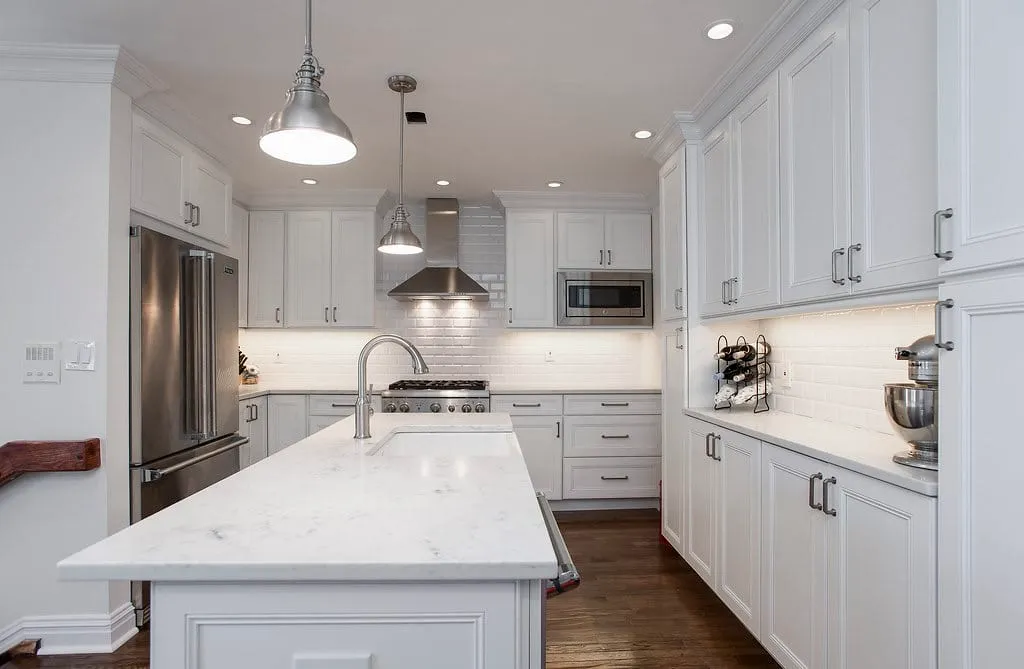
Cabinet painting and cabinet refacing both start from the same complaint, a kitchen that looks tired even though the layout still works, and they solve it from opposite directions. Painting keeps every door, drawer front, and box exactly where it is and changes only the finish on top. Refacing pulls the doors and drawer fronts off entirely, replaces them with new ones, and skins the exposed box surfaces in matching veneer. One is a finish change. The other is a materials change that leaves the box carcass in place. They land in different price brackets and hold up differently over the years that follow, and one of them isn't an option at all on certain cabinet materials. Here's how the two actually compare.
Key Takeaways
- Painting is a finish change on the doors, drawer fronts, and exposed box faces you already have. Refacing replaces the doors and drawer fronts outright and skins the boxes in new veneer, but leaves the box carcass and layout untouched, same as painting does.
- Professional cabinet painting for a typical kitchen runs roughly $2,500 to $6,500, averaging around $4,000, or about $30 to $70 per linear foot. Refacing runs about $3,000 to $13,500, averaging around $8,250, or roughly $100 to $450 per linear foot depending on the door material.
- Painting only works on solid wood or real wood veneer. Laminate and thermofoil cabinets have a plastic film face that standard primers won't bond to, which is the single most common reason a painting quote turns into a refacing recommendation instead.
- Painting wraps in four to five days on site. Refacing takes about the same three to five days once the crew is on site, but the new doors and veneer usually need several weeks of lead time to fabricate before that work can start.
What painting actually changes
A professional cabinet painting job strips or lightly sands the existing finish, repairs dents and gouges, primes with a bonding primer, and applies two coats of a hard-curing enamel to the doors, drawer fronts, and exposed box faces. Doors typically come off to be sprayed flat in a controlled space, then get rehung with the original hinges, or new soft-close hinges if you're upgrading at the same time. Box interiors are normally left alone. Painting a kitchen means painting what you see when the doors are closed, not what's behind them.
That scope has a hard ceiling. Painting changes colour, sheen, and surface condition. It doesn't touch layout, storage configuration, or box condition. If the real complaint is that a corner cabinet wastes half its depth, a fresh coat of paint will make the kitchen look better and solve none of that.
What refacing actually changes, and where the two overlap
Refacing goes a step further than painting without going as far as a full teardown. A contractor removes the old doors and drawer fronts, replaces them outright in the material and colour you choose, and applies matching veneer over the exposed box faces so the kitchen reads as one finish. The box carcasses stay exactly where they were, same as with painting. If you're weighing refacing against a full gut-and-replace instead, our comparison of cabinet refacing versus full replacement covers that decision.
The overlap is bigger than people expect: neither approach can move a cabinet run, add storage that wasn't there before, or fix a layout that never worked. What differs is the doors and the surface material underneath the finish, and that's what drives most of the cost and durability gap below.
Cost: what the numbers actually look like
Professional cabinet painting for an average kitchen runs $2,500 to $6,500 nationally, averaging around $4,000, scaling from roughly $1,000 to $3,500 for a small kitchen up to $5,000 or more for a large one. Per linear foot, that works out to about $30 to $70, or $70 to $125 per door and $30 to $110 per drawer front if you're pricing by piece rather than by run. Labour makes up the large majority of that cost, close to 85% of the total, since the material cost of enamel and primer is small next to the hours of prep, spraying, and reinstallation.
Refacing runs meaningfully higher because you're paying for new manufactured doors and veneer stock, not just labour and finish. A typical kitchen runs $3,000 to $13,500, averaging around $8,250, or roughly $100 to $450 per linear foot depending on material: laminate doors sit around $80 to $125 per linear foot, real wood veneer runs $100 to $250, and solid wood doors push toward $200 to $500.
Painting costs less than refacing on almost every kitchen, but the size of the gap depends on what door material you'd choose for refacing. Against laminate refacing doors, the difference is real but not enormous. Against solid wood refacing doors, painting can come in at a third of the price or less for a comparable-looking result, since paint doesn't care what the substrate is made of the way a veneer choice does.
Timeline: close on-site, different lead time
Both jobs move fast once a crew is actually working in the kitchen. Painting typically wraps in four to five days between removal, prep, priming, two coats, and reinstallation. Refacing runs a similar three to five days on-site for the same reason painting does, the boxes never leave the wall and there's no demolition phase to work around.
Where the two diverge is everything that happens before that on-site work starts. Painting can usually begin as soon as a crew is booked, since the material is enamel and primer off the shelf. Refacing needs new doors, drawer fronts, and veneer stock fabricated to the exact dimensions of your existing boxes before installation can begin, which commonly adds a few weeks of lead time on top of the installation days themselves. If you're planning around a fixed date, that lead time is often the deciding factor before either project's on-site duration matters at all.
Durability: what actually fails, and where
This is where the two approaches genuinely diverge, not just in degree but in what can go wrong. A painted finish is a coating bonded to whatever surface was underneath it. It holds up well when the substrate is solid wood or real wood veneer and the prep was right: full de-glossing, a bonding primer matched to the substrate, and a hard-curing enamel rather than a wall paint pressed into cabinet duty. Where painted finishes actually fail is predictable: handle areas, a door edge that swings against a counter, anywhere grease or moisture sits repeatedly near a stove or sink. Those are wear points on any cabinet finish, but a coating that wasn't properly bonded chips and peels there faster than one that was.
Refacing sidesteps that failure mode because the new doors and veneer come pre-finished from the manufacturer, so they wear more evenly at the same contact points. What refacing can't sidestep is the box underneath. The carcass is unchanged in both approaches, so a box with water damage, swollen particleboard, or a frame that's out of square will show that problem through either a new painted finish or a new refaced veneer. Neither fixes what's wrong with the box; both just change what's on top of it.
Manufacturer-grade cabinet enamels are built for this kind of daily handling. Sherwin-Williams markets its Emerald Urethane Trim Enamel with a lifetime limited warranty for cabinets, doors, and trim, calling out "areas that are cleaned frequently" as the intended use case (Sherwin-Williams, retrieved 2026-09). That's a real signal of what a properly specified paint system is built to withstand, though no manufacturer publishes a hard number of years a painted or refaced finish should last before touch-up. Treat any specific year count quoted online for either approach as a rule of thumb, not a tested figure; it varies with substrate, prep, and how hard the kitchen gets used.
When painting is the right call, and when the material rules it out
Painting makes sense when the boxes and doors are structurally sound and the substrate can actually take a coat:
- The doors and boxes are solid wood or real wood veneer, which paint bonds to properly with the right primer.
- The layout and storage already work. Painting can't add a pantry cabinet or fix dead corner space, only change what you see.
- You want the lowest-cost visual reset, especially against a solid wood refacing quote.
There's one hard exception that rules painting out entirely: laminate and thermofoil doors have a plastic film face that standard primers don't adhere to the way they bond to wood. A specialty bonding primer can sometimes work, but it's a narrower, less reliable path, and a lot of painting contractors will steer a thermofoil kitchen toward refacing once they've looked at the doors up close.
When refacing is the right call
Refacing is the better fit when painting's material ceiling is the actual problem, or when you want a factory-finished surface rather than a field-applied one:
- The doors are laminate or thermofoil, which refacing replaces outright rather than trying to coat.
- You want a different door style or profile, not just a different colour, since refacing changes the door itself.
- You're prioritizing an even, factory-applied finish over the lowest price.
We walk homeowners through this exact decision as part of our kitchen renovation work in Guelph, where a lot of the cabinet conversations start as "should we paint or reface" and end up folded into a wider kitchen renovation cost discussion once the layout itself is on the table alongside the finish.
Cabinet painting vs. refacing at a glance
| Cabinet painting | Cabinet refacing | |
|---|---|---|
| What changes | Finish on existing doors, drawer fronts, and exposed box faces | Doors and drawer fronts replaced outright, boxes skinned in new veneer |
| Typical cost | $2,500 to $6,500 for an average kitchen | $3,000 to $13,500 for an average kitchen |
| Cost per linear foot | $30 to $70 | $100 to $450, depending on material |
| Typical timeline on-site | 4 to 5 days | 3 to 5 days, plus fabrication lead time of several weeks |
| Works on laminate or thermofoil doors | Generally no, adhesion problems | Yes, doors are replaced rather than coated |
| Can change door style or profile | No, finishes the door you already have | Yes, new doors in the material and style you choose |
| Can change layout | No | No |
| Wear pattern | Field-applied finish, most vulnerable at handles and high-contact edges if prep was rushed | Factory-finished doors, tends to wear more evenly at the same contact points |
Resale value: does either one pay for itself
Neither painting nor refacing has its own dedicated line in the industry's cost-versus-value data; both fall under the broader minor kitchen remodel category, which returned an estimated 113% of its cost at resale nationally in the 2025 Cost vs. Value report, the strongest return of any interior renovation category measured that year. That figure describes a full minor remodel scope, cabinet fronts, hardware, and countertop together, not a standalone paint or reface job. Cabinet fronts are the largest single visual element in that scope, though, which is why either job on its own still captures a meaningful share of that return.
What happens to hardware and the boxes underneath
Painting almost always leaves the original hardware in place unless you ask for new pulls and hinges, since swapping hardware is a small add-on rather than part of the core scope. Refacing typically includes new hardware, since new or matching holes get drilled into the new doors either way.
Neither approach touches what's inside the boxes or changes the box footprint. If the real issue is that a kitchen's storage doesn't work, both painting and refacing leave that problem exactly where it was, the same limitation our comparison of cabinet refacing and full replacement covers for anyone deciding whether a layout change is actually on the table.
Where cabinets fit with the rest of a paint job
Cabinets rarely get repainted in isolation. Our paint sheen guide by room covers why cabinets and trim call for a harder, glossier finish than the walls around them, and our piece on surface prep and why it determines how long paint lasts is worth reading before assuming two quotes cover the same scope of sanding and priming.
The material split plays out geographically too. On painting projects in Oakville, a lot of the older cabinet stock is solid wood in good shape, which makes painting the straightforward call once the layout isn't changing. On painting jobs in St. Catharines, the mix runs closer to fifty-fifty, since older housing stock there brings in more laminate and thermofoil from past renovations, exactly the material that pushes a homeowner toward refacing instead.
Frequently asked questions
Can I paint over cabinets that were refaced years ago?
Usually yes, if the refacing doors and veneer are real wood rather than laminate or thermofoil. The same substrate rule applies whether the surface underneath is original or a previous refacing job: paint bonds well to wood with the right primer, poorly to laminate or thermofoil film.
Does painting cabinets myself save meaningful money over hiring a pro?
The material cost is a small part of a professional quote, since labour runs close to 85% of the total. A DIY job can look reasonable in photos and still fail early at high-contact points if the substrate wasn't fully de-glossed or the primer wasn't matched to it. The savings are real on materials; the risk sits in exactly the steps that determine whether the finish holds up.
How do I know if my cabinets are laminate, thermofoil, or real wood before getting quotes?
Real wood and wood veneer show actual grain that varies piece to piece. Laminate and thermofoil have a uniform, slightly plasticky surface with a seam where the film wraps around the door profile, usually visible on the back or an edge. A contractor doing an on-site assessment can tell within seconds of looking at the door edge, worth doing before you get quotes for either approach.
If I'm painting cabinets as part of a bigger kitchen renovation, does the sequence matter?
Yes. Cabinet painting is typically one of the later steps, after any layout, plumbing, or electrical work that would generate dust or require removing cabinets. Painting first and then disturbing the area with other trades is the most common way a good paint job ends up needing touch-ups before the rest of the project is even finished.
Where this fits in a bigger plan
Painting and refacing solve the same visible problem from two different starting points and budgets. Get the substrate honestly assessed before picking either one; painting a thermofoil door is a shortcut to redoing the job, and refacing a kitchen that only needed a colour change is spending more than the problem required. For how cabinet work fits into the broader sequencing of flooring and paint across a whole home, see our guide to flooring and interior painting for Ontario homes.