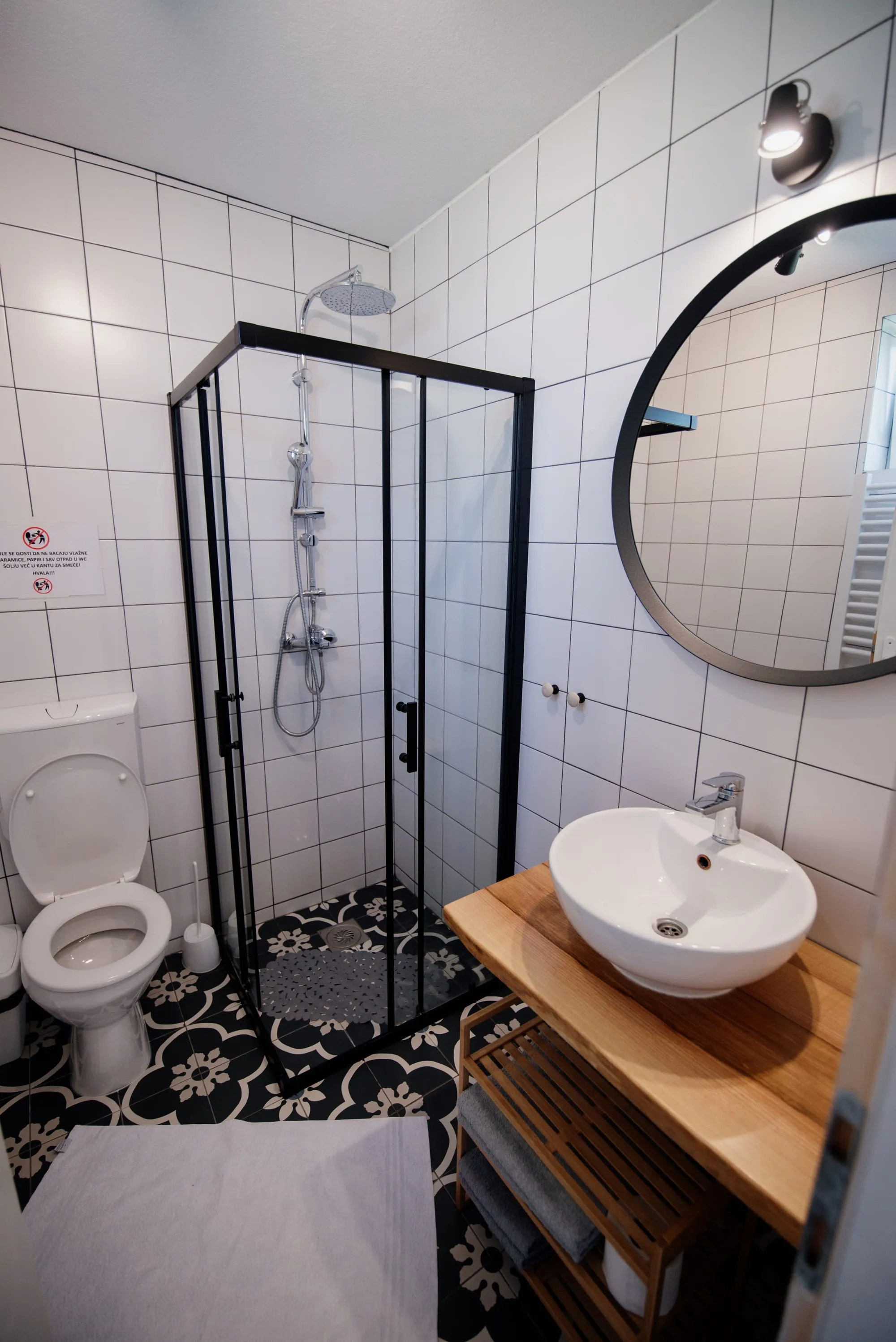
Once the shower is framed and plumbed, the wall surface is the decision that shapes almost everything else about the job: how long the crew is on site, what the bathroom looks like on move-in day, and how much upkeep it asks of you afterward. Tile and one-piece acrylic (or fiberglass) surrounds solve the same problem in opposite ways. One is built from hundreds of small pieces with a maintenance schedule attached. The other is a handful of molded panels installed in a day. Here's how they actually compare.
Key Takeaways
- Acrylic panels install in roughly one to three days; tile runs four to ten days once membrane cure and grout cure are counted.
- Grout is porous. It holds moisture and soap residue in a way a molded acrylic surface doesn't, and mold can take hold in as little as 24 to 48 hours if a damp surface doesn't dry.
- A damaged tile can usually be replaced on its own; a damaged acrylic panel is a full-wall replacement, since the panels are one continuous piece.
- Buyers in higher-end neighbourhoods still read acrylic as a builder-grade compromise in a primary bathroom, while it reads as a perfectly adequate finish in a secondary bath or rental unit.
- Both surfaces depend on what's behind them. A tiled shower needs a real waterproofing membrane, not just cement board, and so does an acrylic surround at every seam and penetration.
| Tile | Acrylic / fiberglass | |
|---|---|---|
| Installed cost | Roughly 2 to 3 times the acrylic price for a comparable surround | Lower upfront cost; the budget option in almost every comparison |
| Install time | 4 to 10 days, including membrane and grout cure | 1 to 3 days, ready to use almost immediately |
| Ongoing maintenance | Reseal grout every 6 to 12 months | Wipe clean; recaulk seams every 5 to 10 years |
| Typical lifespan | 30 to 50 years | 8 to 15 years |
| Repairing damage | Usually a single-tile fix | Usually a full-panel replacement |
| Resale read, primary bath | Expected in higher-end homes | Can flag the room as not yet updated |
How the two surfaces are actually built
Tile is a system, not a single material. Ceramic, porcelain, or stone tile gets set over cement board or a waterproofing membrane, then the joints between tiles are packed with grout, a cement-based or epoxy filler that has to be sealed and eventually resealed. Every seam, every grout line, and every corner is a separate joint that can eventually fail.
An acrylic or fiberglass surround is molded as one to five large panels that snap or glue into place over the existing wall framing, with caulk sealing the handful of seams where panels meet each other and meet the tub or shower base. There's no grout anywhere in the assembly. The tradeoff is that the whole surface comes from a single mold, so the pattern and color choices are far more limited than what tile offers.
That structural difference, dozens of small joints versus a handful of large ones, is the root of almost every other difference on this list: cost, install time, maintenance, and how a repair actually happens.
Upfront cost: what's really being compared
Cost estimates vary by source depending on whether they're pricing a full three-wall surround or a smaller basic install, but the gap between the two materials holds up across both. Oakwood Remodel prices a full acrylic surround at $3,500 to $7,500 installed against $9,500 to $18,000 for a comparable tile job (Oakwood Remodel). For a smaller, more basic install, Journeyman HQ puts acrylic at $800 to $2,500 total against $2,000 to $8,000 or more for tile (Journeyman HQ). Either way, tile runs roughly two to three times what an equivalent acrylic surround costs, and a meaningful part of that gap is hidden in the tile side of the ledger: the waterproofing membrane, backer board, and setting materials that go in before the first tile is even cut.
Neither range accounts for anything else in the room, the vanity, the floor, the fixtures, so treat these as the shower wall's own line item rather than the whole bathroom budget. A full bathroom renovation in Hamilton prices the shower or tub surround as one piece of a larger scope, and which surface you pick there moves the total more than most homeowners expect going in.
Install time and how much disruption each one causes
This is where the two materials diverge the most. An acrylic surround can go from demolition to a usable shower in as little as one day for a straightforward swap, two to three days for a larger or more complex configuration. Tile needs the membrane to cure before grout goes in and the grout to cure before the shower can be used, which stretches even a straightforward job to four to ten days end to end, and longer if the tile pattern is intricate or the crew is waiting on a custom order (Oakwood Remodel; Journeyman HQ).
If the bathroom being redone is the only one in the house, that difference is the practical reason a lot of homeowners choose acrylic even when tile is otherwise their preference. It's also why a curbless shower or a custom-glass enclosure, both of which add fabrication and cure time on top of the base install, tend to push a project toward the longer end of either range, well beyond the shower wall itself.
Grout maintenance and mold risk
Grout is inherently porous. It absorbs moisture, soap scum, and skin oils in a way a molded acrylic panel simply doesn't, which is why grout needs periodic sealing and acrylic doesn't need sealing at all. In a shower used daily, resealing grout every six to twelve months is a realistic interval, since steam and constant water exposure wear down a sealant faster than it does anywhere else in the house (Seal It Green). A simple test tells you whether it's due: sprinkle water on the grout, and if it soaks in instead of beading up, the seal has worn through.
The stakes behind that maintenance task are real. The EPA identifies moisture control as the central defense against mold, and notes that damp materials generally need to dry within 24 to 48 hours to keep mold from taking hold (EPA). A grout line that stays damp between showers, especially in a bathroom with a weak exhaust fan, is exactly the kind of surface that condition describes. Acrylic's smooth, non-porous surface gives mold nowhere comparable to root, so day-to-day cleaning is closer to a wipe-down than a maintenance task with its own calendar reminder.
That doesn't make acrylic maintenance-free. The caulk at panel seams is the equivalent weak point: it discolors and can separate from the surface within five to ten years and needs to be dug out and replaced when it does, the same job as resealing grout, just less frequent (Oakwood Remodel).
Water-tightness: the surface is only half the story
Whichever surface you choose, the material behind it decides whether the shower actually stays dry over the long run, not the tile or panel itself. Cement board resists moisture better than plain drywall, but it isn't a waterproof membrane on its own, and water that gets past a grout joint or a compromised acrylic seam can still reach the framing behind either surface if there's no membrane doing the actual waterproofing job. That's true across every city we build in: a Cambridge bathroom renovation in one of the city's older homes is just as likely to turn up cement board with no real membrane behind the tile as a newer build is, since the fix is the same regardless of the surface finish going back on top.
For a full breakdown of what actually goes into a waterproof shower assembly, our guide on bathroom waterproofing and the membranes that do the real work covers the part of the wall you never see once the tile or acrylic goes back on.
Repair versus replace: what happens when something goes wrong
A single cracked or stained tile is usually a contained repair. A tile setter cuts out the damaged piece and its surrounding grout, sets a matching replacement, and reseals the joint, without touching the rest of the wall. The catch is finding a matching tile years later; if the original run is discontinued, an exact match may not exist and a close substitute becomes the realistic option.
Acrylic doesn't offer that option. Because the surround is molded as one continuous panel, a crack, a burn mark, or a deep scratch generally means replacing that entire wall section, not a patch. Repair kits exist for small scuffs and hairline cracks, but they're a cosmetic fix, not a structural one, and a larger failure at a seam or corner is a full panel swap. That's the tradeoff for the faster, simpler install: fewer joints to fail day to day, but a bigger job on the rare occasion something does fail.
Resale perception
Tile and acrylic don't carry the same weight with a buyer walking through the house. In higher-end neighbourhoods, an acrylic surround in the primary bathroom tends to flag that room as not yet updated, and buyers or their agents may mentally price in a future tile renovation rather than treating the room as finished. In a mid-range home or a secondary bathroom, the same acrylic surround reads as an entirely normal, adequate finish rather than a shortfall (Oakwood Remodel).
That split makes the decision less about which material is "better" and more about which bathroom you're finishing. A primary ensuite in a home priced to compete on finishes is a different call than a basement bath or a rental unit, where low maintenance and a fast install matter more than what a future buyer's agent notices on a walkthrough.
Which one actually fits your bathroom
Choose tile if this is a primary or feature bathroom in a home where finishes matter to resale, you want a pattern or material the acrylic catalog can't replicate, and you're comfortable with the resealing schedule that comes with grout.
Choose acrylic if the bathroom needs to be back in service fast, it's a secondary bath, rental unit, or basement where low maintenance matters more than a custom look, or the budget doesn't stretch to tile's higher installed cost.
Either choice interacts with the rest of the room more than it first appears. A full bathroom remodel in Guelph usually prices the shower surround, the waterproofing behind it, and the glass or door together as one connected decision, since the surround material affects what kind of enclosure fits and how soon it can be templated. If you're weighing tile against acrylic for your own bathroom, we can walk the space and tell you which one actually makes sense for how you use it and what you're planning to spend elsewhere in the room.
Frequently asked questions
Is acrylic as durable as tile long term?
Not over a full ownership span. A well-installed tile shower can last 30 to 50 years, while acrylic surrounds typically need replacement in the 8-to-15-year range as the panel material and caulk seams age out (Oakwood Remodel). Acrylic wins on day-to-day durability against chips and cracking; tile wins on how long the whole assembly lasts before it needs replacing.
Does an acrylic surround actually resist mold better than tile?
Yes, on the surface itself. A molded acrylic panel has no grout lines for moisture and soap residue to collect in, so mold has far less to take hold on. It isn't immune everywhere: the caulk at panel seams can still develop mold if it isn't kept clean and dry, the same weak point grout represents on the tile side.
Can I mix the two, tile the floor and acrylic the walls, or vice versa?
Yes, and it's common in practice. Tile floors pair with either wall material without a conflict, since the floor and wall surfaces are separate systems tied together by the same waterproofing membrane underneath both.
Does an acrylic surround need a permit the way tile does?
Neither one triggers a permit on its own in most municipalities if the shower stays in its existing footprint. What does trigger one is moving plumbing, opening a wall, or changing the framing, the same rule that applies regardless of which surface goes back on afterward.
Whichever way you land on tile versus acrylic, the surface is the visible half of the decision. If you want the full picture of what a bathroom renovation actually involves start to finish, permits, plumbing, and the timeline in between, our complete guide to bathroom renovation in Ontario covers the rest of it.